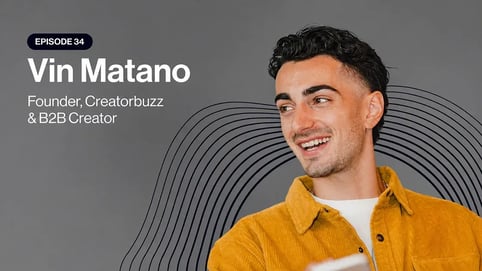
Vin Matano is the founder of Creatorbuzz, a B2B influencer marketing agency that pairs software companies with creators. He spent six years in tech sales at Demandbase in New York, started making day-in-the-life videos about the job on the side, and left in June 2024 to run the agency full-time. He still makes the videos, and they are still where much of the agency's business comes from.
In this episode of Soundstripe Sessions, Jeff Perkins talks to Vin about the cold email he sent Jeff back in 2019, why a $20 tripod from his employer mattered, how a B2B influencer campaign actually runs from brief to post, renting a real plane to fly a banner over a conference, why his team picks creators on engagement instead of follower count, what keeps creator content commercially safe, the two contract clauses every creator should read twice, and how to start posting on LinkedIn without hating it.
If you hire creators, or you are one, this one is worth your time. It also pairs well with the Rebecca Rechtszaid episode on brand deal clauses, which Jeff brings up halfway through, because Vin describes the same contracts from the side of the agency writing them.
Key takeaways
- Video is a long play. Vin first prospected Jeff in 2019, and the content he posted in the years since is what kept him in front of people long enough for conversations to start.
- His employer bought him a $20 tripod, a light and some microphones, and the CEO commented on his videos. That permission mattered more than the gear.
- Creatorbuzz grew almost entirely from inbound. Brands that came to Vin for a brand deal often left as agency clients.
- A clear brief is the difference between a campaign that works and one that drowns in revisions. A broad brief lets the creator latch onto the wrong part of your product.
- His team largely ignores follower count. A creator with a small following and high engagement is, in his words, like buying low on a hot stock.
- Commercial safety gets settled in the brief, before a creator is contracted. Royalty-free music is a standard line in nearly every brief he writes.
- For creators: usage rights should run for a fixed window, usually 30 or 60 days, and never in perpetuity. Watch exclusivity too.
- If you are starting from zero, post for volume. Nobody is watching yet, and the reps are the point.
Listen to the episode
The cold email from 2019
Jeff found Vin's videos a couple of years before this conversation and could not stop watching them. They were day-in-the-life videos about working in tech sales, on a platform where most posts are a lot more buttoned up. It turned out the two of them had history Jeff had forgotten.
Vin: It's funny. I don't remember where you were at previously, but you were part of my territory. So I started to prospect and research you, and I was just looking before this podcast at my DMs with you, and it was 2019 that I had reached out to you. So it's very full circle.
Jeff, who thinks he was at ParkMobile at the time, apologized in case he had blown him off. He hadn't. Jeff had written back, which he says he does whenever someone sends him something worth answering.
Jeff: I'm always on the lookout for new sales tactics or innovative sales tactics. So when someone can break through and get my attention, I'm always impressed, and I think it warrants a return reply.
Vin's point was that the timing of that exchange is the whole argument for making videos at all.
Vin: The video is kind of a long-term play, right? I might connect with someone five years ago, they might see my content coming up over the feed over and over again, and that might lead to a conversation later on down the line. So it's definitely a long play.
He is honest about what the videos did and did not do for his sales numbers.
Vin: I don't think it necessarily helped directly with sales, at least at Demandbase. However, I did think it helped in various other areas in terms of brand partnerships, speaking opportunities, networking. And I do also think it potentially helped shorten a sales cycle once I got in a conversation with somebody, because they could go check me out and see I'm a real person and legit.
A $20 tripod and a CEO who commented
Back then, Vin says, plenty of companies were nervous about their salespeople posting on LinkedIn. He started on his own, and Demandbase leaned in.
Vin: They were encouraging me to do it more, which is a really great place to be, because I did have friends at the time whose companies weren't really thrilled with people posting on LinkedIn, rightfully so. It was a new thing. They bought me a $20 tripod from Amazon and a little light and some microphones, which I thought was really encouraging. Okay, they're actually cool with me making content. The CEO would always comment on my videos. So it put me in a position where I had the free range to explore that.
Jeff asked whether colleagues started copying him. Not many did.
Vin: So many people are interested in creating content, and they see someone's video and they say, oh, I can do that, or I have more expertise. And they don't actually either start or keep up with it. I think that's the biggest challenge.
The first video was awful
Jeff's read on Vin's videos is that they have craftsmanship, and that craftsmanship is what separates the creators you notice from someone holding a phone on a walk. Vin is quick to say it did not start that way.
Vin: My first video that I ever posted, I had to go on a work trip to Chicago, so I was like, maybe I'll just film this trip. And I watched it back recently and it was so bad. It was awful. But it was just through repetition you get better and better. I rarely even do those day-in-the-life videos anymore. Now I'm trying to do storyboarding and writing a full story from start to finish. When I started I was using my iPhone 10. Now I have a video producer with an FX3, which is a real fancy camera.
Jeff admitted the thing that stops a lot of people: he will have an idea for a video in a coffee shop and not film it, because he does not want to be that guy. Vin still feels it too.
Vin: I'll still be uncomfortable. I think the more I do it, the less uncomfortable I am about it. And the settings also help. If I go to a marketing conference, marketers are cool with you creating content and it's an encouraging space. Sometimes you'll be somewhere where you can tell that's not as welcome.
His advice for the coffee shop moment is to not film it there at all.
Vin: If I were you, I'd probably take that thought or idea that I had, write it down, sit on it, and start to concept it. Some people like the script. I like the script. Some people like rough outlines. Then you can film it in a place that's more controlled and private for you to mess up and reshoot it and do different angles and not feel judged, like your home office or wherever you can.
Getting the brutal parts of sales out of the way
Vin grew up in North Jersey, about 20 minutes outside Manhattan. Jeff is from the other end of the state, in Cherry Hill outside Philadelphia. Unlike most people in sales, Vin went looking for the job on purpose.
Vin: A lot of people's narrative is, oh, I stumbled into sales. I was actively trying to pursue a sales career. I started doing door-to-door sales in college. I was selling Verizon Fios, internet and TV. That was awful. I was doing a lot of sales internships and all the brutal sales stuff. I did telemarketing. I worked for a real estate company, cold calling for them. All the crappy parts of sales, I got out of the way.
Demandbase was his first job out of college, which he describes as luck. He started as an SDR on phones and email, then moved into an account executive role for a little over four years. It was a good fit, partly because he was selling to marketers.
Vin: When I was there it was the peak of ABM, and all these ABM platforms were popping up or getting acquired, and it was very competitive. So that taught me a lot about how to position yourself against a competitor that on paper does pretty much a similar thing to you. How to manage a large sales cycle. I was doing enterprise deals. I think I closed six million in SaaS in under four years. My longest sales cycle took 40 months, and I think it was a 180K per year deal.
Jeff had his own version of the long cycle, from a company that went to the same conference three years in a row.
Jeff: The first two years we sold nothing coming out of the conference. It was a massive investment. And then year three we came back and closed like three million in business. You meet the people the first year, you see them again the second year, you start the conversations, and by year three they're your friends and you can get the deals done. If you expect to close all the deals your first year at an event, you're not going to do it.
From a $200 post to an agency
Before the videos, there were text posts. One of them went viral.
Vin: I had one post that went viral, and at the time it got like a million impressions, which back then was definitely considered viral on the platform. It was basically a story about how I was prospecting somebody, and long story short, it led to me meeting Gary Vee through that whole adventure. So I was like, oh, maybe I'll share more advice like this. I started off doing written sales advice on LinkedIn, and I started to get a few brand partnerships, very small. My first one, I think I got paid $200 for a text post.
Vin: And I was like, this is great. This post took me 20 minutes to write and I just got paid $200. Then as I got more into video, I started investing in other channels like TikTok, which opened up more brand opportunity. And now I think the timing is right, where a lot of tech companies are investing in influencer marketing in a way that wasn't happening five or six years ago.
He had a hunch early that LinkedIn would get its own influencer economy, because every other platform had one. He even cold emailed some of the software companies he used every day, offering to post about them. It was too early. The real signal came later, while he was still at Demandbase.
Vin: I had two brands reach out to me that were like, hey, can you just help us find more people like you? We want to do more of that. And I signed them as a consultant, or freelancer, for a really low amount. That was a proof of concept. And that was enough for me to be like, okay, this is a good indicator that brands are looking to do this at scale.
He had a strong year behind him and had just closed a large deal, so he had a cushion.
Vin: I was like, if I go all in on this and I make zero dollars, at least I'll be all right to the end of the year. So in June of 2024 I went all in. The initial thought was to create a SaaS tool, like a marketplace. But I got some advice: why don't you start with services, because that's something you can do right now without any capital. You can start getting cash flow. And that turned into something a lot larger.
For the longer view of what comes after that decision, the Brooke MacLean episode on building an agency worth working for is a good companion to this one.
Inbound, almost entirely
Jeff assumed Vin had been out prospecting the software companies he wanted as clients. He hasn't, much.
Vin: Luckily a lot of it has been inbound through the content I'm creating. So me investing even more into my content is a giant flywheel. I'm attracting brands for brand partnerships for my personal brand, and I'm also attracting brands for my business, because I talk a lot about my business. Sometimes a brand will reach out to me for a brand partnership, and then I'm like, well, I can help you find some more people like me. So it's scratching both itches. Even when we launched, I didn't really go outbound for new client acquisition.
Tai Anderson made a version of the same argument from the music side in his episode on turning customers into fans: the people who already trust you are the ones who bring you the next customer.
How a B2B influencer campaign actually runs
Creatorbuzz works only with B2B tech brands, and the creators it books are what some people call knowledge-based creators: professionals who post about their field. Vin says new clients arrive in one of two states.
Vin: It's either, we have a campaign that we just need help executing, or we want to start investing in influencer marketing but we're not sure how. So we'll help with the briefing process: who you want to get in front of, what type of creators you want to partner with, what type of format, whether it's video or written or long form. Then we start sourcing creators and recommending them to the client. The client says yes, this is exactly what we're looking for, or maybe not. We start outreach, we negotiate on the client's behalf, and then we work on the content with the creators until it goes live.
Jeff asked what separates a campaign that works from one that is just fine. Vin's first answer was the brief.
Vin: A creator can incorporate a technology into their content, but there needs to be a particular use case. If you have a broad brief and you tell the creator to do whatever they want, what happens is the creator might misunderstand the overall concept of your business, or focus on one core part that you don't really focus on that much anymore, and it just creates a lot of back and forth. So I'd recommend having a solid brief and going after a creator that aligns perfectly with it.
From the creator side, he says, the best fit is a product you already use or a space you already know, and he used Soundstripe as the example.
Vin: Any creator that makes high-quality content would be a very easy integration with you guys, because whether they're using you or a competitor, they can easily talk about the value prop. And if they are using a competitor, that could be a really good opportunity for them to start trying you out and potentially switch over.
A real plane over Webflow's conference
Jeff asked for Vin's favorite campaign. He had two, one from the personal brand side and one from the agency side.
Vin: We did some work with Webflow at their conference. We helped recommend creators to send to the event and film content there, me being one of the creators. And they had redone our website, since we're a Webflow customer. So at the conference I rented a real plane with a banner of our Creatorbuzz URL. The video idea was that we rented this plane and it flew over the conference hall, and no one saw it, so we should just invest more in our digital presence with Webflow. I had a ton of fun doing it, and the brand loved it.
Vin: From the agency side, some of the fun stuff is anything around events. We just hosted a dinner with one of our clients, Apollo. It was a 30-person creator dinner. We invited creators from New York City and had a whole space rented out, and it was a way to develop a relationship between the brand and the creators they want to partner with. We even secured rights from some of those creators to make content at that event and post it later on LinkedIn and Instagram.
That last part is the one he wants marketers to hear.
Vin: A lot of marketers assume that if they throw an event, people are going to post from it. It's not typically the case. Same thing with gifting campaigns. We've done a few influencer gifting campaigns for SaaS brands, and the thinking is, we'll send them this thing and they're going to post. Nine times out of 10 they don't. That's why we put a little paid behind it to encourage some folks to post.
Jeff asked whether that means a program is bigger than a single sponsored post. It usually is.
Vin: We managed a program for one of our clients for the past 12 months, and we've paid one creator over six figures over the course of the 12 months, because they're so integrated. They're doing so much with this person.
Why so many B2B creators came out of sales
Jeff pointed out a pattern. Many of the best-known B2B creators came out of sales development, including Morgan Ingram, who started as an SDR at Terminus, and Zoe Hartsfield, who started as an SDR and later moved into community and influencer roles at Apollo. Vin agreed and offered two theories.
Vin: I don't know what it is, whether salespeople are super money hungry, me being one of those salespeople, or salespeople are always looking to get an edge, whatever that is. If they think creating content will help them get an edge in sales, I'd assume they'd invest in it. But in my little sphere when I started, it was only salespeople that I followed, because that's what I was making content on. Now that I'm outside of that, there are so many types of creators in the B2B space. It's almost infinite. Who's making content about payroll operations? Well, there are creators making content about all these things. It's crazy.
Jeff mentioned another agency founder working the same space, Aneesh Lal of the Wishly Group, who calls himself the Jerry Maguire of LinkedIn. Then he described how much the creator model has upended the way he was trained to buy media.
Jeff: I'm a bit of an old school marketing and advertising guy. The way I'd always approach campaigns back in the day was, where can I go to get the most eyeballs? Marketing used to be a formula of reach times frequency. You just had to get in front of the most people. With creators that's flipped. Compared to the nightly news, the audience is pretty small, but it's super targeted and it's so personal that the audience really connects with you. As you recommend things, they're going to take it very seriously.
Josh Rabinowitz, who ran the music department at Grey for 14 years, covered the agency side of that older model in his episode on music in advertising.
Target accounts over impressions
Jeff asked what Vin would tell a marketing leader who knows influencer marketing is where things are going but is nervous about starting. Vin started with how B2B buying has changed.
Vin: The reason you'd invest in a B2B creator is because they're niched. They're in a particular niche that you care most about, and they have trust within that niche. B2B buying is changing quite dramatically, especially with the advancements of AI. Most of the buyer journey is done anonymously. People don't want to fill out forms on websites anymore. The SDR role is in an interesting spot now, and as a former SDR I can say that. People are shopping anonymously. They're shopping in communities like Exit Five, or they're asking friends. They're looking at LLMs. People want recommendations, basically. And what's the best way to get a recommendation? From people you follow or trust, aka creators.
The research backs up the shape of that. The 2026 Global B2B Buyer Experience Report from 6sense, which surveyed 4,611 recent B2B buyers, found that buying groups spend roughly 60% of the buying cycle before they ever contact a seller, and that the vendor they favored before that first contact wins 82% of the time.
That changes what a campaign is supposed to measure.
Vin: When we're doing a campaign, we're not necessarily concerned about whether we got millions of impressions, although that would be really nice to have. What we want to look at is: are there target accounts engaging with our influencer's content? Are the right titles engaging with our influencer's content? That's basically all we care about.
Engagement over follower count
Jeff asked how Vin finds the right creators. The first place to look, he says, is closer than most brands think.
Vin: A lot of the time the influencers are right under their noses. A lot of these brands think, oh, we need to find the Mr. Beast of B2B marketing. Sometimes that doesn't exist. So it's: who is our customer that's a well-respected voice in our community or niche? Those are the easiest places to start. Then ask that person, do you know anyone else that's like you? That's a really easy way to get started. You don't need hundreds of influencers like you would in the consumer space. If I'm selling a water bottle brand, I want thousands of people talking about it. In B2B, I just want to get in front of the right people, because I can't put my credit card in and buy six figures' worth of Salesforce.
His team does the rest by hand, through a network of creators it has built up and manual recruiting when the network has a gap. The criteria are not the ones brands usually ask for.
Vin: They definitely have to be active. If they haven't posted in six months, it's not something we'd look into. Follower count we don't necessarily look at at all, actually. Sometimes brands still do, and we have to do a little education: just because they have fewer followers doesn't mean it's a good or bad thing. What we're looking for is the engagement and the quality of content they're putting out, because all these platforms are algorithmic now, not chronological. Your content very rarely goes to your followers.
Vin: If they have a low number of followers and a high amount of engagement, that's like buying low on a hot stock. So we try to convince our clients that this is actually a good investment, because our money will go a lot further with that creator. And we invest a lot in video creators, because video is a good asset to have for paid. So we look at the quality of the content too. Can they make an asset we'd want to use for paid, or just organic?
Royalty-free in every brief
This is the part of the conversation where Jeff's two careers meet. In traditional advertising, he said, everything ran through general counsel, down to the script, the visuals and the music. Influencer marketing is looser, which is mostly good, until it isn't.
Jeff: In the music space where I live, we see lawsuits all the time, and a lot of it is influencer marketing, or social media teams just not understanding the rules, usually a junior-level person. It's really expensive when you have a copyright violation, and that adds up if you use a lot of songs or a lot of copyrighted assets in your social posts. So what do you do with creators to make sure they're producing assets that are commercially safe for their clients?
Vin's answer is that it gets handled before anyone signs anything.
Vin: A lot of that work is done upfront, before you even start contracting your creator. A lot of what we call guidelines take place within the brief. Pretty much every brief is going to have "make sure you're using royalty-free." A lot of creators already have access to these tools. Me as a creator, I've used pretty much all of these tools to test them out. Video editors have access to all these tools. So it's not an uncommon ask.
Regulated categories take it much further.
Vin: We work with a client in the fintech space, and I've never experienced so much legal review. You have to put disclaimers on the screen. The creator would say something, and what they said was approved, but they had to include this really dense disclaimer, a paragraph in really small font, on the screen. So in the brief, if it's a regulated space like fintech or law, we spend a lot more time with the brand on what the creator can't say. Okay, they can't say this is a bank. What can they say instead?
Jeff's framing for why this matters is that a creator is a media channel, the same as a TV network, and the legal infrastructure has not caught up.
Jeff: People are paying you for a brand deal not just because they like you or think you're funny or smart, but to reach your audience. Why do you advertise on TV? To reach the audience. Why do you advertise on Google? It's similar. The truth is, a creator usually isn't going to get sued. The brand that paid the creator is the one that's liable, and a lot of brands have learned some of these lessons the hard way.
That is the point the Rebecca Rechtszaid episode makes from the legal side, and the short version of the rules is in our guide to music licensing terms and what commercial use actually means. A brand deal is commercial use, even when the post is "just" organic social.
Vin added a wry footnote: for all the scrutiny on influencers, he watches podcasts and movies stuffed with undisclosed product placement. "We're just a long way from getting this stuff right," he said.
Write the script before you open the AI tool
Jeff has been on LinkedIn forever and likes what AI writing tools do for people who are not strong writers. He also thinks there is a lot of slop on the feed now. Vin's rule is about order.
Vin: I don't recommend using those platforms, especially if you're getting started. You need to get that muscle working on constructing a script or putting together a proper LinkedIn post. Most creators will use AI in some capacity, but I never start a script using AI. I never open AI first. I always write the script first. I jot it down in the notes on my phone. Nothing too sexy. But maybe I say, okay, this hook could be a little better, can you give me some more hook options for this post? Or the transition from this part to this part is rough, can you help me with that? Those are the things you should be using AI for, or helping you do some research to inform your script.
Jeff uses it mostly as a proofreader. His wife, a strong editor who edited his book, used to find typos in his LinkedIn posts every day, and recently told him she had stopped finding them. Vin's response was that the typos might be worth keeping.
Vin: Sometimes the typos are nice now, in the age of AI. You want to see someone's human. I've started to think about that more and more as more people use AI: not to be so perfect.
His example was Bon Iver. Justin Vernon recorded the basic tracks for the band's debut, For Emma, Forever Ago, alone in his father's snowbound Wisconsin cabin, and the homemade record landed on critics' best-of-2008 lists.
That moved the conversation to music, where the backlash against generated tracks has been loud. Jeff's view is that the platforms made it worse by not labeling AI music and letting listeners decide, and that people feel misled when they find out. He also raised the commercial problem, using one of the big AI song generators as the example: it has been in court with the major labels over how it was trained. Warner Music Group settled with the company in November 2025, but Universal and Sony are still suing, and in September 2026 they filed a second lawsuit over its newest models.
Jeff: I'm hoping there's going to be more of a swing into real artists and real music, even if it's got flaws. I think that's what people are really looking for now.
Vin: I think it's swinging that way. There's a whole emerging category of BTS, behind-the-scenes content, because people want to showcase that we manually did this, we're not using AI. With the plane video, people were like, you could have just used AI for that. And I'm like, you're missing the point. I could have done it with AI for sure. The point is that I rented an actual plane to fly over. That's what I'm really focused on right now. What's the hard thing? How can I take this video concept and make it even harder?
Usage rights, exclusivity and being easy to work with
Jeff asked what a creator new to brand deals should watch for. Vin started with usage.
Vin: Watch out for usage rights. How long can they use your content or your face? Can they repurpose your content? Some people are okay with all this, by the way, so take that for what it is. But for the most part you want a fixed time frame where they can use your content. You don't want it in perpetuity, ever. Net payment terms, I think sometimes are a losing battle, but usually net payment terms are around 30 days, meaning the brand has 30 days to pay you after the content goes live.
His bigger piece of advice was about behavior, not contracts.
Vin: Just be easy to work with. Literally. As someone spending a lot of brand dollars on creators, we will go back to a creator even if they didn't perform as well as we wanted, because they met the deadlines, they provided a high-quality asset, they understood the brief properly. Sometimes they overdeliver. They share more than what's contracted for, which is a really nice place to be, especially if you're a small creator. We'll pay a creator just for an Instagram Reel, and they'll take that video since they already made it and post it on TikTok, LinkedIn and YouTube for free. That's an easy way to build a relationship with a brand.
Vin: In the opposite cases, we might not work with a creator again because they're really hard to work with, or their management is. They never deliver on time, they're always trying to renegotiate rates, or they don't take feedback well.
On lawyers, Vin was candid. He would say yes, but he knows most small creators cannot afford one. The bigger creators his agency books usually have management or attorneys they can bring in. Early on, he admits, he asked an AI chatbot what to look out for in a contract, and he is not sure that is good advice.
Vin: The main thing is usage rights. When you're looking through a contract, make sure there's a fixed term. Usage rights typically only last 30 or 60 days. Sometimes they're more, and you can charge more for that. If they're ever in perpetuity, that's really the main thing you have to look out for.
Jeff brought up the attorney who had been on the show a few weeks earlier, and the clause she flagged hardest: category exclusivity. If you are a health and wellness creator and you sign a broad exclusivity clause for $500, you may have locked yourself out of your own category. Vin agreed it belonged on the list.
Vin: Exclusivity is very important. A lot of brands working with smaller creators on smaller budgets likely won't ask for exclusivity, because it's too expensive. But the big brands, take a big AI company for example, are going to have mandatory exclusivity, and they're going to pay for it. It's very expensive. Like you said, if you're an AI creator and you get an exclusive offer from one of them, now you can't work with any other brands, and your whole niche is AI. So the big brands compensate to make up for that.
Three things to post about on LinkedIn
For people who want to build a presence on LinkedIn, whether for brand deals or their next job, Vin's first point is to pick a format you will actually keep up. Some people start with text because their face is not on camera. He started with video. Then he passes along the guidance he says LinkedIn itself gives creators, which comes down to three kinds of post.
Vin: One would be news and trends. You give your commentary or point of view on something that happens in the news that's unique to you. If there was some big news around FTC regulations on music usage, that's something you could comment on that would be relevant to your audience. The second is career advice. Everyone can share some sort of career advice based on their linear or nonlinear career. And the third would be workplace stories: specific examples of things you went through, lessons learned, wins, losses, advice from coworkers. Those are really easy places to start.
Personal content belongs in there too, as long as it is attached to something useful.
Vin: My entire video is not about something personal, but it could be one or two things in the script that are personal to me. As long as your content is educational, plus a personal element, that's a pretty good recipe for a successful post.
And the motive matters.
Vin: Don't start posting because you want a brand deal, or because you need more leads. You should have fun creating the content. I have a friend who runs a ghostwriting agency, and he was making content about how to structure a LinkedIn post, and it was doing okay. Then he started a series on Instagram poking fun at different corners of tech and founders, and I could already tell he's having so much more fun. Create a format that you enjoy, that you can keep showing up for every week, and the rest will come.
Volume first, then quality
Early on, Vin posted almost five days a week. Now it is once or twice, and much better. Jeff still posts five days a week, mostly out of habit.
Vin: If you're starting from zero, just focus on volume, because you're going to have a lot of bad posts. And if you're starting from zero, chances are no one's seeing these posts anyway. So just get the idea out. You could post the same thought twice from different angles to see which performs better.
He called one tool the best thing on social right now. Instagram's trial reels, launched in December 2024, are shown to people who do not follow you first, so you can test a video before your followers ever see it.
Vin: You can test a bunch of different reels that are literally the same video with different hooks, or the same video edited differently, or captions versus no captions, and see which performs better before it ever gets to your followers.
His workflow now runs about two weeks per video: a concept, a script that can take a week, filming, then editing. What feeds it is a running list of topics on his phone.
Vin: Let's say you get off a sales call and you tried a new tactic and it worked. I want to share that. Or the call didn't go well. That's a story right there. Or you're feeling stressed about your workday. That's another post. Every feeling you have, every experience you go through, is a topic you can dive deeper into. And the cherry on top is comparing it to something visual. We had a hiccup with a client once. They weren't happy, and the main thing in the feedback was that we hadn't communicated well, so they didn't know what we were working on. I wanted to make a post about learning to be a better communicator, and the visual I chose was a glass ball. I dropped it and it shattered everywhere. The hook was that I dropped the ball with a client.
Why he stopped writing posts
Vin makes almost nothing but video now, and the reason is distribution.
Vin: If I write a post, I can only post it on LinkedIn. If I create a video, I can post it on all my channels and get a lot more reach. And I think video builds trust at scale in a way text can't. People can see my mannerisms, how I talk, how I look. When I'm on sales calls, people are always like, oh, I've seen your content, I love your stuff. It helps me build rapport quickly.
The same logic sits behind cutting one long recording into many short ones, which is how a single episode like this one turns into a week of posts. Our guide on how to clip a podcast for Reels and other platforms walks through that process.
Jeff's complaint is that his own LinkedIn videos now get less engagement than his text and image posts. Vin says both things he has heard are true: the platform pushed video hard when the video feed launched, and it has since recalibrated.
Vin: With any new feature, they're going to push the content. The problem with LinkedIn is that it's a content-deficient platform. There are over a billion users and only a small share of them create content. So when they created the video feed, there weren't enough people making video for them to get good data back. If you posted a video, they loved you and pushed it to everybody. Since then they've corrected the algorithm, and people are posting more videos. More younger people who are video-native creators are joining. So it's more competitive. My reach has gone down, but my engagement is still about the same.
LinkedIn's own numbers match the direction he describes: the company reported in mid-2024 that video was its fastest-growing format, with uploads up 34% year over year.
If your videos are not landing, Vin has a checklist.
Vin: I'd challenge you to look at the videos you're posting. Do they have a visual hook? A verbal hook? Is it just a Zoom recording from a conversation that no one has any context for? Is there a title slide? Are there captions? Is there B-roll? If your videos aren't doing well, that's where to look.
Advice to his younger self
Jeff: What's one piece of advice or wisdom you would give to your younger self?
Vin: I wish I had continued to explore my creative side more. It took a backseat through college and my first six years out of college. I wasn't really using my creativity. Now, being an entrepreneur, it's something I'm constantly using, and managing campaigns on the back end is something I'm constantly using. So my advice is to keep doing things that are creative for no reason at all, other than that it's a muscle you need to train.
He is easiest to find on LinkedIn under his own name, and on Instagram, TikTok and YouTube as @vinmatano.
Frequently asked questions
Who is Vin Matano?
Vin Matano is the founder of Creatorbuzz, a B2B influencer marketing agency that connects software and B2B brands with professional creators. He spent six years in tech sales at Demandbase, starting as an SDR and moving into an enterprise account executive role, and began posting about the job on LinkedIn on the side. He left Demandbase in June 2024 to run Creatorbuzz full-time, and he still creates content on LinkedIn, Instagram, TikTok and YouTube.
What is Creatorbuzz?
Creatorbuzz is a B2B influencer marketing agency founded by Vin Matano in 2024. It works only with B2B tech brands, pairing them with knowledge-based creators who post about their professional field. The agency helps with the campaign brief, sources and recommends creators, handles outreach and negotiation on the brand's behalf, and works with creators on the content until it goes live. It also runs larger programs, including creator dinners and event activations.
What is B2B influencer marketing?
B2B influencer marketing is paying creators who are trusted voices in a professional niche to feature a business product in their content. Unlike consumer campaigns, which often need hundreds of creators and huge reach, B2B campaigns focus on getting in front of a small number of the right buyers. Vin Matano measures success by whether target accounts and the right job titles engage with the content, not by total impressions.
How do you choose creators for a B2B influencer campaign?
Vin Matano's team largely ignores follower count. The criteria are that the creator posts actively, gets strong engagement relative to their audience, and produces good enough content to reuse in paid campaigns. The easiest place to start is a customer who is already a respected voice in your niche, then asking that person who else is like them. A creator with a small following and high engagement can be the best value on the list.
What should creators look for in a brand deal contract?
Usage rights come first. Vin Matano advises a fixed usage window, typically 30 or 60 days, with more money for anything longer, and never a grant in perpetuity. He also flags category exclusivity, which can lock a creator out of their own niche, and payment terms, which usually run net 30 from the day the content goes live. He recommends a lawyer where the budget allows, and notes that many larger creators already work with management or an attorney.
How do brands keep influencer content commercially safe?
By settling it in the brief, before any creator is contracted. Vin Matano says nearly every brief his agency writes tells creators to use royalty-free music, and regulated categories like fintech get much longer lists of what the creator can and cannot say, sometimes with on-screen disclaimers. The brand usually carries the legal risk for a sponsored post, so the guidelines protect the brand as much as the creator.
How often should you post on LinkedIn when starting out?
Vin Matano recommends volume when starting from zero, posting as many days a week as you can manage, because early posts will be rough and few people will see them anyway. As quality improves, frequency can drop. He posted almost five days a week early on and now posts one or two high-quality videos a week, each taking about two weeks from concept to final edit.