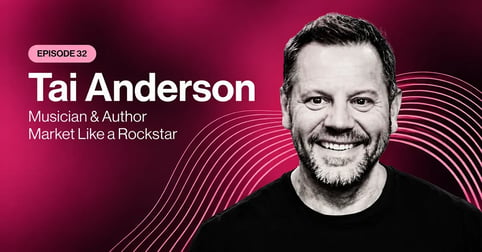
Tai Anderson is a founding member of Third Day, the four-time Grammy-winning Atlanta band he played bass in for 22 years and quietly ran the business side of the whole time. He designed the merchandise and the stage, hired and fired, and argued with labels about ticketing. After the band stepped off the road he spent a decade leading marketing and creative for a mortgage lender, and this spring he went back out with Third Day for a 30th anniversary tour. His book, Market Like a Rockstar, came out in September.
In this episode of Soundstripe Sessions, Jeff Perkins talks to Tai about why launch day should be the starting gun and not the finish line, the 287 job applications that taught him he had a different definition of marketing from everyone else, a CAA agent who walked out of a label meeting after one sentence, the night Third Day got rid of the middle-priced ticket, what Bono taught him about meeting fans, and why he won't use a song generator in the studio.
If you make things for an audience and want that audience to come back, this one is for you. Tai is also the second Atlanta marketer on the show, after Brooke MacLean on building an agency worth working for, and the two episodes make a good pair.
Key takeaways
- He treats a release as the beginning of the work. In music, he says, launch day was treated like the finish line, and it should be the starting gun.
- After four Grammys and a marketing degree he sent out 287 job applications, and realized he defined marketing differently from almost everyone he talked to: the funnel is at most half the journey, and the other half is turning customers into fans.
- His favorite part of being in a band was merchandise, because fans pay you money to advertise for you.
- CAA's John Huie told the band, in the middle of a label meeting, "I don't believe in crossover. I believe in spillover." Third Day grew by being more itself, not less.
- The band cut every middle-tier ticket and sold only VIP and general admission. In his telling, they doubled their box office year over year.
- What moves people up what he calls the ladder of loyalty is delight: the small unexpected extra, like a free live recording of the show you just saw.
- For the 30th anniversary tour, the band opened with its most-streamed song instead of saving it for the encore.
- His book is built on the ROCKSTAR framework: Reach, Obtain, Cultivate, Kickstart, Serve, Trust, Advance, Referral. The first four are the traditional funnel. The last four are where fans come from.
Listen to the episode
Launch day is the starting gun
Tai held up the book within the first minute, and Jeff approved. Rule one of promoting a book is showing the book. The book had been out a couple of weeks when they recorded, and Tai had already decided he was not going to repeat a mistake from the music business.
Tai: I've learned my lesson from the music days with a new release. For so long in music, your launch day was almost like the finish line, and it really should be the starting gun. That's how I'm looking at this. The thing that's interesting, even with a title like Market Like a Rockstar, is I'm trying to figure out how to market a book, and it's inundated with so many people telling me how to do it. Here's how you create a loop: take out your ads, that creates your sales, use your sales revenue to pay for more ads. And I'm kind of like, can't we just do this old school, where one person gets it and they like it and they tell a friend?
Tai: A book can be a 10 or 20 year process. It's launching really well. I'm trying to find the line, I think we all are, of not annoying all of our friends and family with constant self-promotion, but also being really proud of something that I want to share with people.
Jeff has written a book too, and his experience was that nobody finds a book by browsing. What sold copies for him was speaking.
Jeff: The key I found is to try to book speaking gigs with a couple hundred people and have the book purchase be part of the speaking gig. That's when I sold the most books, when I was keynoting or speaking at an event and the event organizers would buy the book as a giveaway, and then I'd sit there and autograph it. I don't know who really would want my autograph.
Tai had just tried a version of that at a CreativeMornings event in Atlanta.
Tai: I brought a few copies of my book and it was essentially my $10 business card. We'd be in a conversation, and sometimes something we were talking about was in the book, and I'd say, would you like a copy? In this attention economy, is someone going to read it? I don't know. But you can't spell authority without author, so I like to say.
He also warned listeners up front about how far he took the theme.
Tai: I said there's a disclaimer in the beginning: if you love music, you're going to love this book, because instead of a table of contents, it's the run of show. Instead of worksheets, it's the sound check. The pull quotes are called riffs, and they're organized into greatest hits. I went deep into the music metaphor. If music just isn't your thing, I'll recommend you three other books, because my book would be incredibly annoying to you. It's not just a metaphor. It's the real architecture for the book.
287 applications and a different definition of marketing
Jeff: What inspired you to write a book? It takes months, if not years sometimes. Why did you do it?
Tai: There were many times writing the book I was like, can I just go make a record? It would be so much easier. I'd have to go back to 2015. I had won four Grammys with Third Day. I had gone back to college and got my marketing degree, and I was really confident that Coca-Cola probably wanted to hire me to be their next CMO. And, you know, 287 job applications later, maybe not so much.
Tai: There's a great Chris Stapleton song, "White Horse." I'm waiting for the cowboy on the white horse to come save me. I think I've realized in life there's no cowboy coming. We've got to be our own cowboys. What I found over and over again going into the corporate world is that I had a fundamentally different definition of marketing than just about everyone I talked to. Everyone puts up the funnel. Even if they say this isn't true, I say their budgets are moral documents, and they reveal their definition of marketing is: how do we talk to strangers and turn them into customers? I was adamant that that is at most half the journey. It's not about getting someone to the first sale. It's about mobilizing them into a fan, because fans are your champions in the marketplace.
The proof, for him, was always the merch table.
Tai: People would ask me my favorite part of being in the band. Is it writing music? That's great. You start with nothing and you come up with something. Is it playing live and that resonance with the audience? Absolutely. My favorite part was merchandise. That's where I knew I was a marketer. I always designed our merchandise. How cool is it that people pay us money to advertise for us?
Tai: When I share that with business people they kind of laugh, like it's impossible. I'm like, we all do it every day. We do it with Yeti. We want to tell the world this is a little part of who I am, it's part of my identity. I like to say Yeti sells the world's most expensive sticker, but it comes with a free cooler.
Chapters written on a tour bus
He built the framework about 10 years ago when he joined the mortgage lender, and taught it to thousands of real estate agents as a continuing education class. The book itself came out of planning Third Day's reunion. The band's 30th anniversary tour ran 30 cities this spring, ending at Gas South Arena in the Atlanta suburb of Duluth on May 10, followed in June by a single anniversary show at Red Rocks.
Tai: When we were putting the reunion tour together, I was like, let me Stephen Covey this thing. Begin with the end in mind. I really want at the end of this year to have a book. I'd love to be able to speak more. I had a lot of people saying you need to be doing this full time, and I was like, it's not that the book is going to guarantee I'll be a successful speaker, but I can pretty much guarantee I won't if I don't have a book. So many a chapter was written and edited on the tour bus, rolling down the highway early in the morning and late at night.
Tai: I was really, when we were talking about it, like, guys, can we do theaters? Because it had been 10 years. Is anyone going to come out? Well, people came out. We had people from all 50 states, the UK, Australia, New Zealand, Brazil, who all came to the show as a celebration of everything the band has meant to them. It was such a validation of what I was writing about: fandom isn't about preference. It's about identity. And when you make those kinds of connections, they endure.
A five-year overnight success
Jeff: Before we talk more about the book, I want to learn a little bit more about you. Where did you grow up?
Atlanta, the whole way through, from the city to Chamblee to high school in Roswell, then a year at Georgia Tech. He was already in Third Day by then. He started with the band at 16.
Tai: We would play locally. There was a little theater in Marietta, the Strand. R.E.M. played there back in the day, and it had really been dilapidated. But we were almost like the house band. We had a little practice space underneath the stage. In the Christian music genre, national acts would come through and play there, and they'd always get us to open for them because we could always fill the room. We had this great local following.
It did not take long for a label to notice. Third Day signed with Reunion Records, and the band's self-titled major-label debut came out in 1996.
Tai: Then we were traded over to a label called Essential, with Jars of Clay, and they were owned by Zomba, which had just broken NSYNC and the Backstreet Boys. Then we got traded for a fifth round pick over to Sony. I like to say we were a five-year overnight success. From 16 to 21 we had plenty of vans and trailers, plenty of changing tires on the side of the road. But with our first record, which is now a gold record, we really resonated with an audience, and grew over the next few years. By our fourth record, that was our biggest seller, at over two million.
The band ran for 22 years. When singer Mac Powell wanted to make a solo record, Tai went and got the marketing degree.
Tai: I was kind of always known as the business guy, which is not something you can put on your LinkedIn unless you're wearing a bow tie. But in the band I designed our merchandise and our stage design, and I hired and fired. I was really like the COO. I was always coming up with ideas and meeting with the label and looking at ticketing models.
Spillover, not crossover
Jeff: You kind of hit the lottery. Getting a record deal, putting out multiple records, filling auditoriums and arenas. So few acts actually get to that point. Was it really tough to walk away from it?
It was. Around 2015, when he was going through it, everyone was passing around Simon Sinek's "Start With Why." Tai took the lesson and then pushed past it.
Tai: With apologies to Simon Sinek, I found that really doesn't get to the core. You've got to start with the who. It all starts with identity. Here in Atlanta, there's no Chick-fil-A without Truett Cathy handing out a free Chick-fil-A card to every single person he ever met. There's no Apple without Steve Jobs. The identity of who a band is, who a brand is, is inseparable from the people and the relationships. And the other side is really knowing who your audience is.
Tai: Our secret to success, and I talk about this in the book, was not crossover. It was spillover. Early on, when we were signed with some of these mainstream labels, they would tell us, hey, if you guys will just downplay the faith angle a little bit, we can get you on 96 Rock here in Atlanta. That was always the dangling carrot. If you just dilute who you are, we can give you mass appeal.
Then came the meeting he still tells people about. In the room was John Huie, the CAA agent and a founding partner of the agency's Nashville office.
Tai: We were in this meeting with the record company and they were dangling that carrot, going through this whole spiel about what they're going to do, the music videos, how we can be more palatable if we just tone it down. And John Huie stands up and says, "I don't believe in crossover. I believe in spillover." And he walks out of the room. Classic. I wish I was that wise and profound, that I could just say little things philosophically and leave.
Tai: I found it so true. Once we saw that exponential growth, it was from digging into who we were as a Christian band, knowing our audience, not trying to hide it. The name of the band was Third Day. We don't need to write songs that sound like we're singing to your girlfriend but are really singing to Jesus. Let's just be who we are. And when we did that, boy, did it explode. You can look at Taylor Swift and say she went from country to pop, but she took her fans with her. That's spillover.
Rungs on the ladder of loyalty
Jeff: A band inherently creates a very emotional connection with the audience. But what goes into sustaining that over time? How did you turn people who were concertgoers into fans who would keep coming back and tell their friends?
Tai: A band and a brand, I think it's the same challenge, and it's the same challenge for your business. You have to give people somewhere else to go. There need to be multiple rungs on your ladder of loyalty. That's what I'm working through now. I've written a book. How is that going to translate to speaking engagements, to consulting, to half-day workshops? What are the other offerings where there's somewhere else to go?
The first rung, in his account, is quality. He credits a formula he heard from David Salyers, an early marketing leader at Chick-fil-A: value equals quality divided by price.
Tai: Discount brands are lowering the price. Seth Godin calls it the race to the bottom. Is that really a race you want to win? The best brands, Apple, Chick-fil-A, are constantly improving the quality. So part of it is that we were relentless to always try to get better. We worked with great producers and engineers. We'd give up a point and big bucks to have Chris Lord-Alge mix the record. For Christian music, I think we really raised the bar. And we always found great acts to take on their first tours, like Switchfoot and Needtobreathe, who went on to great success.
The second is giving fans a reason to go deeper than a ticket.
Tai: The record companies at the time were asking how to get mass exposure to sell albums, then singles, then here's Napster, okay, iTunes saves us, then streaming. All of this relies on reach, on reaching people for this really small sale. What we found was, once you get them through the door, live, they want to come back and bring a friend. Then we started to dig into VIP experiences, culminating in cruises and events. So while everyone else was asking how to sell a 99 cent single, we were asking how to sell a $2,500 cruise.
And the thing that moves people up, he says, is not keeping the promise. Keeping the promise is how you keep trust. It is the extra nobody expected.
Tai: The biggest thing that takes people up the ladder of loyalty, in business or a band, is delight. That unexpected extra little thing. We went on a cruise one time and both our singer and I didn't bring our families, so we could spend every meal eating with different people on the cruise. In our VIP, yes, you get the custom tour poster for that city and the meet and greet with the band. But a little moment of delight was after the show, when we had recorded the concert live, we sent them a digital download of that show as a thank you. We all feel the same thing at a restaurant. When the manager sends over a free dessert, how much more likely are we to come back and tell someone else about it?
Getting rid of the middle-priced ticket
Jeff: Were these things you were coming up with, or was the label saying, you should do this VIP thing and this cruise?
Tai: The label had nothing to do with it. It was all about record sales and radio play. Even our managers at the time, when we first started, it was like, Tai, you just take care of merchandise and all of the live stuff, because we're not really interested in that. Well, now that is the music business. That's all that's left.
The experiment he is proudest of came from a podcast and a phone call to the promoter who handled most of the band's shows, sometime in the 2010s.
Tai: I said, nobody puts on Instagram, "I bought the mid-priced ticket." They post it when they got value, whether it was such a great deal they're happy for the deal, or they were VIP and premium and front row. Why don't we just do those tickets? Why don't we get rid of the middle? Who's excited about the middle?
Tai: We played the Gwinnett Arena one year, it's now Gas South Arena, and the tickets were two rows of VIP at 100 bucks, then 75, 55, 45, 35, 25. I think they had to give away $15 tickets to sell out the cheap seats. There were all these tiers, and the worst thing was when the best seats would sell and the worst seats would sell and there were empty seats in the middle. So even though we'd sold it out, it was like, okay, let's try something new. This promoter was willing to try with us. I said, let's do VIP and general admission.
Tai: That means we can sell as many VIP as we want, as long as we're willing to keep our promise. You could get there at 4:00 for a little acoustic show early, the autograph signings, all these things. It didn't cost us any more to distribute 500 digital downloads than it would 20. The VIP was only limited by how many we sold before general admission sold out, because we could keep moving the line back and the GA would just fill in. And we doubled our box office year over year.
In 2006, the band changed management and Tai went looking for Coran Capshaw at Red Light Management. In his memory, Third Day was about the third act on the roster, after Dave Matthews Band and Phish. He studied how the Dave Matthews operation ran its fan club, which gave fans places to go beyond the album: live recordings, a fan community, the band's charitable work, and steady communication long before social media.
Meet-and-greets, even for introverts
Jeff pointed out that not every act is built for this. Some artists are introverted. Some would find a meet and greet miserable.
Tai: I agree with you. If you're going to leave a bad impression because you're grumpy, then don't do meet and greets. But I would probably tell any young act, get over it. Read my book, read Raving Fans, read Horst Schulze's book. You have to embrace that the people who resonate with your music are going to give you your livelihood. Create the parameters where you can be at your best. But if you're not going to do that, then how are you going to connect? Are you just going to make lip-sync videos for social media? That's great, but that's really top-of-funnel activity, and attention is fleeting.
Jeff brought up an earlier conversation with Scott Welch, who managed Alanis Morissette. Welch's point was that the machine that used to turn an unknown into a star mostly does not exist anymore, so young artists have to build their own audience one room at a time.
Jeff: His point to young musicians is to treat every concert you do, whether you're in a tiny room or an amphitheater or opening for someone, not just as an opportunity to perform, but to build your audience. And that doesn't mean you put up a slide that says follow me on Instagram. It's going into the audience, staying after, going to the merch table. It's a really unique thing you can do for someone, to see you perform and then come chitchat with you and shake your hand and take a selfie.
Tai: Absolutely. Maximize it. Think about it for you as an author and a speaker. You don't want to show up on stage and then mysteriously exit. You want to go out and shake hands and connect.
What Bono knows about fans
Tai is a big U2 fan. Bono once sent the band a fax welcoming them the first time Third Day played Dublin. He told a story from the book-length interview Bono did with a French journalist, about how he is so good with fans.
Tai: Bono said, I'm great with fans because I am a fan. I know what fans want, because I'm such a Beatles fan, such a Bob Dylan fan, and I've gotten from them what I know fans want from me. The interviewer says, well, what is it? He says, fans want a blessing. Then classic Bono, he goes into the Old Testament story of Jacob and Esau, where Jacob puts the fur on his arm, because his brother was really hairy, to trick his blind father and steal the blessing. Bono says, how did Jacob get the blessing over Esau? I think it's just because he wanted it more. That's how I was. I wanted the blessing. And remembering that when I interact with fans, that's what I keep in mind. They just want a blessing.
Then the twist. Tai has met Bono four times, and every time Bono knew his name. The best example was backstage on the Vertigo tour in Atlanta, where the band were guests of the ONE Campaign.
Tai: We go back to this meet and greet area behind the stage, a black curtain, and there's the mayor, there's Sanjay Gupta, there's the head of the CDC, Mike Mills is there. Along the way I'd been telling the ONE Campaign rep about a trip I had just taken to Uganda, meeting recovering child soldiers. Bono comes in, walks past everybody important, walks right over to me and goes, "Tai, tell me about your trip to Uganda." I can't believe Bono remembers me from two years ago. And finally our singer's like, "Tai, the assistant just told him the story and fed him the info." And you know what? It didn't matter to me. It still made me feel the same.
Tai: Think about that for our businesses, using our CRM. Bono is the master of making people feel seen, Republican or Democrat, young or old. In the book I talk about meeting Taylor Swift, and how she just dropped to her knees to look right at my daughters, in their eyes. There are little things for artists. Listen. Repeat their name back in the conversation. These basic decent things you would teach somebody in their training at Chick-fil-A. If you can do those as an artist, it goes a long way to make people feel seen and heard, and feel like you're blessing them.
Play the hits
The conversation took a long and happy detour through U2 at the Sphere and Bruce Springsteen. Jeff is from New Jersey and has seen Springsteen more than 30 times. Tai's description of the last tour stop in Atlanta was the one that stuck.
Tai: The only way to explain it is I felt less lonely after the show. Politics are so much more divisive, we're all in our cars by ourselves, more time in headphones and screens, and I just felt like I was at church. These are my people. I don't want heaven to be a bunch of robes and church music. I want a Bruce Springsteen show, or a U2 show, or a Coldplay show.
That turned into a debate both of them were on the same side of. Jeff's friends had just seen a legend play a set without a single song they recognized. Tai bought a hat at a Wallflowers show that says "play the hits."
Tai: The kinds of acts I love, they play the hits. And yes, give yourself two or three moments in the night where you go a little deeper. But a concert should be about this community with the audience. If I've just gotten a babysitter and went out to eat and bought this ticket, don't leave me going, why are you leaving hit songs off the table?
Third Day put that into the setlist for the anniversary tour.
Tai: We got the data from Spotify, now that it's been 10 years and we have this whole catalog. What are the top songs? We actually opened the night with our number one streaming song. We really debated it, because normally you'd save that for the encore. But we knew we were coming with hit after hit. And looking out and seeing three generations of fans in the audience, people whose parents brought them as teenagers back in the day, and now those teenagers are adults with their own kids, and seeing tears in people's eyes and how much it's meant to them. It didn't feel like an option to go, hey, let's do some shoegazing.
Tai's caveat was that you have to be able to back it up.
Tai: I use this when I'm teaching. You know the act with the big song, you can picture the video, "Take On Me." It's a-ha. Can you name me another a-ha song? Nobody can. So if I'm going to see a-ha, they probably should save it for later in the show. You want to lead with establishing that connection, and then build on it. There's a real arc to a show. And if the artist can't do it with joy, I'm like, make room for somebody else.
Team human
That is where the conversation turned to generated music. Late last year an AI-generated act topped the iTunes Christian music charts, which landed close to home for a founding member of one of the genre's biggest bands. Tai has done a lot of AI video work in his corporate role and is trying to stay open-minded, but in the studio, he and the friend he is making new music with are not using a song generator at all.
Tai: I was talking with another singer-songwriter, and he says, I still have the song on the acoustic, the melody and the lyrics, but I put it into the generator and it's like a fast forward until I have my demo, and then I can go in with real musicians. So there's nothing left of the generator when I'm done. But I'm like, you're approaching that as a singer-songwriter, defining the song purely as the melody and the lyric. Play "Billie Jean." The drum beat is just as much a part of what makes that a song, and everyone recognizes it within one measure. Play "Let It Be." It doesn't take the melody or the lyric, just that piano part. "Sweet Child O' Mine." How can you say that's not just as much a part of the song? I get it as a tool. But I do feel like it's a slippery slope, and I think it would be great if they do require the labeling.
Jeff, by his own description, actively despises AI music.
Jeff: We are proudly at Soundstripe human-made music. We promote it. That's our thing. If the generator starts to not just take what you're writing, but actually starts to generate, it's based on copyrighted music. So you as an artist may be ripping someone off and you don't even know it. Like, I need a riff for this, I'm just going to have the generator help me with this riff. That riff might have come from another artist, and that artist might be able to track it back at some point. So even if you've recorded it with professional musicians, you still might have an issue.
The legal fight over how the big song generators were trained is still going. The three major labels sued the best-known song generator in 2024. Warner Music settled its case in November 2025, and Universal and Sony's lawsuit remains active. Jeff made a related point, from the brand side, in the Josh Rabinowitz episode on music in advertising.
Tai's objection is less about the courtroom and more about what the shortcut does to the person using it.
Tai: The brilliance of music is the happy accidents. The brilliance of the Beatles is they're listening to Little Richard going, hey, let's do this, but they can't, and their own uniqueness comes in. Creativity used to be the idea plus 10 years to get your 10,000 hours and develop your craft, and then you could express the idea to the world. Now it's idea plus AI tool equals output. If I was going to get good on piano, it takes me 10 years, and whoever my teacher is and the songs I learn, all of that goes into the gumbo and shows up in my expression. If you go right to the fast forward, you never develop that vocabulary, your own little unique things.
Tai: The brilliance of U2 and Coldplay and Bruce is their limitations. I mean that as the opposite of a slam. They could put on whatever seasonings they want, but it's drums, bass, guitar, vocal. The best creativity is when you limit the palette. Then the focus becomes the song and the idea. I played with a generator one time. I had a lyric idea, and within five minutes it sounded like it was ready for a big church here in Atlanta that Sunday. But how can something have soul if it's made by a soulless entity?
What he described instead was the session he had just come from.
Tai: The guy I'm working with is really talented. He sings and plays guitar and drums and keys. He doesn't need me there. He could play the bass. But he says, I just like the way you play bass and your ideas. I walked in today and he's playing a song, and he's like, oh great, hop in. No charting, nothing. I just start playing along, hitting the wrong notes trying to figure it out, and he's like, oh, that's awesome, that little happy accident right there, let's build on that. You don't get that if you go right to a machine that sounds really good. It's derivative, but it sounds really good. The best music starts from a place where there's a freedom to suck.
Tai: Even if your brain doesn't know it, that's part of what all of us are ultimately going for, whatever our creative medium is: authenticity and connection. I think there's going to be a real swing back toward that.
Jeff: I think you're right. Team human, right here.
Fandom for a mortgage company
Jeff: A band is emotional. But you were working for a mortgage company. Your mortgage broker is not Third Day. How do you help marketers make that connection and create fans when they don't have that same emotional pull?
Tai's first move is to ask whether it is possible at all, and his answer is that people already do it for brands every day.
Tai: Seth Godin talks about culture as "people like us do things like this." The best brands do achieve that. I'll walk right past the bubble coolers at Walmart and go buy the Yeti. I'm paying more, but I also put the sticker on the car. With software you'd think, how's anyone going to feel about that? But with the best brands, I want the sticker on my laptop. I'm a Mac, not a PC. I've got my Fender. There are brands we pay money to advertise for. I think that's a clue that you're achieving it.
Tai: Look at CrossFit. What do people say? I am a CrossFitter. It's a statement of identity. So as a brand, listen to what your audience is saying. If you can get them to say that present-tense statement of identity, you know you're hitting it. The path to get there is creating intentional delight. And if your business is really transactional, then make sure you're delivering remarkable service.
The framework in the book is an acronym. ROCKSTAR: Reach, Obtain, Cultivate, Kickstart. Then Serve, Trust, Advance, Referral.
Tai: The kickstart is the first sale. That's the traditional marketing funnel. My next steps are serve, by creating intentional moments of delight. Trust, by keeping your promise even when it's hard. Advance, by finding ways to go deeper and take them up the ladder of loyalty. And finally, activating the crown jewel of marketing, which is referral, where people are happy to tell other people about you. It's possible for a real estate agent or a mortgage company. The challenge I found is you only need a mortgage company when you need a house. If it's a one-time transaction, it's not impossible, but it's more difficult.
Jeff's example was Delta. He flies enough to get handwritten notes on his seat, and that is a large part of why he will not switch airlines. Tai, a Delta million miler, has a drawer of the same notes.
Tai: Those little notes maintain my loyalty more than the bottle of bourbon I got when I hit a million miles. What do you say about Bruce? I am a Bruce fan. Present-tense statement of identity. If you tell me you're a Bruce Springsteen fan, you love Atlanta United, you love Ted Lasso and Wes Anderson movies, I know more about you from four or five things you're a fan of than just about anything on your LinkedIn profile. Fandom is how we express who we are to the world.
A complaint handled well
Before Soundstripe, Jeff ran ParkMobile, a company in a category everyone resents. He joked that he was CEO and head of customer service, because the complaints found their way to his LinkedIn inbox and he answered them himself.
Jeff: People would send me the nastiest notes. Your company's the worst, I hate you. And I would respond and say, I know how frustrating it is when parking doesn't go the way you want or you get a ticket. And suddenly they would reply, I'm so sorry, I was having a bad day, I appreciate you so much. Just a little while ago you wanted me to die.
Tai has a chapter on exactly that. He calls it the remix method, and he credits the steps to Horst Schulze of the Ritz-Carlton.
Tai: A complaint handled well is actually a fan-making opportunity. The best relationships in your life, we're both married, there has been static along the way. The real depth comes as you work through those challenges. When you're dealing with a complaint, number one, listen. Half the time people just want to vent. Empathize. That doesn't cost anything. Then apologize, and don't give a fake apology. Instead of "I'm so sorry you feel that way," just say "I'm so sorry." That didn't cost anything either. This isn't a court of law. It's a $20 parking ticket. Then correct, and then look for that moment of delight. It can be as simple as a handwritten note.
He has even thought about asking for a bad review of his own book.
Tai: I was thinking about a social post going, hey, my book just launched, I got 19 five-star reviews, I'm looking for a one-star review. Because all five stars almost feels unbelievable. I know my book isn't for everybody. When you look at a company, you don't want to see all five stars. You want to see a four, and you want to see how the brand corrected the problem.
Advice to his younger self
Jeff: Last question, I ask this to all the guests. What's one piece of advice or wisdom you would give to your younger self?
Tai ended the anniversary tour by jumping off the front of the stage every night and staying with fans until security sent everyone home. His advice was the same thing he would tell a new musician.
Tai: Just own it and embrace it. You have to get past any of the applause, anything where you think you're big stuff, and realize what a gift it is to treat your customer, your fans, with dignity, and to grow them. For me with the book, I'm not looking at it as a New York Times bestseller. There are going to be people, and already some out there, who go, man, I love this book, it helped me do a better job. You have to look at success as doing the thing. If you're the filmmaker, you make the film. If you're the musician, you make the music. Don't look at success as the numbers.
Tai: I'm sure you're a Rick Rubin fan too, and he talks about that. For me, that's the spiritual part. Everything you make, you put out there as an offering, and the response is beyond your control. It's like a pitcher in baseball. You put your best effort in, but you've got to release the ball, and once it's released there's nothing else you can do to determine the outcome. So do the thing. Yes, we market it and promote it. But don't make that your identity. Make the identity that you did it with excellence.
Jeff: Do the thing. Love it.
Tai says he has no unanswered texts, emails or LinkedIn messages, and he means it as an invitation. He is most active on LinkedIn as taianderson3d, and his speaking and book details are at taianderson.live.
Frequently asked questions
Who is Tai Anderson?
Tai Anderson is a founding member and bassist of Third Day, the four-time Grammy-winning Christian rock band from the Atlanta area, where he also ran the band's business side, from merchandise and stage design to ticketing. After the band stepped off the road in 2015 he spent a decade as marketing and creative director at the mortgage lender Supreme Lending Southeast. He rejoined Third Day for its 30th anniversary tour in 2026 and is the author of Market Like a Rockstar.
What is Market Like a Rockstar about?
Market Like a Rockstar is Tai Anderson's 2026 book on turning customers into fans, drawn from his 30 years with Third Day and a decade in corporate marketing. Its argument is that the traditional marketing funnel, which ends at the first sale, covers at most half the journey. The rest is moving customers up a ladder of loyalty until they recommend you. The book is structured like a concert, with a run of show instead of a table of contents.
What is the ROCKSTAR framework?
ROCKSTAR is the eight-step framework at the center of Tai Anderson's book: Reach, Obtain, Cultivate, Kickstart, Serve, Trust, Advance and Referral. The first four steps are the traditional funnel, ending with the first sale. The last four are where fans are made: serving through intentional moments of delight, keeping the promise even when it is hard, offering ways to go deeper, and finally earning referrals from people happy to tell others about you.
What does "spillover, not crossover" mean?
It is advice CAA agent John Huie gave Third Day during a label meeting in which executives urged them to tone down their faith to reach mainstream radio. Crossover means diluting who you are to reach a new audience. Spillover means becoming more fully yourself, so the audience you have grows and brings others with it. Tai Anderson credits that approach with Third Day's growth and teaches it as a branding principle.
How did Third Day turn concertgoers into fans?
Tai Anderson describes three moves. The band kept raising the quality of its records and shows. It gave fans somewhere else to go after the ticket, from VIP experiences to fan cruises. And it built in unexpected delight, such as sending VIP guests a free live recording of the show they had just attended. The band also simplified its pricing to VIP and general admission only, which he says doubled its box office year over year.
How should a business handle a customer complaint?
Tai Anderson's method, which he credits to Horst Schulze of the Ritz-Carlton, has five steps: listen, empathize, apologize, correct, then add a moment of delight. Listening matters first because many people mainly want to vent. The apology should be real, not "I'm sorry you feel that way." He argues a complaint handled well is one of the best chances a business has to turn an unhappy customer into a fan.
What does Tai Anderson think about AI-generated music?
He sees song generators as a slippery slope and does not use them in the studio. His argument is that a song is more than its melody and lyric, since parts like the "Billie Jean" drum beat are part of the song too, and that skipping years of learning an instrument means never developing a personal vocabulary. He values the happy accidents of real musicians playing together and supports labeling AI-generated music.