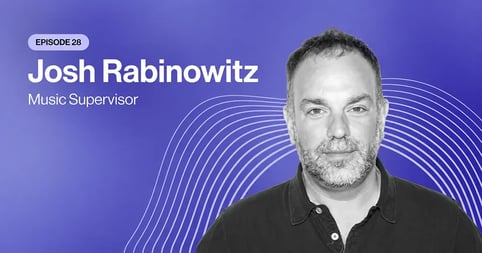
Josh Rabinowitz spent 14 years running the music department at Grey, one of the largest advertising agencies in the world, choosing and producing the music behind campaigns for the NFL, Volvo, Gillette, CoverGirl and a long list of others. Before that he spent seven and a half years at Young & Rubicam. He was the first person to preside over the Music Jury at Cannes Lions, he now runs a consultancy in Brooklyn called Brooklyn Music Experience, and he teaches music supervision at Berklee College of Music.
In this episode of Soundstripe Sessions, Jeff Perkins talks to Josh about growing up in Brooklyn before Brooklyn was cool, the ska band that became a funk band and toured I-95 for years, how a trombone player got into the jingle houses of 1996, what it takes to get 20 people to agree on a piece of music, the cover version that charted after the Big Game and then got pulled off the air, and why he still asks "what's the source?" before he says yes to anything.
If you make things with music in them and you have ever had a client fall in love with a track you cannot clear, this one is for you. Josh has spent 30 years in that exact spot. The earlier Thomas Golubić episode covered the same job from the television side. This is the advertising side, where the budgets are bigger, the timelines are shorter, and the kitchen has more cooks.
Key takeaways
- He grew up in Brooklyn, went to the high school from the movie Fame, and played trombone in a ska band that turned into a funk band. Booking, managing and producing the band could not sustain a life in New York, so he went looking for another way to stay in music.
- When he started in 1996, advertising music was 90 to 95 percent original, custom composition. Today most major brands license famous songs because the fan base and the associations come with them.
- His whole method comes down to one phrase: achieve the expected feeling in an unexpected way. Find the diamond in the rough, then realign it to sell a product.
- A TV show needs three or four people to agree on a song. An ad can need 20. Trust with your collaborators is the only thing that makes the process work.
- His best placement was a cover of "Carry On" for Sony, sung by Alana Davis. It charted, she was on the morning shows, and then the ad was pulled after a real-life tragedy.
- Licensing a song means clearing the publishing and the master. A single pop song can have 10 to 12 writers, some with half a percent, and every one of them has to say yes.
- His hope for generated music is a system that identifies whose work went into a track so the original creators get paid. Until then, his advice to a brand holding a generated track is to ask its lawyers first.
- Advice to his younger self: fight for what you think is great, but not every time.
Listen to the episode
Brooklyn, before it was cool
Jeff opened the way he always does, by asking where the guest grew up. Josh has never really left.
Josh: I grew up in Brooklyn, where I'm still residing. I grew up here before it was super cool. Now it's so cool I'm not cool enough to be in Brooklyn, but I have roots here. I was a big music student. I studied music as a trombone player, jazz and orchestral music. I went to a music high school. If you saw the movie Fame, you know my high school. And I studied music in college. Then I really didn't know what to do. I pursued a whole bunch of different musical routes, went to grad school a couple of times, dropped out a couple of times, and I landed in the space where music intersects advertising. I've been in it for 30 years now, which is pretty cool. I've seen a lot of shifts.
Jeff: Did you go to high school with a bunch of famous people?
Josh: There were people that went on to become famous. A lot of great musicians. If you know some of the great pop studio musicians, Omar Hakim, or Marcus Miller, who I think is still considered a great jazz bass player, as well as many people on Broadway, some artists, a lot of great classical musicians, fine artists, actors, dancers.
His parents were not musicians. They were both psychiatrists. The music came from the radio.
Josh: I really loved music. I listened to AM and FM radio over and over, and the music kind of stuck there in my brain. I'm kind of geeky when it comes to music of the 60s, 70s, 80s, just because I listened to so much of it. I always wanted to play an instrument. I started out on the piano, played a little recorder. I'm actually a very good recorder player. Not something that's very monetizable. I pursued the trombone because I saw a band come by my middle school, and the trombone player got a lot of cheers. I was like, I want to play and get a lot of cheers when I play. I picked up the trombone and stuck with it for many years.
Jeff: The trombone player is like the highlight of the band, right? Especially when you get the chance to get it out there on the solo.
Josh: It really can be. I like to play loud. I played in a ska reggae band that became a funk band and toured around the East Coast, up and down I-95 basically, for many years. And I really enjoyed it. The problem with it was it was very hard to monetize and sustain a life in New York City, in Brooklyn, with the money that I was making playing in a band, also booking the band and managing the band, producing the band. So I looked elsewhere to try to monetize, and I found this avenue.
45s, soul radio, and a mother's record collection
Jeff: Talk about some of your early musical influences. What were some of your favorite albums, or first albums that you really got into?
Josh: At first it was 45s, because that's what radio was playing. It was before the album era, at least before it infected me in the best possible way. I listened to a lot of top 40 soul and R&B music, and loved it, loved it, loved it. My mother had a ton of albums. She was into music, and she of course had Beatles albums and a lot of folk music. So that was another influence on me. But I loved James Brown and Sam Cooke and Otis Redding. The Jackson 5, Michael Jackson when he was really young. Some of the production on those songs was just amazing, and it really stuck with me. That's why I think I played in a band that was a soul, funk, ska, reggae band. A lot of the influences I had stayed with me forever.
Jeff asked whether there was ever a moment when the band felt like the plan, the thing that was going to break through.
Josh: It was the goal at some level. I knew it was like winning the lottery on many levels. But I loved the interaction with the audience. We were the type of band that was all about getting people to move and jump up and down. We played a lot of small clubs and colleges up and down the East Coast, in college towns, so many different places in the Southeast particularly, and it really resonated down there. But it didn't click in that we were such a great live band, we didn't dedicate a lot of our focus to creating hits and songs that could potentially permeate and reverberate within culture. Although some of it I thought was excellent.
Josh: It just became difficult to sustain a band and keep everyone in it and pay everybody and make the magic happen. So that's why I started to glance elsewhere. But I wanted to stay in music more than anything else. I feel like sustaining a life in music is like winning the lottery. When I did land a job, I was really happy and surprised, because I didn't have any great connections. Maybe four degrees of separation from the music business rather than one. And flash forward 30 years later, I'm still in it.
Jeff has heard this story a lot. Musicians who go back for the law degree or the CPA and keep playing on weekends. He said it is one of the reasons Soundstripe looks the way it does.
Jeff: We're a royalty-free production music catalog, but our employees are all so happy to be able to work in the music industry. For many of them it's a lifelong dream. Most of the people in our company are musicians. Even though they work in marketing or accounting, they're still all musicians. So it's great that we can give them that opportunity to be connected to music and at the same time make a living wage, have health benefits, and all the stuff you need to live your life.
Getting into the jingle houses in 1996
Jeff worked in advertising for the first decade of his career, and he admitted that the music guy was always the person he thought had the coolest job in the building. So he asked the obvious question: how do you get that job?
Josh: Back then, 30 years ago, there weren't that many opportunities in the music and advertising space. Flash forward to today, there are so many people that do it, and it's not just music and advertising. It's music and film, music and television, music and gaming, trailers. But back then, some of the agencies actually had music staffs. A couple of people that were considered music producers rather than music supervisors, because most of what was put into music, as you probably remember from your early days in advertising, was original music. Once in a while it was a licensing of a fairly well known song or possibly an emerging artist. But when I first got into it, in 1996, it was 90 percent, maybe 95 percent, creating original bespoke custom music for an advertising campaign, or for a 30 second or 15 second spot.
Josh: I got to know a few of the people mainly because I was playing trombone on some sessions. A lot of these music houses, they used to be called jingle houses. They were like a mini Brill Building, or like Tin Pan Alley, where people would bang out music and produce it really quickly. That's what it was still like in advertising when I got into it in 1996. I got my foot in the door at one of those music production companies located in downtown New York City. I had a couple of friends that knew what was going on in that space, one or two of them had started their own thing, and they suggested contacting a few people. One of the guys appreciated the fact that I wasn't someone who had been in that space. I came from playing in a band and playing as a session musician, but not really on ads. He thought, this guy isn't jaded by the process, let's bring him in. He gave me a shot, and it was a pretty good opportunity.
Josh: What I found to be amazing was that some of my heroes, some of the great session players, were based in New York City, and I got to work with them, and eventually, as a producer, collaborate with them. These are people that I worshipped on many levels. So that's how I got in. It was through the music house side.
He was at that first house for six months. Then he went after a cooler one.
Josh: There was this other one that worked with some famous artists. They did some film work, some TV work, and their bread and butter was advertising. I pursued them, and because I had done some pretty cool things within the first six months, they gave me a shot. I worked in that music house for six years. We had a stable of composers, music writers, DJs, producers. But I saw the other side of the business, the ad people. I liked the fact that they can make the call and get people to work on stuff and then go home, instead of staying up all night producing music and demos and mixes and splitting out the stems, preparing them for a mix. That was really fun, but it was a lot of work. I was getting to the point in life where I'd like to be the person asking people and telling them what to do, rather than the person who's always being asked to do stuff and stay up all night.
Twenty chefs and one song
Jeff: Talk about the process you go through to find the perfect song for the ad, or the story your agency is trying to tell.
Josh: It's really about a collaboration. There are teams that come up, the creative team of an art director and a copywriter. They're the germ of the team that ideates and comes up with these ideas. Many of them would come to me or my team. When I worked at Grey, I was the head of the whole music department. When I worked at Young & Rubicam, previous to that, I was one of four or five people who were assigned different accounts. So a creative team on an account would come to me and say, we're working with Ericsson phones or Nokia phones or the NFL or Sony Electronics, and here's our idea. We want some music to work with the idea as we pitch it. What do you think? Or, we have a great song in mind. We love this song. We know we can't afford to get this song. We'd like to do something that makes you feel like that song.
Josh: With advertising, the stakes are pretty high. The budgets are good. It's global multinational corporations at times, with very big marketing budgets, and they can spend money. That's the beautiful part of it. But the most difficult part is that because they spend so much money and have so many people involved, whether it's that creative team of the art director and the copywriter, then their creative director, then the group creative director, the global chief creative director, maybe some production people, plus the clients, you could have a kitchen full of 20 different chefs, and you have to get that music from point A to point B.
The thing that made it work, he said, was not a process. It was a relationship.
Josh: The way it worked best, Jeff, is when I developed a symbiotic relationship with my collaborators, where I was working with them for a few years and we were able to pump out work and understand how each other worked and respected each other's process. When people would come to me, I would strongly consider ideas and be very passionate about it. If they believed in my passion, which they would after time, generally speaking, they would let me do the music thing and I'd let them do the creative thing or the editorial thing. There are so many different ways of procuring great music for people. That's a whole conversation in itself. But the magic comes from that mutual respect and trust that you develop with your collaborators. For people just getting into the business, it's very difficult, because you're green and you don't have a lot of relationships and time and experience.
Show them the work that won
Jeff has noticed that people fall into two camps on music in a spot. Either it is background and any track will do, or it is half the communication in the ad. There are not many people in the middle. He asked how Josh got the first camp to care.
Josh: I would show them the best work, the award-winning work. I think that's what everyone's driven by: winning awards, getting recognition, coming up with something groundbreaking that resonates in culture, that wins something at Cannes Lions or at the Clio Awards. It's great for their advancement, it's great for their compensation, but it's also just great for their careers. So, proof of concept. I would show people great award-winning work that utilized excellent music, and talk about how that music not only expressed the storytelling but was the feeling, and had an authenticity that consumers can relate to.
Josh: I think that's why a lot of the music used in advertising today, versus when I started 30 years ago, is music that already exists in culture and has clicked and resonated and hooked people. There's a fan base for certain songs, and there's the associative power of these songs. A majority of the major brands are using very, very famous songs and spending a ton of money to license them, because they feel like the authenticity and the equity is really important.
Then he gave the line that the whole conversation kept returning to.
Josh: I always talk about the storytelling and the meaning and the feeling of what a great piece of music can do. And then also trying to find a piece of music that makes you feel the expected feeling, but it's done in an unexpected way. Something that is a really beautiful song that can have a complexity and a mix of emotions, but makes you feel very powerfully. That's what I'm always trying to do. Everybody wants to break through the clutter. I always think that if you can find that diamond in the rough, and I think most music supervisors feel this way, you know, you've talked with my friend Thomas about music supervision, we're always trying to find that thing that nobody else really knows about. We're music geeks. We're detectives of music. We find tracks that exist in this level of unknownness that hardly anybody knows, and try to pluck it out and reapply it and realign it to help sell a product, or a concept, or a brand's purpose.
Thomas, The Bear, and the CEO's daughter
The Thomas in question is Thomas Golubić, who sat down with Jeff earlier this year. Jeff mentioned that Thomas has a hot take on The Bear: he does not like the music on the show, and Jeff's read is that it is because picking well known songs looks easy compared to finding the ones only the geeks know. (For the record, Jeff likes the music in The Bear.)
Josh: I like the music from The Bear too. I know the showrunners were basically the music supervisors on that show. And you find this with a lot of creative people. They have a passion. Vince Gilligan has a passion for music. I'm sure Thomas can tell you Vince has a lot of great ideas and put forth many of them. That's a lot of what music supervisors do. People put forth a song and we go out and make sure we can clear it and negotiate it and make it work within budget.
Josh: It's the left brain, right brain thing. The left brain is the negotiational, project management, financial, organizational part. The right side is the curational, creative part. Some people lean one way, some people lean another. I think to be a successful music supervisor in media, you have to be balanced.
The passion, he said, cuts both ways. Sometimes the person at the top of the approval chain has loved a song their whole life and cannot see that it does not work.
Josh: It's amazing how much passion people have for music, to such an extent that a showrunner or a creative director or a client might feel like it has to be a piece of music that they love, that they've loved their whole life. And it doesn't always work. Trying to negotiate that creatively with people can be very difficult. There are often times where we will get approval from all these different cooks in the kitchen, all the way up to the top client, and then the top client says, "I think it's pretty good, but my daughter doesn't like it. Can we re-evaluate?" That's a tastemaker for him. Somebody who's in touch with a certain aspect of culture or demographic. But yeah, I love to find things that are unknown, and again, achieve the expected in an unexpected way.
Pink Moon, bouncing balls, and the Apple bump
Jeff: When you're showing people examples of great ads with great music, where the music really carries the storytelling, what are some of those examples?
Josh: I'm a professor. I teach at Berklee, as you mentioned. I spend a whole week on music and branding, and I have a presentation where I play some groundbreaking ones. The ones that resonate outside, like you mentioned, where someone picks a song for a piece of media and it becomes very popular. There's one that was mind blowing, and it happened at the turn of the century, 1999, 2000, for Volkswagen. They used a song by Nick Drake, "Pink Moon," off the Pink Moon album. Nick Drake was a great folk singer, kind of depressed, and had actually committed suicide in the mid 70s. His song "Pink Moon" is just this beautiful, beautiful song, and they used it in a Volkswagen ad. I think it's called "Milky Way." Everyone discovered Nick Drake because of that use. I thought it was such a beautiful, meaningful thing. It's art meets commerce, where it's not just heavy on the commerce but slightly heavy on the art.
Jeff could not place the spot, so Josh described it: young people driving to a party with the roof down, arriving, looking at the house, and deciding they would rather keep driving and look up at the sky.
Josh: It's a beautiful ad. And "Pink Moon," I'm not sure exactly what the content is about. Some people mention that it could be about a guy on heroin staring out into space looking at a pink moon. So it's not always a spot-on connection, lyrically or literally, to what's going on in the song. But there's a lot of beauty in there.
Jeff's own go-to example, the one he shows at conferences, is the Sony Bravia spot with the bouncing balls in San Francisco. He plays a version with the music stripped out, just the sound of the balls hitting the street, and then plays it with José González's "Heartbeats" underneath.
Jeff: You're just like, goosebumps. It's such an emotional thing, and what does it have to do with televisions? I don't know. But it just hit so hard. And then that song, as a result of the ad, became sort of a hit on a lot of the charts. It shows the impact these songs can have. It's not just on the ad, the song becomes popular.
Josh: And it's a cover song. I don't know if you ever listened to the original version of it. It's a pretty cool song, and it's totally unexpected. This is not what you would expect. But because it's so beautiful, and it's about color, the ad spells out color, C-O-L-O-R. It's part of my presentation as well, that one. It's achieving something in an unexpected way, and that was groundbreaking.
Josh: There are so many examples of people that have become hit makers because their song was used in an ad. A lot of what happened with the body of work for Apple, the Apple brand, not the Apple label for the Beatles, although that had a lot of success early on. The artist Feist, the artist Yael Naïm, they both had hits. They broke into culture. They call it the Apple bump. If you get your song in an Apple ad, there's a bump in your career. Some of the biggest artists ever, U2 and Paul McCartney and Coldplay and Wynton Marsalis, participated in these Apple ads, not only because it's artful and creative. It's also a great way to connect to culture, because it's a lifestyle brand. Every brand hopes that they could be like that. Volkswagen is one. Nike is another. The Gap, historically, has been amazing with music. Apple, probably the best.
Josh: I've always tried to break artists and create hits through ads. That's always been my quest. A lot of songs that I produced, maybe a cover version of a song for an ad, for Sony, for the NFL, for Yahoo, I've worked with artists that also released that version on their albums, and some of them have had some successes. I was always hoping to have the big mega hit, because all those media dollars are being spent on music, and millions if not billions of people are seeing it at a global level. I've come pretty close but never hit the grand slam, unfortunately.
"Carry On," Alana Davis, and the ad that got pulled
Jeff: Let's talk about your placements, because you've done probably thousands of them. If you're going to say your top music placement in an ad of all time, what would it be?
Josh: I have a few. My top one was one where we did a cover version of the song "Carry On" by Crosby, Stills, Nash & Young. It's the first song on their Déjà Vu album. We auditioned a lot of artists for Sony Electronics, and found this artist that used to come sit in with my band once in a while. Her name is Alana Davis. She had recently been dropped by her label. She has this beautiful voice, a soulful, blue-eyed soul kind of singer. Kind of like a Joss Stone, if you know who she is.
Josh: We did this version and it just clicked in culture. For the release in the Big Game, they were doing a longer form ad. I worked with Sony Music, and they decided that they would release a full-length version of the song and put a prompt at the end of the spot saying, "Alana Davis, 'Carry On,' available at sony.com." It was released on Columbia Records as a single right after the game. I thought there's all this magic and synergy happening. The song started to chart on the singles chart, and she was on all these different news programs and morning shows.
Josh: But then what happened was, the content of the advertisement was about a guy who sells his company and then decides to go up into space, like a vanity project. And then one of the space shuttles crashed in real life. So they decided to pull it off the air. It was probably one of my best pieces of work that I collaborated with a few different people on, and I thought this would be the grand slam. But that was, I think, probably my best execution.
The spot aired during the 2003 game. Days later, the space shuttle Columbia broke apart on re-entry.
Publishing, masters, and the Rabinowitz problem
Jeff wanted to know how the rights worked on that one. Did Sony already own the song, or did they have to go to the writer?
Josh: We did. It was written, the main writer, 100 percent of the writer share, was Stephen Stills. His manager was this legendary guy Elliot Roberts, who had worked with Neil Young and so many others. His real last name was Rabinowitz, by the way. Just like Lou Reed. Lou Reed's original last name is Rabinowitz. Phil Ramone, the great pop producer, Rabinowitz. There's a bunch of Rabinowitzes out there, but they all changed their name.
Jeff: No relation to you, though.
Josh: Maybe three or four degrees of separation. Trevor Rabin is also a Rabin. He's a great rock and roll producer. But we went to Stephen Stills and his publisher and got the rights. Any time you license something, music supervisors know this, you have to get the publishing rights and you have to get the master recording rights. It's like song of the year versus record of the year at the Grammys. Song of the year goes to the publisher and the songwriter. Record of the year goes to the artist, the record label and the producer. So we created our own master recording and gave that to Columbia Records, which is part of Sony. And the publishing was with Stephen Stills. It was a major publisher. It could have been Warner Chappell, or Universal Music Publishing, or EMI at the time. We have to clear all that stuff.
Then he described what that looks like on a modern pop record.
Josh: It's a real detective research pursuit when you're trying to find out, on a Beyoncé song for instance, there might be 15 writers. How do you get all the publishers to sign off, and all the writers? And it's different percentages. One is 10 percent, one is 5 percent. I'm sure with you guys you have different percentages aligned with the different people that compose and write for you, and you work out a deal on how they get compensated. But when I'm rolling in this space, there are often times I have to contact maybe 10 to 12 writers on a song, and someone might have just 0.5 percent of the writer share, and they may have a publisher that's aligned with them. So it's a lot of phone calls, a lot of emails, a lot of deal memos, and then getting it all straight, a lot of agreements. On the master side it's generally one, maybe two if there's a sample in there.
Jeff has a war story of his own from his agency days. The creative team wanted "It's Your Thing" by the Isley Brothers for a kids' fruit snack. He drove out to Long Island with the storyboards to see the last holdout, who looked at them and said no. He did not want his song in a fruit snack commercial. That was the end of it.
Jeff: How long does that take? Your process to figure out the rights for a song and then go and get everybody to sign off? It's got to take not days, but weeks or even months sometimes, right?
Josh: It can. With advertising, it's usually negotiations and rights management on steroids, because it's all happening so quick. I don't mind that. I like it when it's fast. Sometimes there's advance notice. You may have worked on accounts where they know six months ahead of time what's being produced and maybe have an idea of the music. But most of the time you have a few days to a few weeks, maybe a month, to work something out. And then it changes all the time. Like you said, someone might not agree to do something for a children's fruit snack. Some people are very opposed to alcohol, or to other things, companies that use labor in different countries. There are people that are very mindful of certain things, and other people that don't care as much.
Josh: And then there's estates. A lot of the great music that's out there was composed or produced or performed by people who are gone. Frank Sinatra's gone. You have to go with his estate. Ray Charles is gone. You have to go with his estate. I relicensed something by Ennio Morricone, "The Ecstasy of Gold." Metallica uses that piece of music to come out. We had to re-record it precisely, to sound exactly like a remix of it, so we could have the elements and the stems. The estate is managing a lot of different uses of music, and they might not get back to you right away. You're under the gun, trying to figure out a budget so you can go to Abbey Road Studios, like we did, and record an orchestra and a choir and a soloist, and then try to forensically make it sound exactly like the remix we had the rights to. So you need that time.
Vibe, aura, and getting 20 people to agree on it
This is where Jeff described what Soundstripe built for exactly this problem. The catalog is owned outright, so there is no chain of writers to chase, and there is a search tool on the platform where you can drop in a link to a popular song and get the closest match in the library.
Jeff: What's funny is that a lot of our clients now are like, it's just not worth it to go chase the popular song. But if we could find something that has the same vibe. Making it easy to match the sound and vibe in a catalog that's easy to license, that's something that's really worked well for us. For big broadcasts, they're still going to want the big sync song. But advertising is so fragmented now that they're like, okay, we're going to use the big song in our broadcast ad, but for all of our socials we just need something that has the same vibe, and we're going to use a commercial library song.
Josh: The word vibe is such a great word. Vibe, aura, feeling. That's what we're always trying to figure out: how can we come up with a vibe, and how do you get everybody to intersubjectively agree on what that vibe is? It's not so easy. When you have technology that helps you get there, you're trying to objectify it, and it's very difficult, because music is so subjective. That's why I use the word intersubjectivity. You're capturing a feeling that people agree is very much the right feeling. People don't always agree on the feeling. People can be very passionate about a style of music or an artist that they've loved their whole lives.
Josh: Many brands love a really great song. But how do you figure out what that vibe is, because you can't afford to use it on everything, and find that other song? Can technology and AI help you do that? I think it can. There have been so many times when people have said, well, I love Dave Matthews, or I love Phish, or I love Led Zeppelin, or I love "Seven Nation Army" by Jack White. Maybe the biggest song in the world, if you think about all the people that sing it every day at soccer stands and sports events. I wish I wrote that song. But you can't license that song. He's not going to license it for a branding initiative. So how do you capture that feeling?
Josh: In television, you don't have that many people that have to agree. You have a music supervisor, a showrunner, a music editor, maybe one of the executive producers. In film, you have a music editor, a music supervisor, the director, maybe another person. In advertising, like I mentioned, there's 20 people that could be involved. Maybe 15. How do you get everyone on the same page? How do you agree on what a vibe is? I think technology could be very helpful in pinpointing that in a meaningful way.
Jeff: You have 20 people involved, including the CEO of the client's daughter, who's 14 and has very strong opinions.
Josh: Twenty-one people.
Where he lands on generated music
Jeff asked the question everyone in music is asking right now. As a musician who has spent his whole career in and around music, what does Josh make of where AI-generated music is today?
Josh: I think there's an ethical problem there, and I think it's a real challenge. There certainly was an ethical problem when it came to sampling, and how hip-hop became one of the most important styles and genres of music globally for years and years. How do you rectify that? How do you make it ethical, award people the proper compensation? Streaming. There's an issue with streaming and creators, as we all know. Creators get really mad at Spotify because they're not being compensated properly, and Spotify is making an incredible amount of profit. I have a problem with the ethics.
Josh: I was hoping by now that there would be one superior platform that would be able to assign codes or markers on pieces of music. So if it is being used in an AI composition, it could be watermarked and figured out. There are a lot of platforms trying to do it. But I feel like if you wrote a piece of music and you have the rights to it, and somebody's interpolating it into an AI composition, you should get some sort of compensation. I just don't think there's a platform that's able to establish that, an interface, an aggregator, whatever you want to call it. That's my hope, because I feel like it's unfair. I know many people in my travels to conferences all over the world who complain all the time and say, my music was somehow given to one of these generators, and they're utilizing it in the compositions. It's just really hard to find.
Jeff described the last two years from where Soundstripe sits. Two years ago, the prediction was that a catalog like theirs would be out of business in six months. What clients are actually saying now falls into three buckets.
Jeff: One, there's just too much risk with it. We don't know where it was trained. It's not transparent. If the company we use to generate music gets sued and loses a lawsuit, we could be liable down the road. Two, what they found is that the prompting process is just as time-consuming as going to a catalog and finding a song that works for your project. And often the post-production people doing the work are not composers, so it's hard for them to prompt to create the song, and it can get very expensive if they keep prompting. Suddenly you're like, oh man, we just spent $5,000 to prompt to create a song. Burned up all our tokens.
Jeff: And then the third part, and the part that gives me a little bit of hope, is around the authenticity of human-made music, and people, especially brands, correlating that to trust. I've heard that from some big brands recently. They're not using AI imagery, they're not using AI video, and they're not using AI music, because they want to be authentic, real, because that's their brand position. If your brand position is all around authenticity, you can't do a video that's chock full of AI video and AI music. So I'm cautiously optimistic that we're going to land in a pretty good place. There's a place for AI music. You want to make your mom a birthday song, that's super fun to do. But when it comes to commercial use, there's still going to be an appreciation for the artistry, the quality, and the authenticity that comes along with real music.
Josh: I'm with you. I think those are great points, honestly, and well thought out. I think authenticity is the key word to all of it. Creativity can be really authentic. Although machines can create original stuff that might resonate with culture, and people might love it.
"What's the source?" and the return of demo love
Josh had a recent story that illustrated the problem better than any argument.
Josh: I encountered a weird one recently, Jeff, that I think is worth sharing. A brand brought forth a piece of music that AI created. Maybe an editor they were working with, or someone in post, just used the technology and threw something up, and they really liked it. They said to me, "What do you think?" I was like, "Well, what's the source?" They're like, "It's an AI thing." I said, "Why don't you ask your attorneys what they think? Because I think you could be in trouble if you can't identify the true sources of it. You could set yourself up for litigation or liability issues, intellectual property copyright issues." So the lawyers were like, "Yeah, we're not good with this." They came to me and said, "They're not good with this. Can you do something like the AI track? Can you use that as a reference and come up with something with the same vibe, the same aura, the same feeling?" I was like, "Yeah, I guess I can."
Josh: But that was kind of a backwards way of approaching what has been done in the past, where people come up with a famous track, as we alluded to, and say, "Can you do something like it?" And it's like, no, you can't. Okay, how can we do something that makes you feel like it? This thing called demo love happens, where people fall in love with a track. The AI track, the famous Led Zeppelin track, a Beastie Boys track, a Beck track, or Moby, when Moby was the king. With his album Play, every single track was licensed to media, and you heard a lot of ripoffs and litigation that happened. You'd approach Moby and say, "We'd love to license your song 'Porcelain' for an ad," and he's like, no. And then you hear something that sounds almost exactly like it on the air, and they get sued. I've seen that happen many, many times. So what's going on with AI was happening before.
Jeff brought up a trade press piece he had read about artists using generated music for ideation, then going into a studio and recording every instrument before release. He thinks it is interesting and risky at the same time, because the generator was trained on copyrighted material and re-recording it with real players does not launder that.
Josh: Exactly. That could be a big problem. I would have to say that in my role as a music supervisor and producer all these years, one of my most important jobs was policing copyrighted music, because my clients could have been in real trouble if something was used. A creative person might push, push, push to have a piece of music used, and I'd always have to say, no, we can't use it, we don't have permission, or it sounds too much like something else.
Josh: In 30 years, I only had one thing that went awry. A music company that licensed different artists' music, like yours, licensed us a piece of music that coincidentally sounded like a horn line from a very rare, diamond in the rough, 1975 soul track. And we got a cease and desist. Once I heard that original soul track, and the melody of the song we were using for a big global multinational corporation, my heart sank. It coincidentally sounded very, very, very much alike. So we had to settle it and take it off the air. That's what I'm trying to avoid all the time. People fall in love, demo love, temp love. They just can't let go of a piece of music. They want to use it so badly, and they're willing to forgo the possibility of a lawsuit in pursuit of this passion for a piece of music.
Influencers are media companies now
Jeff has watched something strange happen in the last few years. When he was coming up, nothing shipped until legal had seen every frame and every clearance was on file. Then influencer marketing arrived, and brands started paying creators with audiences of 100,000 or a million people to make what is, functionally, an ad, with no one checking what song was in it.
Jeff: If you're an influencer and a brand comes to you for a collaboration, you are essentially a media company. They're paying you to reach your audience, to create the content you put in front of your audience, which is an advertisement. But up until recently there was no check on that. No one like you saying, what song are you using in your TikTok video? And often they're just saying, cool, Taylor Swift, cool, Kendrick Lamar, I'll just put that in my promo for a cookie brand. And then six months later a wave of lawsuits comes through and everyone's like, what? They're influencers. The music's on the platform. Why can't they just use the music that's on the platform? It's an amazing shift. People were so careful and conservative with music, and all of a sudden they're like, let the influencer be the influencer. And then they've suffered the repercussions, which is a lot of lawsuits against big brands.
Josh: There have been a lot. That's been a headache for me recently. The distinction between organic postings and paid postings, paid media, in engaging influencers. What we do with some of the influencers for the brands I work with is we give them a library of music. We pay a flat fee, and they can use as much as they want. Some influencers don't understand this. They're like, "It's user-generated, this is something I do, I'm going to put a Taylor Swift song on there." Once it becomes a really big deal, that's when the lawsuits and the litigation happen. There's a lot of technology out there that tracks whether somebody's using stuff without permission. I've engaged a company like that once or twice. It's a really different dynamic than it was maybe 10 years ago.
Jeff said that is exactly how one large global cosmetics company runs it with Soundstripe. A thousand influencers, and every one of them has a Soundstripe account. Any influencer video for the brand has to use a Soundstripe track, not the music on TikTok or Meta or YouTube. His reasoning was simple: the commercial music on the social platforms is not there forever. A song might be cleared for three months, and if you are still using it after that, the artist is coming after you. (That kind of program is the shape of a Soundstripe enterprise arrangement.)
Josh: I think it's a great way, Jeff, of finding a diamond in the rough. Something in your catalog, part of your platform, that nobody's heard before. And it could break. Sometimes they're looking for music that is essentially as ignorable as it is interesting. Something that is cool, it works, it has the right vibe, it supports the message. But every once in a while one of those pieces is not so ignorable. It's just amazing.
Jeff's example was a placement in Grey's Anatomy last year. Not a background bed but a vocal track, running under one of those three-scenes-at-once montages: someone delivering a baby, someone dying, a relationship coming apart. The song had been sitting in the catalog for five years until a music supervisor heard it and decided it was perfect for that exact moment.
Josh: That's what it's all about, really. Finding something that nobody else has found, and trying to make it break. That's been my quest forever. It's different with film and television compared to advertising, or trailers, where they trailerize music, turn something inside out, deconstruct it, reconstruct it, mash it up with something. Advertising, generally, it's one piece of music. Maybe it's a score, but most of the time it's a piece of music that exists. How can you get a piece of music that was meant for one thing and translate it, transcribe it, realign it to something else, and make it explode in culture? That's the quest.
Advice to his younger self
Jeff: Last question. I ask this to every guest. What one piece of advice or wisdom would you give to your younger self?
Josh took a long pause on this one.
Josh: Fight for something that you think is great, but you can't do it all the time. In my earlier career, I did it all the time. I was fighting and butting heads with people. I'm like, I know about music, I'm so passionate about music, you've got to listen to me. I wouldn't scream at people, but I would be very passionate and intense about it. And it's a collaboration. So what I would say to my younger self is, yeah, you can fight, but you have to be a little more sophisticated about how you do it, because there are so many cooks in the kitchen. How can you get people on board? How can you create this intersubjective frame of mind where we all agree on what the vibe is? Try to have some tools and some modes of interaction that can get you to that place. I feel like I butted heads with people a bit too much on the early side. Sometimes the result was good. Other times people were just like, this guy, he's just not so easy to deal with.
Josh's consultancy is Brooklyn Music Experience, and his contact details are on its site.
Frequently asked questions
Who is Josh Rabinowitz?
Josh Rabinowitz is a music supervisor, producer and consultant based in Brooklyn. He ran the music department at the advertising agency Grey for 14 years, and before that spent seven and a half years at Young & Rubicam, producing and licensing music for brands including the NFL, Volvo, Gillette, CoverGirl and Sony Electronics. In 2016 he served as the first Music Jury President at Cannes Lions. He founded the consultancy Brooklyn Music Experience in 2019 and teaches music supervision at Berklee College of Music.
What does a music supervisor do in advertising?
In advertising, a music supervisor finds or produces the music for a campaign, then clears and negotiates it within the budget. Josh describes it as a left-brain, right-brain job: the creative side is curating the right piece of music, and the business side is rights research, deal memos, negotiation and project management. In an agency the supervisor also has to get a large group to agree, which can mean 15 to 20 people, from the art director and copywriter up to the client.
What rights do you need to license a song for a commercial?
Two sets of rights: the publishing rights, which belong to the songwriters and their publishers, and the master recording rights, which belong to whoever owns the recording, usually a record label. Josh compares it to the Grammys, where song of the year goes to the writer and publisher and record of the year goes to the artist, label and producer. If you record your own cover version, as Josh did with "Carry On" for Sony, you create a new master and only need to clear the publishing.
Why is licensing a famous song so hard?
Because every writer and publisher on the song has to approve the use, at whatever share they own. Josh says a modern pop song can have 10 to 15 writers, some holding as little as half a percent, each of whom may have a separate publisher. A single holdout can kill the deal. Artists and estates also refuse uses they object to, such as alcohol, children's products or companies they disagree with, and estates managing many requests may not respond quickly, which is a problem when advertising timelines run days to weeks.
What was Josh Rabinowitz's best-known ad placement?
Josh names a cover of Crosby, Stills, Nash & Young's "Carry On" sung by Alana Davis for a Sony Electronics campaign in 2003. Sony Music released the full-length version as a single on Columbia Records right after the ad aired during the Big Game, the song started charting, and Davis appeared on news and morning shows. The ad, which showed a man selling his company to fly into space, was pulled from the air after the space shuttle Columbia disaster days later.
What does Josh Rabinowitz think about AI-generated music?
He sees an ethical problem that resembles the early sampling debates: music is being fed into generators and the original creators are not compensated. He would like a system that marks or watermarks source material so that anyone whose work is interpolated into a generated track gets paid, and he says no platform has established that yet. When a brand recently brought him a generated track, his first question was "what's the source?" and his advice was to ask their attorneys, who declined to use it.
Do influencers need to license music for sponsored posts?
Yes. In the episode, Jeff and Josh describe how brands paying influencers for sponsored content are effectively buying advertising, and a wave of lawsuits has followed brands whose influencer videos used popular songs without a license. The music built into social platforms is meant for personal, organic posts and is often only cleared for a limited time. Josh's approach is to give influencers a licensed library to work from, and Jeff describes a cosmetics brand that requires all of its influencers to use Soundstripe tracks.