The 3 act story structure splits a story into three parts: a setup that introduces a character and a problem, a confrontation that makes that problem worse, and a resolution that answers it. What separates the acts is not running time but two turning points, the moment the character commits to acting and the moment the last easy option disappears. Get those two moments right and the acts mostly take care of themselves.
Most explanations of this model stop at the labels. You get the names of the beats, a diagram with a rising line, and no sense of what has to happen on screen for a beat to land. That gap is why people who have read five articles about three acts still end up with a second act that drifts for four minutes before anything changes.
This guide covers what each act owes the viewer, the nine beats that sit inside them, where the two turns fall and how long each act tends to run. It covers the outlining procedure that starts at the ending, where music has to change to keep the shape readable, the mistakes that flatten a second act, and how the model differs from four-act, five-act and the Hero's Journey. It works the same whether you are cutting a feature, a documentary, a brand film or a ninety-second social piece.
The turn is where the music changes.
Your second act turns. Find a cue that turns with it, from 116,000 tracks built for video.

What is the 3 act story structure?
The 3 act story structure is a model that divides a story into setup, confrontation and resolution. Act one establishes a character, a world and a problem, and ends when the character decides to act. Act two escalates the cost of that decision until the easy options are gone. Act three answers the question act one raised. The acts are marked by turning points, not by page counts.
The useful part of the model is not the number three. It is the pair of hinges. A story with a clear first turn and a clear second turn reads as structured even if the acts are uneven. A story with three tidy acts and no real turns reads as a list of scenes, which is the most common failure in short-form work.
Where the three-act model comes from
Almost every guide on this topic credits Aristotle with inventing the three-act structure. He did not. In the Poetics (written around 350 BCE) he argues that a whole has a beginning, a middle and an end, and he defines each one by causal position rather than by act count: a beginning is what does not follow from anything else by necessity, an end is what follows from something else and has nothing after it. Three parts, yes. Three acts, no.
The version screenwriters use comes from Syd Field, whose 1979 book laid out what he called the paradigm. Field's own paradigm worksheet is blunt about where the load sits: the four elements that hold a story in place are the beginning, Plot Point I, Plot Point II and the ending. The acts are the spaces between those markers. That is why this guide spends more time on the turns than on the acts.
Act one: the setup
Act one owes the viewer four things: who this is, what their world normally looks like, what breaks it, and what they decide to do about it. It ends on a decision, not on an event. The inciting incident happens to the character. The first turn is the character choosing, and that choice is what buys the audience's attention for the rest of the story.
Exposition: the world before the problem
Exposition establishes the normal state so that the disruption reads as a disruption. It is the shortest-lived part of the structure and the part most often overwritten. You are not building a world, you are building a baseline, and a baseline only needs to be specific enough that the audience notices when it breaks.
In practice this means one clear behaviour rather than three explanatory lines. Show the character doing the thing they always do. The audience will infer the rest. If you are working from a recognisable character type, the shorthand does some of this for you, which is part of why hero and anti-hero archetypes keep earning their place in mainstream work.
The inciting incident
The inciting incident is the event that makes the character's normal life unworkable. It arrives from outside the character's control, which is what distinguishes it from the first turn. A phone call, a diagnosis, a client brief, a body in the road. The character does not choose it, they receive it.
It should land early. Attention data is unforgiving on this point. Wistia's 2026 State of Video Report, drawn from more than 13 million videos and 79 million hours of viewing on their platform, found that engagement drops as length rises and that the main message has to land before viewers start tuning out. Even in the formats that hold attention best, educational and tutorial video under five minutes, viewers get roughly halfway through on average. If your problem does not surface in the first quarter, a good share of the audience never learns what the film is about.
The first turn into act two
The first turn is the character's decision to engage with the problem. It closes act one and sets the terms of act two. Before it, the character is reacting. After it, they have a goal, and every scene can be measured against whether it moves them toward or away from that goal.
This is the beat worth naming explicitly before you shoot. Writing it into a video treatment forces the decision into one sentence, and a first turn that cannot survive one sentence is usually not a decision at all.
Act two: the confrontation
Act two is where the character pursues the goal and pays for it. The common description, rising action, is misleading because it suggests more obstacles. What rises is cost. Each attempt should take something the character cannot easily replace: time, an ally, a belief about themselves. Act two runs roughly half the story, which is why it fails more often than the other two combined.
Rising action and escalating cost
The test for any act two scene is simple. After this scene, is something harder or more expensive than it was before? If the answer is no, the scene is texture, and texture does not need four minutes. A sequence of equally difficult obstacles reads as repetition no matter how different each one looks.
Cost also has to be visible. An internal cost the audience cannot see is not a cost yet. Give it a physical form: the thing that gets sold, the door that closes, the person who stops answering.
The midpoint
The midpoint is a discovery or reversal that changes what the character is doing, not just how hard it is. Before the midpoint the character is usually reacting to the problem. After it, they understand something new about the problem and go on the offensive. It is the single most effective fix for a second act that drifts.
Because the midpoint changes the terms rather than the stakes, it rewards a formal shift as well as a narrative one. Directors mark it with the visual grammar of the film: a lighting change, a lens change, or a change in aspect ratio as a storytelling tool. The audience does not have to consciously register the shift for it to work.
The second turn into act three
The second turn is the point where the character's current approach stops working and the last comfortable option is gone. It is often called the low point, though low is about options rather than mood. What matters is that the route into act three is forced. If the character could still walk away here and the story would survive, the turn has not happened yet.
Act three: the resolution
Act three answers the dramatic question act one asked. It is the shortest act and the least forgiving, because everything in it has to be paid for by something already established. New information introduced in act three reads as a cheat. New consequences of old information read as inevitability, which is the feeling audiences remember as a satisfying ending.
The climax
The climax is the moment the question gets answered, usually through direct confrontation with whatever has been blocking the character. It should be the most specific sequence in the film. Generic climaxes are almost always a symptom of a vague dramatic question rather than a staging problem.
One practical check: name the question in the form the audience would ask it. Does she get the grant? Does the band finish the record? If the climax does not clearly answer that exact sentence, the ending will feel soft regardless of how big it is.
Falling action and the closing image
Falling action releases the tension the climax built and shows the changed normal. It is short by design, usually a single scene or a handful of shots. The closing image works best when it rhymes with the opening one, showing the same world with the difference made visible.
This is the stretch where cutting discipline matters most, because the audience is no longer carried by the question and will notice any seam. Standard continuity editing practice does the heavy lifting here.
How long each act should run
The conventional split is a quarter, a half, and a quarter. It is the figure repeated across screenwriting guides and the one most editors carry in their heads. No study establishes it, so treat it as a description of what most finished work looks like rather than a rule to hit. It stays useful because imbalance is easy to spot against it.
| Act | Share of runtime | What has to land |
| Act one | About 25% | Character, normal world, inciting incident, the decision that ends the act |
| Act two | About 50% | Escalating cost, the midpoint reversal, the second turn that removes the last option |
| Act three | About 25% | The climax that answers the question, falling action, the closing image |
The proportions scale down, but not evenly. In a ninety-second piece, act one is often eight or ten seconds, because the first turn has to arrive before the viewer decides whether to stay. Short-form tends to run a compressed setup and a proportionally longer confrontation.
How to outline a story in three acts
Outlining in three acts works backwards, not forwards. You name the ending first, then place the two turns that make that ending inevitable, then fill in the acts between them. Building forwards from a good opening is how second acts end up as a list of scenes with no cost curve running through them.
How to outline a story in three acts
- Name the ending first
Write the final state in one sentence: where the character ends up and what changed. Everything upstream exists to make this specific ending feel earned, so it has to exist before the beats do.
- Write the dramatic question
Phrase the story as a yes or no question an audience would ask in the first few minutes. If the question takes more than one sentence, the story has two subjects and one of them belongs in a different piece.
- Place the two turns
Fix the decision that ends act one and the moment in act two when the last easy option disappears. These are the load-bearing points. Place them before any other beat, and write each as an action the character takes or loses.
- Place the midpoint
Find the discovery that changes what the character is doing rather than how hard it is. Set it near the centre of act two. Without it, the middle has no reason to change direction and will read as repetition.
- Build act one backward from the first turn
Work out the smallest amount of normal life and the single inciting event needed to make that decision make sense. Anything that does not serve the decision is exposition you can cut in the edit anyway.
- Stress-test act two against the cost curve
Walk every act two scene in order and ask what it takes from the character. Cut or combine any scene that leaves them exactly where it found them, then check the remaining scenes still escalate in sequence.
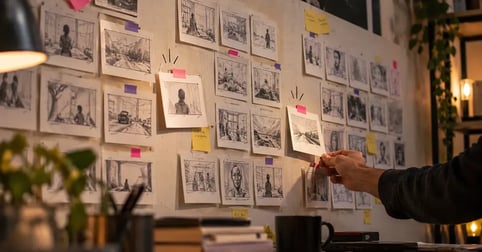
From there the outline hands off to production documents. The beats become panels in a storyboard template, and the panels become rows in a shot list template. Do not skip straight to the shot list. A shot list built without turns will look organised and shoot badly.
Where music sits in a three-act cut
Each act asks something different of a cue. Act one music establishes tone and gets out of the way, because the audience is still gathering information. Act two music carries escalation and has to leave room to grow. Act three music can be the loudest thing in the film because there is no new information left to protect. The turns are where the music has to change, since that is where the story changes.
The mechanism behind this, how a cue shifts what viewers feel about a scene they are already watching, is covered in more depth in our guide to how music shapes what viewers feel. What matters structurally is placement. A cue that starts before the first turn and continues through it tells the audience nothing happened. Cutting the cue at the turn, or replacing it, is one of the cheapest ways to make a structure legible.
How much room you have is a measurable question rather than a taste question. A 2026 study presented at the Audio Engineering Society convention in Copenhagen, run by researchers at Queen Mary University of London, played four film scenes to 40 viewers in a cinema with alternate mixes that changed only loudness, pitch or spatial placement. The EMORSION study found measurable differences in reported emotion and immersion between mixes, with self-reported immersion the most sensitive measure. The authors describe the work as an exploratory proof of concept, so read it as evidence that small audio decisions register, not as a settled effect size.
Most cues sit with the scene. Scoring against it is a deliberate move with a long history: a review published in Frontiers in Psychology in February 2026 by researchers at Oxford and the National Research Council in Rome notes that music added to film is typically congruent, and that a director combining violent action with happy music is using crossmodal counterpoint as a rhetorical device rather than producing an averaged middle emotion. The midpoint is where this pays off most often, because the audience is being told that the thing they understood has changed.
The practical constraint is finding cues that can do three different jobs across one piece without sounding like three different films. Searching by energy rather than by genre helps, which is how the catalogue of royalty free music for videos is organised.
Common three-act structure mistakes
Nearly every three-act failure traces to the same root: the acts were treated as containers to fill rather than as consequences of two decisions. Once the turns are vague, the symptoms follow in a predictable order.
- Act one runs long. Usually caused by building a world instead of a baseline. Cut to the last moment the audience still needs before the inciting incident.
- The inciting incident and the first turn are the same beat. They are not. One arrives from outside, the other is a choice. Collapsing them removes the character's agency from the story's first quarter.
- Act two has obstacles but no cost. Things get harder without anything being lost. This is the drift readers describe as a sagging middle.
- No midpoint. The character is reacting at minute five and still reacting at minute forty. Without a reversal, act two is one long scene.
- The second turn is emotional rather than structural. The character feels defeated but still has options. If walking away is viable, the turn has not happened.
- Act three introduces new information. A resource, an ally or a fact that was not planted earlier. This reads as a cheat even to audiences who cannot say why.
- The ending answers a different question than act one asked. Common in documentary, where the question often changes during the shoot and the opening never gets recut to match.
Three-act versus four-act, five-act, and the Hero's Journey
The competing models mostly disagree about where the breaks fall, not about what happens in a story. Every one of them has a setup, an escalation and a resolution somewhere inside it. What changes is how much subdivision the model gives you in the middle, which is the part most writers need help with.
| Model | Where the breaks fall | What it adds | When to reach for it |
| Three-act | Two turns, at roughly 25% and 75% | The simplest frame that still forces a decision and a point of no return | Default for film, video and most short-form work |
| Four-act | Splits act two at the midpoint | Makes the midpoint a structural break rather than an internal beat | When the middle is the problem and you want the reversal enforced |
| Five-act | Breaks the middle into three | Finer control over escalation, inherited from stage drama | Longer or ensemble work with several threads to interleave |
| Hero's Journey | A longer sequence of named character stages over the same arc | Named character beats rather than structural markers | Myth-shaped stories with a single protagonist and a transformation |
Picking between them is less important than picking one and placing the turns. A four-act outline with vague hinges has the same problem as a three-act outline with vague hinges.
A second act that moves needs music that moves.
A midpoint that changes the story needs music that changes too. Start with 116,000 tracks.
Frequently asked questions
Start at the ending, then place the two turns. Write the final state in one sentence, phrase the story as a yes or no question, then fix the decision that ends act one and the moment in act two when the last easy option disappears. Add the midpoint reversal, build act one backward from the first turn, and check that every act two scene costs the character something.
The most common mistake is an act two with obstacles but no cost, where things get harder without anything being lost. Close behind are a missing midpoint, an act one that builds a world instead of a baseline, an inciting incident collapsed into the first turn, a second turn that is emotional rather than structural, and an act three that introduces information nobody planted earlier.
The difference is how finely the middle is divided. Three-act structure has two turning points and treats the confrontation as one long act. Five-act structure, inherited from stage drama, breaks that middle into three parts for tighter control of escalation. The story events are usually the same, so five acts suit longer or ensemble work with several threads to interleave.
No. Plenty of films use nonlinear time, several protagonists, or an episodic shape that resists act division, and the model describes finished work more often than it dictates it. What most films do share is a point where a character commits and a point where their options run out. Those two moments matter more than the act count.
By convention act one runs about 25% of the runtime, act two about 50%, and act three about 25%. This is a description of what most finished work looks like rather than a measured rule, so use it to spot imbalance rather than to hit a mark. Short-form usually compresses act one hardest, since the first turn has to arrive before the viewer decides whether to stay.