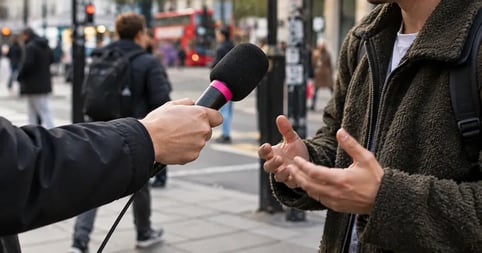
A vox pop is a short run of quick, unscripted interviews with members of the public, recorded in a public place and edited so several people answer the same question. The name comes from the Latin vox populi, "voice of the people." It looks like the easiest format in video until you sit down to cut it.
Broadcasters have used the format for more than 90 years. It's cheap to shoot with a single camera and a decent mic. The hard part starts the moment you ask a stranger if they've got a second, and it doesn't stop until the edit is locked.
This guide covers what vox pop means, where the format started, how it's used in news and online, a step-by-step for filming one, how to edit the answers and the music underneath them, and the copyright problem that street audio quietly creates.
Music that lets the answers do the talking
Find an instrumental bed that sits under voices and carries the pace from one stranger to the next.

What does vox pop mean?
Vox pop is short for the Latin vox populi, meaning "voice of the people." In media, a vox pop is a set of brief, unscripted answers from members of the public, usually strangers approached in a public place and asked the same question. American newsrooms often call it a man-on-the-street interview, or MOS. Same format, different label.
Cambridge Dictionary gives the term two senses: the opinions of people recorded talking informally in public places, and the radio or TV item in which passersby are asked their opinion on a subject. Oxford Learner’s Dictionaries labels vox pop as British English. American newsrooms also use MOS, short for man on the street. The root phrase, vox populi, still means popular opinion in general.
One thing a vox pop isn't: a poll. Ten people outside one coffee shop don't speak for a city. They show how people react, not how many people think a certain thing. Worth remembering when a client wants a vox pop to prove a point.
Where vox pops come from
The vox pop as a broadcast format traces back to a Houston radio station. In 1932, KTRH advertising salesmen Parks Johnson and Jerry Belcher took portable microphones onto the street and asked people for their opinions, on a show first called Sidewalk Interviews. As Vox Pop, it became a national NBC program in 1935, according to the University of Maryland archive that holds its records.
The show itself didn't stay on the sidewalk. Per the same archive, it soon became a quiz show, later built episodes around celebrity and human-interest interviews, and went off the air in 1948. The street-interview idea outlived it.
How vox pops are used
In broadcast news, a vox pop does two jobs. It's a type of interview, a quick reaction from ordinary people rather than officials or experts, and it's a structuring device producers use to change pace inside a newscast or close a segment on a lighter note. Online, creators use the same format as a standalone video, with one question asked to a run of strangers and the answers cut tight.
In broadcast journalism
Britannica describes the vox pop as both a kind of interview and a structuring element. As content, it captures short reactions to anything from a government decision to a lighthearted story. Those sound bites get edited into a packaged piece or into a voice-over the anchor reads over B-roll. As structure, a short vox pop varies the rhythm of a newscast, and a good one can close the segment.
If you put the question or the location on screen, treat that text like any of your lower thirds: same font, same position, every time.
In creator and brand video
Online, the vox pop usually is the video. There's no reporter's package around it. One question gets asked over and over, the weakest answers get cut, and the sharpest one gets saved for last. Brands use the same structure for product reactions and customer feedback, because a stranger's unscripted answer lands differently than a spokesperson's script.
How to film a vox pop
Filming a vox pop takes a small kit and a lot of patience. You need one sharp question, a location where people have a reason to care about it, clean audio, and a consistent frame so the answers cut together. Expect most people to say no. The ones who stop give you a few seconds, so everything is set before you ask.
How to film a vox pop
- Write one open question
Pick a single question anyone walking past can answer in a sentence, with no backstory needed. KQED frames its vox pop curriculum around one central question. Test yours on a friend first. If they ask what you mean, rewrite it.
- Choose a location tied to the topic
Go where people already have a stake in the answer, like outside a grocery store for a story on food prices. Check whether the spot needs a permit or the property owner's permission before you set up.
- Set up audio before anything else
A handheld reporter mic or a lav keeps voices up front on a loud street. A camera-mounted shotgun sits farther from the speaker, so it picks up more of the street. Wear headphones the whole time. Our guide on how to record audio for YouTube covers the basics.
- Lock a consistent frame and alternate eyelines
Keep the lens, camera height and headroom identical for every person. Then alternate who looks camera-left and who looks camera-right, so back-to-back answers play like a conversation. For sit-down framing, see our guide to cinematic interviews.
- Approach people before the camera comes up
Start the conversation first. Say who you are and what the question is, then roll. NBC News anchor Hallie Jackson told NBCU Academy she tries to approach without the camera first. Expect a lot of no, and don't take it personally.
- Get a signed release on the spot
Hand every identifiable person an appearance release before they walk away, especially for brand or paid work. What the law requires depends on where you shoot and how the footage will be used, so confirm the paperwork with your client.
- Record room tone before you leave
Capture thirty seconds to a minute of the location with nobody talking, so you have clean room tone to fill gaps later. While you're listening, note any music playing nearby. It matters at upload.
How to edit a vox pop
Editing a vox pop is mostly selection. You'll shoot far more answers than you use, then order the keepers so each cut either builds on the last answer or pushes against it. Music sits underneath to carry pace between speakers, and it has to stay out of the way of the words. The best vox pops end on the answer people repeat afterward.
Build the sequence
Open on the question, either as on-screen text or the first person hearing it, or cold-open on your strongest reaction and bring the question in second. Then order by contrast. A yes after a no, a one-word answer after a rambler. It's the same push and pull a montage video runs on. Save the best line for the end, and cut anything that's merely fine. Fine is dead weight in a format this short.
Smooth the cuts between strangers
Every cut in a vox pop jumps to a different person, often in different light and a slightly different spot. Let the next voice start under the tail of the previous shot using J cuts and L cuts, and lay your room tone under any gap so the background never drops out. When you trim inside one person's answer, cover the jump with footage of the location.
Put music under the answers
Music is what makes a stack of strangers feel like one piece. Go instrumental, and pick something with space in the midrange, where voices sit; busy leads and vocals fight the words. A steady mid-tempo pulse carries pace without rushing anyone. Cut answers on phrase changes rather than wherever the sentence ends, duck the bed under each answer, and let it breathe in the gaps. Documentary beds are a good place to start, and our roundup of royalty free music for documentaries is a good shortlist.
The music you didn't choose
Street audio picks up music you didn't choose, like a shop's playlist or a passing car stereo. On YouTube, every upload is automatically scanned by Content ID, and a match against a copyright owner's reference files produces a claim. Depending on the owner's settings, that claim can block the video, monetize it, or track its views, and the outcome can differ by country, according to YouTube Help.
So listen for it on location. If a song is playing, move, or wait until it ends. In the edit, cut around the bars where it's audible, and swap scratch ambience for the clean room tone you recorded on site. If you can still hear the song in the final mix, assume it's still there.
For how matching, disputes and strikes actually work, see our breakdown of YouTube's Content ID system.
Replace the song you didn't choose
Swap the shop radio for a track you picked on purpose, and cut every answer to it from frame one.
Frequently asked questions
It's short for vox populi, Latin for "voice of the people." Broadcasters shortened the phrase and applied it to segments where ordinary people give their opinion on a topic, which is why the clip is named after the public rather than the reporter.
A typical example is a local news reporter outside a grocery store asking shoppers what they think of rising food prices, then cutting six or seven short answers together. Online, the same structure shows up as a creator asking strangers one question on a busy street and editing the best replies into a single video.
In journalism, a vox pop is a short interview with members of the public, used to show how ordinary people react to a story. Producers also use vox pops to structure a newscast, varying the pace between longer reports or closing a segment on a lighter note.
A vox pop style video is built entirely from short street interviews: one question put to many people, with the answers edited back to back. There's usually no narrator. The strangers' answers carry the whole video, so the question and the edit do all the work.
Yes. Vox pop is the usual term in British media, while American newsrooms tend to say man on the street or MOS. Both describe brief, unscripted interviews with members of the public in a public place.
Get a signed appearance release from every identifiable person before they walk away, especially if the video is for a brand or will run paid. What the law requires depends on where you shoot and how the footage is used, so check with the client or a lawyer before anything commercial goes live.