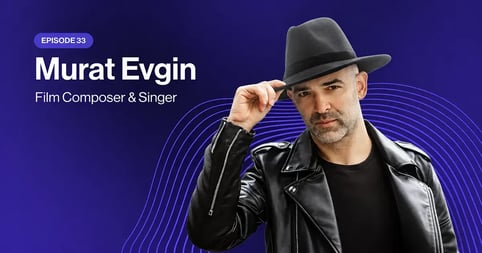
Murat Evgin is an Istanbul composer and songwriter who has scored Turkish television for 25 years, most famously the police drama Arka Sokaklar (Back Streets) on Kanal D, one of the longest-running series on Turkish TV. In 2025 his Turkish-language cover of John Lennon's "Nobody Told Me" closed the second episode of Vince Gilligan's Pluribus on Apple TV, and Rolling Stone put it on its list of the best TV needle drops of the year.
In this episode of Soundstripe Sessions, Jeff Perkins talks to Murat about how a composer in Istanbul landed a placement in an American prestige drama, what it takes to translate a Lennon song without it sounding translated, why Turkish episodes now run longer than most feature films, the delivery formats he has lived through since VHS, and the fight over AI music. Murat is the show's first guest from outside the US, and the episode pairs naturally with the earlier conversation with music supervisor Thomas Golubić, the man who commissioned the cover.
Key takeaways
- Turkish TV episodes have grown from 60 minutes to 140 or 150, often with a 30 to 40 minute recap of the previous week in front of them. Murat writes most of a season's themes before a single scene is shot.
- His route into Pluribus was a paid one-hour consultation with music supervisor Thomas Golubić. At the end of the call he asked what Thomas was working on, and walked away with a list of songs the show wanted covered in other languages.
- He had three weeks. Instead of sending a demo, he sent a finished, professionally mixed and mastered track built on Turkish instruments.
- The cover was a secret for six or seven months. Nobody in Turkey knew it was coming until the episode aired, and then everybody wanted to know who he was.
- His rule for translating lyrics: find the phrase people in your language actually say, not the literal one. The Turkish title, "Bugünleri de mi Görecektik?", is an everyday expression that means roughly "did we really live to see days like these?"
- He writes a theme for every main character, and sometimes for a place, a technique he traces back to Wagner.
- On AI music, he is blunt: the systems are trained on other people's songs without consent, and "this craziness had to stop."
Listen to the episode
Writing a season before it's shot
Jeff opened by welcoming the show's first overseas guest, and Murat promised to clip the introduction for his own Instagram. Then they got into what he was working on, which turned out to be a schedule most composers would find hard to picture.
Jeff: Tell me what you're working on right now.
Murat: Right now I'm composing some new themes for some future TV series. I'm under NDA. Usually in the summer I have a holiday, and then when the new season starts in Turkey, at the end of September let's say, we rush into the studio and try to finish all these themes before our long Turkish episodes, which are now 140, 150 minutes long. And the director and the producer want music in every scene. So this time I decided not to take a holiday, and to finish all the compositions and the orchestrations and the recordings during the summer. So in the fall I'll be relaxed.
Jeff: You're one of the few people working through August, I guess.
Murat: Yeah, I am. And after the placement in Pluribus, I'm also writing more songs in English now for sync placements, and recording them. Once the season starts it's a very busy time. Turkish TV series are a bit different than American ones. Every week a new episode is shot in six days, and in those six days we have to do the music editing and also the composing. Usually, as I said, we compose and record all the themes before the season starts. But sometimes there's still some composing to do, and it's a crazy schedule trying to finish these long episodes.
Why Turkish episodes run 150 minutes
Jeff asked him to confirm the length, because it sounded like a typo. It isn't, and Murat has watched it happen in stages.
Murat: Unfortunately, 20 years ago they were 60 minutes, and in one evening there were two TV series on a regular Turkish channel. But then for some reason the Turkish channels decided to air one series per night, and they decided the episodes should be longer. So the duration went from 60 minutes to 90 minutes, and there were big protests in the industry. The script writers, the composers, the actors, everybody protested in the streets. But sometimes I think it's worse when you protest something, because in a couple of years they made it even longer. They became 120, 130 minutes, which is really hard, and I think it also decreases the quality of the work. Again, you have one week to finish such a long episode.
The export market has its own workaround.
Murat: When Turkish series are sold to other countries, and they are hugely successful in Spain, Italy, Poland, Greece and all the Latin American countries, usually they are cut into three pieces. One episode becomes three episodes, and they air as three separate episodes in other countries.
Jeff: Why do you think they decided to make the shows that long? Is it a storytelling thing, or do they want to sell more ads?
Murat: I think that way they spend less money commissioning TV series. Instead of showing two different series in one night, they commission one series that starts at eight. And this is very interesting: every week there's a summary before the actual episode, a summary of the previous week. Usually this summary is 30 to 40 minutes long. So it's like an actual episode, but you watch a montage of the previous episodes, and then the new episode starts and it lasts till midnight with the commercials. So it's good for the channel, because with only one episode they fill the whole prime time. But it's not good for the industry. With two shorter series, two different crews can earn money. Now one series fills that slot, and fewer people earn money. I'm talking about the crew, the script writers, the actors, the composers. So I don't think it's a good decision for the industry, but the channels probably thought it was better commerce for them.
How a composer in Istanbul landed Pluribus
The Pluribus story is the reason most people will find this episode, and Murat tells it as the payoff of a long, deliberate push rather than a lucky break. His cover plays over the end of "Pirate Lady," the second episode of the series. Thomas Golubić told Rolling Stone it was commissioned specifically for that episode's end credits, and the creative team had decided early that each episode would close on an international cover of a familiar pop song.
Jeff: Talk about how that came your way. How did you get that opportunity?
Murat: That was a huge surprise for me, but I was prepared for this surprise. In 25 years I composed almost 2,500 Turkish TV episodes. Then I composed for factual series like Myths & Monsters on Netflix, and then for The Stuarts, again in the UK. Then the pandemic happened, and it was a hard period for musicians to get a new project as a composer. That's when I came across the term music supervision, music supervisor. Before that I was always trying to be the composer of a show. When I learned about music supervision, I found out you could actually get a sync placement with just one song, and you're in the series.
Murat: Okay, maybe it's not like composing the whole series. But for a composer based in Istanbul, it's very hard to get a composing job from LA. When I learned about music supervisors and sync licensing, first I went to Romania, Turkey's neighbor, for a sync conference, and I met the music supervisors of Europe there. Then, when I did my research, I learned there's a guild of music supervisors in LA, and that Thomas had been its president. I went deeper, came across Thomas's website, and saw there was a one-on-one consultancy session you could buy. I bought it, and we had a one-hour Zoom call. He listened to my songs and my film music. He liked my voice and he liked my composing.
Murat: At the end of the session I said, what are you working on right now? As I remember, he didn't say Pluribus. He said, we're working on a series and we need covers in foreign languages. And he gave me a list of songs. As I remember, there was Cat Stevens' "Wild World," which is one of the first songs I learned while I was learning guitar, and John Lennon's "Nobody Told Me," and maybe an Earth, Wind & Fire song.
The choice should have been easy, and it wasn't, because the Lennon song was the one he didn't know.
Murat: I'm a huge Beatles fan. The Beatles were the only band I had posters of on my wall when I was a teenager. I was crazy about them. But strangely enough, I couldn't remember "Nobody Told Me." I know John Lennon's solo albums, "Imagine," "Just Like Starting Over," "Woman," "Jealous Guy." I memorized these songs as a teenager. But I couldn't remember this one, because it was released after his death. Anyway, I said to Thomas, I'm a huge Beatles fan, let me do a demo of this song. And the deadline was three weeks later.
The brief was specific: sing it in Turkish, keep one line from the chorus in English. What he sent back was not a demo.
Murat: I produced that song with Turkish instrumentation. I have a banjo-like instrument in my house that sounds like a cümbüş, a fretless Turkish instrument. So I added a lot of Turkish percussion, and kanun, which is an instrument you put on your lap and play. It's like a santur. And then I had it mixed and mastered professionally. So I didn't send Thomas a demo. I sent it by email, and I got a reply. He said, "This is great." And I thought, you know my American friends, they're always like, wow, great, man, you're the man. I thought maybe he's just giving the usual American compliments. But then some time passed, and he said, "Vince Gilligan and his team listened to it, and we love it, and we want to use it in the series." I was like, wow, something big is happening.
Murat: So I said, which series is this? Which channel? When is the broadcast? He said, I can't tell you anything. Then I signed an NDA, and even in the agreement there was no Pluribus. It had a different working title. And he said you can't tell anybody. For six or seven months I kept it as a secret. We were waiting for the 7th of November, and my birthday is the 5th of November, so it was a great birthday present for me.
The secrecy had a cost at home, and then it paid off.
Murat: Strangely enough, I couldn't promote it in Turkey. We're used to promoting these things in advance, before the show airs. But he said Vince wants it to be a complete surprise to the audience. So the night it aired in the US, everybody in Turkey on social media started talking about it. Who is this guy? Even though they know my voice from Turkish TV series and my songs, they were saying, a Vince Gilligan show has a Turkish song, what is this song and who is this guy? People Shazamed it and found it on Spotify and YouTube Music, because it was released by Milan Records. Then it became huge news in Turkey. Maybe the first Turkish song in a Hollywood TV series. I don't know if there was a Turkish song in a Hollywood movie or series in the 50s or 60s, but in my lifetime I haven't seen anything like it. I did a lot of television interviews and newspaper interviews. It was a huge step in my career.
Jeff: I love that story, because it all comes down to you hustling. You went and did a consultation with Thomas, and Thomas was on the podcast a couple of weeks ago. Amazing music supervisor. I talk to a lot of musicians on this show, and a lot of them talk about this. You have to be everywhere, you have to meet people, you can't just stay in the studio. Part of your job as a musician, if you want to get your music out there, is to hustle and network.
Murat: Exactly. I think luck is waiting for us at the end of the road, but we must walk there. You must walk to the end of the road. You must do the preparation and the hustle, and then when we're ready, luck is there. But if you don't do the preparation, how can God or luck help you?
The placement changed his numbers and his audience. He says his Spotify listeners roughly doubled, and that a younger generation learned his name for the first time.
Murat: Even though I composed for the longest-running Turkish show, one of the biggest shows, and some other TV shows, the new generation learned my name after Pluribus. It really had an effect on my career. But I don't want to stay a one-sync wonder. I'm looking forward to more sync placements in my career. So let's see what happens.
Translating John Lennon into Turkish
Jeff's next question is the one any songwriter covering a song in another language runs into: the words don't land in the same places.
Jeff: What are the challenges of taking an English-language song and converting it into your language? I imagine not everything's going to rhyme the same way. What's the process to translate it and make sure it still sounds like the original song?
Murat: I think the reason I chose a John Lennon song is because I know him very well. I read so many books about him when I was a teenager. I listened to the Beatles nonstop. If it was, I don't know, a Bob Dylan song or somebody else, maybe it would be harder for me to translate, because I don't know them as well. But I know the life story of John Lennon very well, and I did some research on how he wrote this song, what the lyrics meant for him, where he got the idea.
Murat: Then I tried to find Turkish phrases that wouldn't sound translated, so the translation feels natural. In every language we have idioms, phrases that we use in our everyday lives that are so natural. And Thomas also said, when we heard the song, what we liked about it is that you sing in a theatrical way, like an actor, and to us it sounded like a Turkish pop song. You took the song and made it your own, so it sounded like something Turkish. It didn't sound like a copy of John Lennon. Even though I tried to stay true to Lennon's arrangement, to the way they produced it. I didn't change it dramatically.
The breakthrough was that Turkish already had the title.
Murat: For me as a composer, lyrics are always the hardest part. When I'm composing, the melody is the most important thing and the easiest to finish. I have to spend time on the lyrics. But it was a very nice challenge to translate John Lennon into Turkish, and for the title line we have exactly the equivalent sentence in Turkish. Literally translated it means, were we supposed to see days like this? Something like that. So it really matched.
That everyday phrase became the cover's Turkish title, "Bugünleri de mi Görecektik?" The process is worth stealing for anyone attempting a cover song in another language: know the original songwriter well enough to know what the song meant to them, then look for the expression your own language already uses for that feeling, rather than translating word by word.
Growing up in a musician family
Jeff then went back to the beginning. Murat's father is the Turkish pop singer Erol Evgin, which put a lot of the country's best musicians in his childhood living room.
Murat: I grew up in Istanbul. I was raised in a musician family. My father is also a singer, and that's why I had the privilege of meeting so many important composers and singers of Turkey in my childhood, and musical actors. I think that really shaped and inspired my career. At the age of 12, I decided that I wanted to be a singer. At 15 I was taking classical guitar lessons and composing my little melodies. And when I was 19, I recorded my first album.
From tape to download: 25 years of delivery formats
That first album was cut to tape, and the story of how his scores got from his studio to the network is a short history of the industry.
Murat: Back then we were recording on these huge tapes, and we spent months in the studio to finish an album. In those years they said hard disk recording was coming, that in a couple of years we'd record in the computer. And I was thinking, yeah, but where in the computer? You need a medium, you need a tape. So my first album was recorded on a huge tape. I saw all the change in technology, and in the music business also.
Murat: Twenty years ago, the film company used to send me a VHS tape of the episode I needed to compose for. I'd put it in a VHS player, convert it into an MPEG video file, and import it into my DAW, which is Cubase, and start composing. After I finished, I'd export it, burn a CD and send the CD back to the film company. Then we moved on to DVDs. Then after some years they started sending me the episode online. I'd download it, import it to my DAW, and send back my export by file transfer. And I remember the first episodes, 20 seasons ago, our televisions were square, and then it changed to HD, 16:9 widescreen.
Murat: Before our generation, it would maybe take a lifetime to see these changes. Now everything is so fast. When I released my first album in 1999, it was the time of the CDs, and everybody in the industry was earning very good money from CDs. The record label, the songwriter, the factory that produced the CDs. Then Napster came and things changed. Even in the download era people were still making good money, but now it's streaming. It's ever changing and you have to adapt.
Jeff recognized every step of it. His first job in advertising, in the mid to late 90s, was mostly making copies of tapes and overnighting them to clients, waiting for the call with feedback, recutting on tape and mailing it again.
Plan B: how film school saved his career
Jeff: Was there ever a thought in your mind like, this isn't for me, I want to do something different? Or did you know from a very early age that music was the career path?
Murat: I had no idea I would do instrumental music or write songs for TV series. At 18, 19, all I wanted was to be a rock star. But being a rock star is not easy. First of all, you have to have a major label agreement, and I was an indie. I was making songs and it was so hard to get radio play, so hard to get your music videos on the big channels.
The degree was his family's idea.
Murat: I studied cinema at university. The reason was that at that time there were no royalties in Turkey. The PROs were very new, taking baby steps, and even though we're a musician family, my family didn't want me to only study music. They wanted me to study something else, so I'd know another occupation. I chose cinema, and I didn't really enjoy the cinema education. But a few years later, that education saved my life when I went into composing for TV series and film. Understanding the director, understanding the scene, what works for the scene, what the scene is trying to tell us. I combined my two educations, cinema and music, and I became one of the youngest composers of my generation when I started composing for huge Turkish TV series in my mid-20s.
Murat: Nobody from my generation was interested in composing for series. Everybody wanted to be on stage, the rock and roll, playing to big audiences. I was the guy alone in the studio composing for TV series. But when Turkish series started becoming popular, first in the Middle East, then Eastern Europe, then Latin America, this job became like a star job in Turkey.
Jeff: Was there one moment where you felt like, I've got to have a plan B?
Murat: There wasn't a specific moment, but at every step you feel how difficult it is. You make an album and it doesn't get radio play. Then you make another one. And while making these albums you spend a lot of money. In the 90s, hiring a studio, trying to shoot a music video, I spent an incredible amount of money. When I started composing for a game show or a TV series, suddenly they were paying me to compose music. And I like that more. When I get paid for composing, I love it.
The trade-off was his singing career, at least most of the time.
Murat: Because of the long episodes and the tight schedule, I moved into composing for TV and I kind of forgot my singing career. You can't do both at the same time. But sometimes they ask you to write a song and sing it for the series. Those are always the moments I've been waiting for, because it's not just instrumental music. You show your voice in that series. And I always release my soundtracks. I always put it in my agreement that the soundtrack is mine and only I can release it. Sometimes I wish I could be more active on the singing side, but really, the TV series saved my life.
Songs that traveled further than he did
Those TV songs did something his albums never could: they reached audiences he had never played to.
Murat: I started having sync placements, writing songs for TV series, and the songs that couldn't get radio play became well known through the series. It opened many doors for me. Later, when I composed for telenovelas that became popular in Latin America, I started learning Spanish, because the Spanish-speaking audience was asking about the meanings of my Turkish lyrics. First we translated them, and then I said, why not do a Spanish version? So I made six or seven Spanish versions of my songs.
Murat: The kids in Latin America, hearing the Turkish version every day in the episodes, had already memorized the songs in Turkish, and they started learning Turkish. Their mothers were sending us these videos. I still have one of them on my Instagram page. If I didn't go into composing for TV, I wouldn't have achieved this on my own. Just by being a singer, nobody would have heard me in Latin America. This is the power of Turkish TV series, or TV series in general.
Gatekeepers then and now
Jeff asked whether the tools artists have now, the ability to build a fan base on social platforms without a label, have changed the odds. Murat's answer cut both ways.
Murat: I can talk for Turkey. I'm not an expert in the American market. But I think the level of culture, the level of education, what we call gusto, the music taste of the public, has really decreased in the last 20, 25 years, also in the world. When I was a teenager there were amazing bands, amazing singers. Now it's a different era. There are influencers or models who sing. Even the boy bands in the 90s were amazing. When you heard them sing, they could actually sing as a band.
Murat: But the advantage I see is this. Back in the 90s, when the radios didn't play your song or the music channels didn't play your video, that album was finished. There was no YouTube, no Instagram, no platform where you could take the song and show it somewhere else. They were the gatekeepers. Now there's social media and YouTube and Vimeo. You can make your fan base, you can have your own channel. You don't have to do something with television. You can even produce your own vertical TV series and reach millions of people. That's an improvement I like.
Murat: But now everyone is doing music. Everyone with an iPhone and GarageBand can finish a song. In my teenage years you had to have the money to rent a studio. It was a bit of a privilege to go into a studio and make an album. So every era has its advantages and disadvantages. But I can say there's more democracy in the music business now. Everybody can finish their song and put it out to the world and make their voice heard.
A theme for every character
The craft section of the conversation is where his film school training shows. Because most of a Turkish season's music is written before shooting starts, Murat is scoring from scripts and conversations rather than footage.
Jeff: Take us inside how you start as you're thinking through the music for the different shows you work on.
Murat: As I said, usually we have to compose and finish, let's say, 90% of the themes, the instrumental themes or songs, before production. Sometimes even before the series is shot. Of course there are some themes we write after seeing the episodes. So I must read the treatment, the synopsis, the script very well, and I ask a lot of questions. I have meetings with the producer and the director.
Murat: Personally, I like composing instrumental themes for every main character of the series. Or it could be an important place. In this police show there's a police station, the central station where they have their meetings, so every time we see that meeting, we have a specific tune that plays. So I like to get as much information about the characters as I can. Maybe I bore the directors and producers with my tons of questions, but that's the only way I can get information, because at that stage there's nothing to watch. Not even one single scene.
Jeff: Do they always work, or do you sometimes have to go back afterward and redo it once you've seen the actual show?
Murat: Because I studied cinema, it works most of the time. And this composing for different characters comes from Wagner, the famous opera composer. He used to compose specific themes for specific characters and places. So if you do your preparation well, usually it's spot on.
That is the leitmotif, and on a show that runs as long as Arka Sokaklar, one per character runs out.
Murat: In a show like Arka Sokaklar, Back Streets, where it's 20 seasons and 751 episodes, one theme per main character isn't enough. So in the fifth season, the sixth season, they say, okay, but compose something new for this character now. Or sometimes two characters fall in love with each other, so you write a new song or a new instrumental piece. It's a nice part of the job. I really enjoy it.
The turnaround still surprises him.
Murat: Before TV series, when I wrote a song, I used to wait months for it to appear on television or radio. But sometimes music I compose today is on television tomorrow. That was very surprising for me when I first got into composing for TV.
Jeff: Do you like that pace, or would you prefer more time?
Murat: I like it and I don't like it. I like it because it's really fast. You compose and the next day it's on television. But sometimes I wish I had a little more time, because you're in a rush and there can be small mistakes. Imperfections, let's call them. These are the imperfections that make your song more human, which AI-made music doesn't have right now. But sometimes I wish I had just a couple of days to finish a song.
He doesn't mix his own work, for the same reason mix engineer J.R. McNeely would give: it's a separate craft.
Murat: No, I'm a terrible sound engineer. I leave it to professional sound engineers, because it's their life. They spend their whole lifetime trying to learn this craft, and they have the right plugins and hardware for it. Also, after all the hours I spend composing and recording, I want a little rest while somebody else is mixing and mastering, and I'll be like a supervisor and give my feedback.
The fight over AI music
Murat brought up AI himself, in the context of those human imperfections, and Jeff asked for his full take. He opened with the court case that had just come down in Germany. On 31 July 2026, the Munich Regional Court ruled that the AI music generator Suno infringed copyright by training on and reproducing songs from the repertoire of GEMA, Germany's music collecting society. The case focused on six songs, including Boney M.'s "Daddy Cool." It is a first-instance ruling, and an appeal is pending.
Murat: Recently the German PRO won in court, and I think this will be the start of a huge movement. Now the publishers are suing companies that make songs, because without our consent they are using our music, our compositions, our voices, to form an unoriginal, copyright-problematic new song. This has to stop. Unfortunately there are some very popular songs made with AI in Turkey. I can't say people here are educated enough yet to understand the disadvantages of AI-made music.
Murat: Recently I watched an interview with a musician from my country. She was saying something like, now we don't have to make an appointment with a live musician for a session, I can just do it with my AI. This is so wrong. That musician earns money only when he or she plays on a song. That's their occupation. And there's huge interest from the public in AI-made songs. Whereas when I come to LA, I see even very young people, teenagers, protesting AI-made music. They don't listen to it. And all the music supervisors are saying, don't use AI in your songs. Don't send us songs that have uncleared samples, or if there's AI in the song, don't send it.
He gets pushback in Turkey, and he has an answer for it.
Murat: I try to talk about this in every interview, every time I'm on television, and sometimes I get comments like, yeah, but you're a composer, you also take melodies from other songs, you get inspiration from other songs. Yeah, but it's not the same. I don't steal anybody's melody, and if I steal somebody's melody, that person can sue me. There's a price to pay. But with Suno, it uses all the songs in the world. It's crazy. This craziness had to stop. We've been using AI in our workstations, in mixing, in the plugins we use. But this use, taking melodies or song ideas from other songs and presenting it like a new song, is not legal.
Jeff: They trained on data that was someone else's intellectual property, someone else's copyright, and then they create songs based on what they trained on, and there's no compensation for the owner of that intellectual property. I look at it as just flat-out theft. And the case in Germany is really interesting, because of how they showed it.
Murat: You shared it on LinkedIn. I just watched it today.
Jeff has a direct stake in the question, and he said where Soundstripe stands. (Aaron Sprinkle, one of the composers behind the catalog, made a related argument about why AI-generated music has a ceiling in his own episode.)
Jeff: We use AI a lot in our company for different things, and we use it in our product to make it easier to find the music. But we're proudly 100% human music. We employ a lot of artists who make music for our catalog. And what we're hearing from a lot of our customers is that they appreciate that. They don't want AI slop. They want real music made by real musicians. I don't know what the world is going to look like when the dust settles, but I'm happy that people are waking up. I think you have to disclose it. If it's AI music, you should be transparent that it was built with AI. And I think the artists whose music it was trained on should all get compensated.
Advice to his younger self
Jeff: This is the last question, and I ask it to all of our guests. What's one piece of advice or wisdom you would give to your younger self?
Murat: I would say this is a long road. A long and winding road. It's a marathon, definitely. It's not a sprint, and you must be very patient. Never give up, never stop trying, and look for new opportunities. Maybe it's not on your mind, but you have to try new things. As I said, composing for TV and film was never on my mind, but it opened so many doors for me.
If you want to hire him, he says he is most active on LinkedIn and Instagram, and his music, including the Pluribus cover, is on Spotify. The Rolling Stone list of 2025's best TV needle drops explains why the cover lands where it does in the show. For more on how a song gets chosen for a moment like that, see what a needle drop is in film.
Frequently asked questions
Who is Murat Evgin?
Murat Evgin is a composer and songwriter from Istanbul who has scored Turkish television for 25 years, most notably the police drama Arka Sokaklar (Back Streets) on Kanal D. He also composed for the Netflix factual series Myths & Monsters and the docuseries The Stuarts. He is the son of Turkish pop singer Erol Evgin, and his Turkish-language cover of John Lennon's "Nobody Told Me" closes the second episode of Pluribus.
What is the Turkish song in Pluribus?
It is Murat Evgin's Turkish-language cover of John Lennon's "Nobody Told Me," titled "Bugünleri de mi Görecektik?" It plays over the end of "Pirate Lady," the second episode of Vince Gilligan's Pluribus on Apple TV. Music supervisor Thomas Golubić commissioned it for that episode's end credits, and Milan Records released it when the series premiered on November 7, 2025.
How did Murat Evgin get his song into Pluribus?
He booked a paid one-hour consultation with music supervisor Thomas Golubić. At the end of the call he asked what Golubić was working on and was given a list of songs the show wanted covered in other languages. He chose "Nobody Told Me," had three weeks, and sent back a fully produced, professionally mixed and mastered track using Turkish instruments rather than a rough demo. Vince Gilligan's team approved it.
Why are Turkish TV episodes so long?
According to Murat Evgin, Turkish channels moved from airing two 60-minute series a night to one series per night, and episodes stretched to 90, then 120 and now 140 or 150 minutes, often preceded by a 30 to 40 minute recap. He says it lets a channel fill prime time with one commission, but means fewer crews get work. Abroad, a single episode is usually cut into three.
How do you translate a song into another language for a cover?
Murat Evgin's approach is to research the original songwriter and what the lyrics meant to them, then look for idioms people actually use in the target language rather than translating word by word. For "Nobody Told Me," Turkish already had an everyday expression with the same meaning as the title line. He kept the arrangement close to the original and let the instrumentation and his performance make it sound Turkish.
What did the German court decide about Suno?
On 31 July 2026, the Munich Regional Court ruled in favor of GEMA, Germany's music collecting society, finding that Suno infringed copyright by training on and reproducing six songs from GEMA's repertoire, including "Daddy Cool." The court granted an injunction, disclosure and damages. The ruling is first-instance and an appeal is pending.