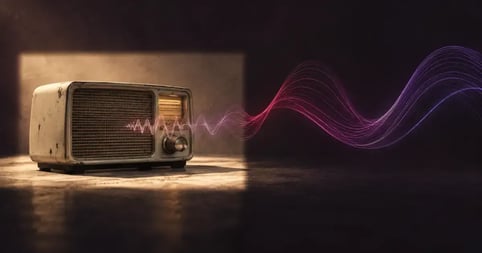
A leitmotif is a short piece of music tied to one specific character, place, object, emotion, or idea, written so that hearing it again brings that thing back to mind. It came out of 19th-century opera, and it's now standard practice in film, television, video games, and musical theatre. Think of the two notes that mean the shark is coming.
One cue you can bend a dozen ways.
Every track comes with stems, alts, and cut-downs, so the same motif can read as loss in one scene and triumph in the next.
What is a leitmotif?
A leitmotif is a recurring musical idea attached to one thing in a story. Hear it, and you know what the story is pointing at.
It doesn't have to be a melody. A chord progression works, or a rhythm on its own. It doesn't have to be long either. Two notes will do if they're distinctive and you plant them properly.
What makes it work is association, not repetition. First time through, the cue is just music. By the third time, it's a name. Same mechanism as everything in the psychology of music: the brain files sound next to meaning and keeps the pairing.
Leitmotif vs motif vs theme
These three get used interchangeably and they shouldn't be.
| Term | What it is | Tied to something specific? |
|---|---|---|
| Motif | Any short musical fragment that recurs in a piece | No, it can be pure structure |
| Leitmotif | A motif attached to one named character, place, object, emotion, or idea | Yes, always |
| Theme | A longer, fuller statement that carries mood across a sequence or a whole picture | No, it sets the world rather than pointing at one thing in it |
What is the difference between a leitmotif and a motif?
Every leitmotif is a motif. Not every motif is a leitmotif.
A motif is any short fragment that recurs: a riff, a drum pattern, a three-note figure in the strings. A leitmotif is a motif with an assignment, bound to one thing in the story. The test is simple. If you can say what the fragment means, it's a leitmotif. If it just recurs, it's a motif.
Where a theme fits
Themes can contain leitmotifs. A main title can hand you several character motifs before the story starts. A theme sets the world. A leitmotif points at something in it.
Where the leitmotif came from
Richard Wagner is the name attached to this, and fairly. He built entire operas around recurring motifs, across a four-opera cycle rather than a single evening.
Der Ring des Nibelungen occupied him from 1848 to 1874, a 26-year span, and it runs roughly 15 hours. The Bayreuth Festspielhaus was built for it, and the first complete Wagner's Ring cycle ran there from 13 to 17 August 1876, with nearly 100 players in the pit.
He didn't invent recurring musical themes, though. Recurring themes before Wagner were already in the room, with Mozart and Carl Maria von Weber both using allusive themes in their operas. What Wagner added was scale and system. His own The Flying Dutchman is widely considered his first major exploration of the technique.
The word did not come from Wagner
Wagner never authorised the term. It came from writers analysing his music dramas. Scholarship on Wagner's use of leitmotifs is direct about it: he neither initiated nor supported the concept as it was later packaged and sold.
What made the word stick was Hans von Wolzogen's 1876 guide to the Ring, which catalogued the motifs and handed them names.
The English word comes from the German word Leitmotiv, built from leiten (to lead) and Motiv (motive), so something close to "leading motive." First known use in English is circa 1880.
You'll find confident claims elsewhere naming the critic who coined it and the year. They contradict each other, and none survives being chased to a primary source. Wagner developed the technique. Other people named it.
The five kinds of leitmotif
Leitmotifs fall into one of five buckets.
Character
The most common by a wide margin. One person, one cue. The Imperial March starts and Darth Vader is in the building, on screen or not.
Place
A location gets its own sound, so the score establishes geography before the picture does. Wagner's Valhalla motif does this for the hall of the gods.
Object
The thing carries the music. In the Ring, the cursed ring has its own motif, attached to the object rather than to whoever is holding it.
Emotion
No character, no object, just a feeling. Tristan und Isolde has a Desire motif for unfulfilled longing, with the dissonant Tristan chord inside it. Composers have borrowed that chord ever since, decent evidence that the Desire leitmotif in Tristan und Isolde works on length that short.
Idea
The abstract material. Fate, renunciation, redemption through love. Scholarship on the Ring names those among its core motifs, alongside woe, Rheingold, the Ring itself, and Valhalla.
How a leitmotif changes when it comes back
Straight repetition gets stale. The technique earns its keep when the cue comes back altered.
Slow it down and thin the instrumentation, and the same motif reads as loss. Shift it minor to major and the character got their win. Move it from a solo horn to full brass and the stakes went up. Layer two motifs and you've said something about a relationship without spending a line of dialogue on it.
One rule governs all of it: the cue has to stay recognisable through the change. If the audience can't tell it's the same idea, you've written a second one.
Trailer editors run this constantly, with one cue re-pitched across the three acts of a two-minute cut. Our roundup of music for movie trailers shows how those get built.
Famous leitmotifs and what each one shows
Der Ring des Nibelungen (Richard Wagner)
The source text, and the reference case because the motifs interact rather than just recur. They combine, invert, and comment on each other across roughly 15 hours, so a motif introduced on the first evening can pay off on the fourth.
Jaws (John Williams)
Two notes, and that's the whole leitmotif. It shows the technique's most useful property: the shark is present the moment you hear the cue, whether or not it's in frame. That's a leitmotif doing work the camera can't afford to do.
Star Wars (John Williams)
When a dictionary needs one modern example of a leitmotif, it reaches for the Imperial March. The reason it works is discipline. It plays when Vader's presence matters and stays out of the way when it doesn't. More on the mechanics in our breakdown of John Williams' most famous scores.
Hamilton (Lin-Manuel Miranda)
Musical theatre uses leitmotifs harder than film, because songs can quote each other directly. Stephen Sondheim built characters this way in Sweeney Todd, and leitmotifs in musical theatre are what Hamilton runs on end to end. Melodies planted early come back later with the meaning turned over.
The Legend of Zelda (Koji Kondo)
Games may be the natural home for this, because a player hears the same cue far more often than a filmgoer does. The Legend of Zelda, Resident Evil, and Pokémon Mystery Dungeon all use recurring themes to mark characters and locations.
How to run a leitmotif without scoring it yourself
Most writing on leitmotifs assumes you've got a composer. Plenty of people reading this have a licensed catalog and a deadline instead, and the technique still works.
Pick one recurring subject: a host, a segment, a client, a place you shoot at often. Then pick one short cue for it and commit. The same cue, every time that thing appears, from the first episode on, is what builds the association. Two tracks that merely sound similar will not do it.
Once the cue is planted, use versions of that same track rather than a new one. Stems, cut-downs, and alternate mixes get you the loss version and the triumph version out of one piece of music. This is where it can go wrong. If you build a series identity on a track and can't reuse it cleanly later, you're stuck, so confirm your license covers the whole run and read up on how music rights and royalties work first.
For picking the cue itself, our guide on how to choose the best music for films covers selection in more depth.
Finding a cue distinctive enough to carry a name is the hard part. Soundstripe has 116,000 tracks by real artists plus roughly 100K sound effects, and Supe, Soundstripe's AI search assistant, is built for this kind of search: describe the character or the feeling, react to what comes back, narrow until it clicks. Over 1M+ creators use the catalog, and it's the same music behind work for Nike, Microsoft, PepsiCo, and Bridgerton.
A leitmotif only works if you can use it again.
116,000 tracks by real artists, pre-cleared, so episode forty can reuse what episode one planted.
Frequently asked questions
Every leitmotif is a motif, but not every motif is a leitmotif. A motif is any short musical fragment that recurs in a piece, and it can exist purely as structure. A leitmotif is a motif tied to one specific character, place, object, emotion, or idea, so that hearing it again points the audience at that thing.
The Imperial March for Darth Vader in Star Wars and the two-note shark figure in Jaws are the most widely recognised. In opera, the motifs of Der Ring des Nibelungen are the source material, and the Desire motif from Tristan und Isolde is the most borrowed. Hamilton and Sweeney Todd do the same in musical theatre.
A leitmotif carries story information the dialogue and the picture are not carrying. It reinforces the dramatic action, gives psychological insight into a character, and holds a long work together by recalling ideas the audience has already met.
Nobody invented it in one go. Richard Wagner developed and popularised the technique, but recurring musical themes predate him, with Mozart and Carl Maria von Weber both using allusive themes in their operas. Wagner never authorised the word either. It came from writers analysing his music dramas, and Hans von Wolzogen's 1876 guide to the Ring is what made the term stick.