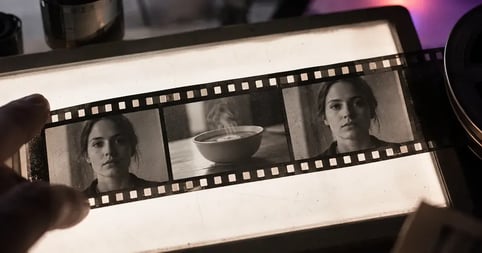
The Kuleshov effect is what happens when an audience reads an emotion into a face that never changed. Show a neutral close-up, cut to something else, then cut back to the same neutral close-up, and viewers will tell you the actor was hungry, or grieving, or in love. The feeling comes from the order of the shots, not from the performance.
It is the oldest idea in editing and still the one that does the most work. Every reaction shot in every dialogue scene is running this structure, and so is every moment a character looks off screen. Understanding it moves the emotional decision out of the performance and into the timeline.
This guide covers what the effect is, what really happened in the experiment behind it, what the research found when scientists tested it properly, who deserves the credit, how to build the sequence, and the one variable every study removed.
Now the sequence needs a sound.
The build steps end at a silent cut. Find the cue that tells the audience how to read it.

What is the Kuleshov effect?
The Kuleshov effect is a film editing phenomenon in which viewers derive meaning from the relationship between two shots rather than from either shot on its own. Placing a neutral face next to an emotional image makes the audience attribute that emotion to the face. The performance is unchanged. The interpretation is not. The standard reference definition frames it as viewers inferring a connection between adjacent images.
That inference is not optional. Audiences do it automatically, whether or not you intended it, which means the cut is never neutral. For the wider toolkit this sits inside, see the basics of film editing.
How the Kuleshov effect works, shot by shot
The sequence researchers test has three shots, not two: a neutral face, an emotional scene, then the identical neutral face again. Film scholars describe the two halves in point-of-view terms. The first is the glance shot, the character looking. The second is the object shot, whatever they are supposedly looking at. The return to the face is where the new meaning lands.
Most explanations get this wrong and call it a two-shot juxtaposition. The three-shot structure matters, because the effect is not really about pairing images. It is about a viewer forming a guess, getting it confirmed, then re-reading the face.
The glance shot
A close-up of a face, held long enough to register, looking at something outside the frame. The face has to be genuinely unreadable. Any real expression and the audience takes its cue from the actor instead of from you.
The object shot
Whatever the character is looking at. This shot carries the emotion, and it does not have to be filmed anywhere near the first one. The audience connects the two spaces because the geometry of the look tells them to.
Why the face comes back
The third shot is the payoff. The viewer now has a reason to feel something, and the only place to put it is the face in front of them. Cut away instead and you have delivered information. Return, and you have delivered a performance the actor never gave.
The experiment, and what we know about it
Lev Kuleshov, teaching in Moscow in the 1910s and 1920s, cut a neutral close-up of the actor Ivan Mozzhukhin (also known by the French screen name Ivan Mosjoukine) against a series of other shots. Audiences praised the acting and described emotions that were not there.
Here is the part most retellings leave out. The original footage is lost, with no photographic record either. The experiment had no controls and no statistical analysis. The surviving accounts, Kuleshov's own included, do not agree on when it was done or exactly what the other shots were. A bowl of soup and a child in a coffin appear in every version. Past that they diverge, and anyone quoting you the precise lineup is guessing.
None of that makes the idea worthless. It made Kuleshov the origin point of Soviet montage theory, and it framed a question worth a century of testing. It just means the famous anecdote is an anecdote.
Does the Kuleshov effect really exist?
It does, and the evidence took a long time to arrive. The effect survived on reputation for decades before anyone tested it properly, and the early attempts were not kind to it.
In 1992, Prince and Hensley recreated the sequence and asked participants whether the face conveyed emotion. Most said it did not. The effect failed to replicate, which is where it sat for years.
In 2006, a team at University College London paired identical faces with emotional and with neutral contextual movies. Participants shifted their attributions of both facial expression and mental state, and imaging showed raised responses in the amygdala and temporal pole.
In 2018, Ildirar and Ewing split participants into first-time and experienced viewers. The experienced viewers built the connection between the shots. The first-time viewers did not, which suggests a learned literacy rather than a reflex.
The strongest evidence is recent. In 2024, researchers at Beijing Normal University tested the effect with purpose-shot film rather than the still photographs earlier studies used. Fifty-nine participants rated the neutral faces from -1 to +1. After fearful scenes the same faces scored -0.45, after happy scenes +0.27, after neutral scenes +0.07. A separate group of 31 did it inside an MRI scanner and produced the same pattern.
One result in that study deserves more attention than it gets. The emotional intensity ratings did not move at all. Viewers read a different emotion on the face, but they did not think the actor was performing any harder. The edit changes what the audience believes a face means, not how good they think the acting is.
Who gets the credit?
Kuleshov's name is on it, but the attribution has been contested from the beginning. His collaborator Vsevolod Pudovkin described the audience reaction in print and later claimed to have co-created the experiment.
A sharper challenge comes from Dr Karen Pearlman of Macquarie University, who argues it should be called the editor's effect. Her point is not that Kuleshov took someone else's discovery. It is that naming a collective craft practice after the one man who observed it writes out the editors who were already doing it, the Soviet filmmaker Esfir Shub among them. She published the argument as a video essay that recreates the sequence using Shub's own face. It is worth sitting with if you spend time in film theory, because it is really an argument about how authorship gets assigned.
How to Build a Kuleshov Sequence
- Shoot or find a genuinely neutral close-up
Frame tight and direct your actor to relax the face completely and look at a fixed mark beside the lens. Blinking is fine. Anything readable is not. Shoot more takes than you think you need, because neutral is harder to perform than sad.
- Choose the object shot for the emotion you want read
Pick the image that carries the feeling, and keep the camera roughly on the same side of the axis as the glance so the look lines up. The 2024 study cut its scene shots to four seconds, matching the average shot length of mainstream features.
- Cut back to the same face
Use the identical take, not a second one. The whole point is that nothing about the performance changed. With a different take the audience may be responding to a real micro-expression instead of your edit, and you will never know which.
- Watch it with a viewer who has not seen the object shot
Ask them what the character is feeling before you explain anything. You cannot judge this on your own footage, because you know what the face is looking at and cannot unknow it. If their answer matches your intent, it works.
This is the same structure behind the reaction shot. If you have ever cut one, you have already built a Kuleshov sequence without calling it that.
Where you have already seen it
The Kuleshov effect is not a special-occasion technique for a big moment. It is the default condition of edited footage, running constantly, whether or not anyone is thinking about it. Three places it shows up most visibly:
- Reaction shots in dialogue. A listener's face means whatever the line before it means. The same held close-up plays as sympathy or as contempt depending entirely on what preceded it.
- Point-of-view sequences. A look, a cut to what is seen, a cut back. Whole sequences get built from nothing but looks and objects.
- Location cheating. A character looks off screen in one city and the next shot puts them somewhere they never went. The look does the lying. Closely related to parallel editing and cross-cutting, where the same trust in shot adjacency holds two places at once.
It also explains why match cuts hit as hard as they do. When the audience is already building a bridge between shots, a visual rhyme to cross makes the connection feel inevitable.
The part the experiments took out
Every study above stripped the audio. Deliberately, and for good reason: to prove the edit alone moves the needle, you have to remove everything else. The 2024 researchers converted their footage to grayscale and cut the sound for exactly that purpose.
Which leaves a gap they name themselves. In their limitations section the authors point out that sound plays a critical role in real film, and raise an auditory version of the effect as an open question. The entire body of evidence describes the picture half of a phenomenon that, outside a lab, almost never runs silent.
Separate work suggests the audio half is doing real labor. Research on crossmodal emotion found that music shifts how a neutral face reads, with the largest shift on neutral faces specifically. The same ambiguity the edit exploits is the one a cue resolves.
For anyone cutting, that is the operative point. The edit sets up the question and the cue answers it. You can build a perfect glance and object shot and still watch the read go somewhere you did not intend, because the music underneath voted differently. For the mechanics, the psychology of music goes deeper, and there is a practical method for how to choose the best music for films once you know what read you are after.
Your cut is built. It is still silent.
Search 116,000 tracks and hear which one lands the read you spent four steps setting up.
Frequently asked questions
It works through a three-shot sequence: a neutral face, an emotional scene, then the same neutral face again. Film scholars call the first the glance shot and the second the object shot. The viewer forms a guess about what the character sees, gets it confirmed, then re-reads the unchanged face with that guess in place.
Yes. A 2024 study at Beijing Normal University tested it with purpose-shot film and found neutral faces rated -0.45 after fearful scenes and +0.27 after happy ones, on a scale from -1 to +1. Worth knowing that a 1992 recreation failed to find it, and the original experiment had no controls at all.
There is no documented date. The work belongs to Kuleshov's teaching and experiments in the 1910s and 1920s, but the original footage is lost, no photographic record survives, and the surviving accounts do not agree on when it happened. Any specific year you see quoted is an estimate.
Effectively all of them. It is not a technique reserved for particular movies. Every reaction shot in a dialogue scene and every point-of-view cut is the same structure at work, so any edited footage with a face and a cut in it is using the effect.
Say it koo-lee-SHOFF, with the stress on the last syllable. The actor at the center of the experiment is trickier: Mozzhukhin is roughly muzh-OO-kin, and he is also credited under the French form of his name, Mosjoukine.