How to Evaluate a Music Licensing Company: 7 Criteria for Brands and Agencies
Most agency teams have a vendor evaluation muscle that runs on instinct: you've vetted enough CRMs, DAMs, project tools, and editing suites to spot a thin pitch in the first ten minutes. Music licensing is the category where that instinct gets soft. The pitches all sound similar. The catalogs all "have something for every brief." And the contracts all promise "comprehensive" coverage in language that doesn't quite specify what.
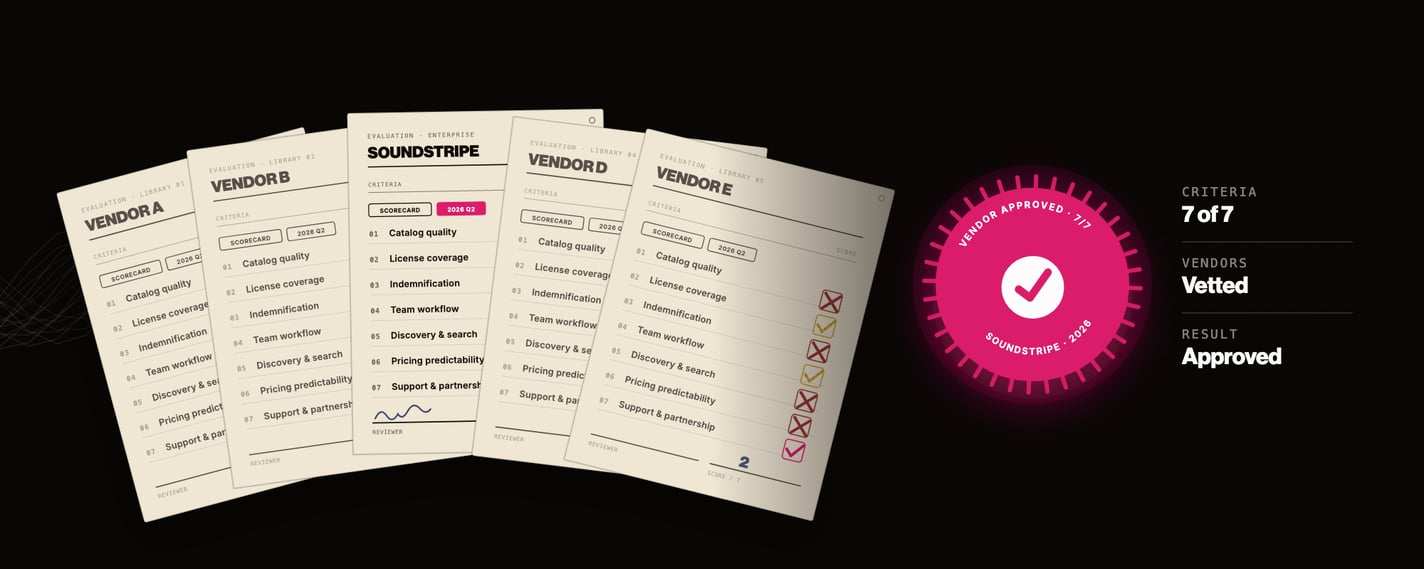
The best music licensing sites for brands and agencies aren't necessarily the loudest ones. They're the ones that can stand up to a real evaluation across the dimensions that actually matter once you're producing content at volume. Here are the seven we'd run any vendor through, plus what to look for in each.
1. Catalog quality and consistency
Catalog size is the headline metric every vendor leads with. It's also the easiest one to game. A library can claim 100,000 tracks while 90% of them are filler nobody ever pulls.
The better metric is utilization: what percentage of the catalog actually gets used by customers each month? A healthy curated library should land somewhere north of 50%; the platforms doing it well land closer to 90%. If a vendor can't or won't share that number, that's its own answer.
Look for:
- Depth across the genres and moods you actually need
- New releases on a regular cadence
- Stems and alternates and cut-downs available across the catalog (not just on premium tracks)
- Music made by real artists with credits you can verify
Explore Soundstripe’s Platform features for comparison to other vendors.
The best music licensing companies treat their catalog like a curated label, not a stock dump.
2. Licensing clarity and coverage
This is where the pitch and the contract often diverge. Make the vendor walk you through, in writing:
- Does one license cover all your channels (organic social, paid social, broadcast, OTT, paid digital, in-store, internal comms)?
- Does it cover the international markets you ship in?
- Does it cover use by your agency partners, freelance editors, contractors, and influencer collaborators?
- What happens to content you've already published if the subscription lapses? (Perpetual rights matter more than people think.)
- Does the vendor actually own the music in perpetuity, or are they re-licensing it from a third party who could pull the rug?
Ambiguous coverage is the single most common source of post-signing disputes. The clearer the language, the better the vendor.
3. Legal protection and indemnification
Indemnification is the contractual promise that if a copyright claim hits, the vendor defends you and covers the costs. For enterprise buyers, $1M is the floor, not the ceiling. Anything below that won't cover the legal fees of a real dispute, let alone a settlement.
Ask about the cap, what it covers (legal fees? settlements? both?), and what's specifically excluded. Then ask whether the vendor's licensing terms have been reviewed by lawyers with deep music copyright experience. (You'd be surprised how many haven't.)
A few more questions worth asking outright:
- How do you handle YouTube Content ID claims when they fire on legitimately licensed tracks?
- Have any of your customers been sued for copyright infringement on music sourced from your platform?
The first question screens for operational maturity. The second screens for honesty.
4. Team features and workflow
A music licensing platform built for individuals breaks the moment you put a team on it. The features that matter at brand or agency scale:
- Multi-seat access with individual logins (so usage is attributable).
- Admin controls for adding and removing seats.
- Shared playlists and team favorites for stakeholder review.
- Project-level organization that holds up across multiple clients or campaigns.
- Usage tracking for compliance and reporting.
- Editor integrations (Adobe Premiere Pro, Frame.io) so the music doesn't sit in a separate browser tab away from where the work happens.
This is the dimension where agencies often have the strongest opinions, since multi-client project management is daily life.
5. Discovery and search functionality
Time spent searching is a real cost. A creative team that loses thirty minutes per piece of content hunting for the right track is burning hours per week and momentum per project.
The better platforms make discovery feel like a creative tool, not a database query.
Look for:
- Meaningful filters (mood, energy, instrumentation, BPM, vocals vs. instrumental, with breakdowns/builds, etc.)
- AI search that lets you describe a vibe instead of guessing keywords
- Similar-track recommendations that actually surface adjacent options
- The ability to favorite and share quickly
Run a real test: have two members of your creative team find tracks for two different briefs in 10 minutes each. The platform that gets you to viable shortlists faster is the platform that will pay back its subscription cost in editor hours alone.
6. Pricing model and predictability
Subscription, per-user, per-use, flat rate, or some hybrid: every model has trade-offs. The questions to ask aren't about which is "best" in the abstract, but which is predictable for your usage shape.
- Will pricing scale linearly as your team grows?
- Are there usage caps that surprise you mid-quarter?
- What's included in the base versus what costs more (stems, sound effects, video footage, premium artists)?
- Does single-track pricing exist as an option for one-off needs?
- What's the contract length and the renewal mechanic?
The honest answer here matters more than the cheapest answer. The best royalty free music subscription for an in-house brand team isn't always the cheapest one; it's the one whose pricing won't surprise procurement in month nine.
7. Customer support and partnership
Self-serve products serve self-serve users well. Brand and agency teams need more than a help center search bar.
The signals worth looking for:
- A dedicated account manager who actually knows your brand and your clients (not a rotating support queue).
- An onboarding process designed for team rollout, not individual sign-up.
- License consultation when something complicated comes up (a global campaign, a UGC question, a broadcast cue sheet).
- Custom playlist curation when a campaign needs a specific brief solved fast.
- Response times measured in hours, not days.
Ask for references from companies your size and in your space, and actually call them. The best music libraries for film and TV (and for brand and agency teams generally) are the ones whose customers will get on the phone.
How to Actually Run the Evaluation
A framework on a slide is one thing; running the evaluation across your team is the work. The way we'd do it:
- Shortlist 3 to 5 vendors using the seven criteria above as a scorecard.
- Run a 2-week pilot with the top 2 to 3.
- During the pilot, your creative team uses the platform on a real brief, your legal team reviews the terms in detail, and a brand or account manager pressure-tests the support process.
- Score the pilots on the same seven criteria.
- Make the call.
The next post in this series goes one level deeper into the licensing terminology that shows up in contracts (sync, master use, royalty-free vs. rights-managed, all-media vs. digital), so your legal review actually has shared vocabulary with the vendor.
Need to explore our enterprise options? Talk to our team. Or create a free account and run the discovery test against a real brief.
Want the full evaluation framework? Download our Buyer’s Guide to Music Licensing
Sound better and create faster with Soundstripe.