Marriott. Chili's. Johnson & Johnson. Fourteen NBA teams. None of them set out to break music copyright law. They got sued for it anyway, all because of music used in social posts that probably never got reviewed track by track.
Music licensing used to be a pretty contained calculation: find a song, pay for a sync license, drop it into a TV spot, done. That math doesn't work for in-house brand teams or agencies anymore. You're publishing across organic social, paid ads, broadcast, OTT, influencer content, sales decks, and the internal CEO recap that somehow ends up on LinkedIn. Each one is a licensing decision. Most aren't getting reviewed.
This piece kicks off a six-part series unpacking what brands and agencies actually need to know about modern music licensing: what changed, what to evaluate, what to ask vendors, where the legal risk hides, and how to build the buying committee that gets the decision right. Let's start with the landscape.
What changed: music licensing in the multi-channel era
The volume side of the equation broke first. Five years ago, a marketing team published maybe one or two pieces of brand video a week. Today, the same team is shipping hundreds of pieces a month: TikToks, Reels, Shorts, OTT cut-downs, six-second pre-rolls, sales enablement, recruiter videos, podcast intros, conference loops. Each one needs music. Each one needs that music cleared for that specific use.
Then the channel mix expanded. A track licensed for "social" in 2018 was usually meant for a Facebook post. Now "social" includes paid Meta ads, Reels with branded audio, TikTok Spark Ads, influencer content where the influencer (not the brand) actually picks the song, and UGC the brand chooses to amplify. Each is technically a different licensing scenario. A lot of older licenses don't cover any of them.
The third shift: who's making the content. Agencies, freelance editors, contractors, and influencer partners all create on the brand's behalf. When a contractor uses an unlicensed song in a deliverable, the brand is the one named in the cease-and-desist. The legal exposure rolled uphill.
And then the lawsuits started landing. The cases against Marriott, Chili's, J&J, and the NBA teams weren't fringe issues. They came from major labels and publishers, and they specifically targeted social content that brands assumed was low-stakes. It wasn't.
Why the old music license model doesn't scale
Traditional sync licensing still has its place. If you're scoring a Super Bowl spot or a campaign anchored on a recognizable song, custom-negotiated sync is the right tool. It's also expensive, slow, and requires legal involvement on every track.
Per-track royalty-free licensing solved part of the problem (you pay once, no ongoing royalties), but it brings its own friction at brand scale. Every track is a new SKU to track, a new line item to bill, a new clearance to confirm. Multiply that by hundreds of pieces of monthly content across multiple agency partners, and you've built a procurement problem with no central record of what's actually licensed for what.
Subscription music licensing was supposed to fix this, and for individual creators it did. The catch is that not every "subscription" actually covers what brands need. Some cover organic social but not paid ads. Some cover the US but not international campaigns. Some end your right to use the music the moment your subscription lapses, which is rough when you find out the brand video sitting on your homepage for three years was technically pulled from a license you canceled in 2023.
The point isn't that any one model is wrong. It's that brand teams need to evaluate a music licensing partner against the actual shape of how their content gets made and where it lives, not against a 2018 picture of marketing.
Where brands get caught: five risk surfaces
When music licensing claims surface against enterprise brands, they almost always come from one of five places:
Paid advertising. A track licensed for organic use gets repurposed for a paid Meta or YouTube ad. Most royalty-free libraries treat paid media as a separate license tier. If yours doesn't, the rights holder will eventually find the impression count.
Influencer and UGC content. Influencer hires a freelance editor. Editor uses a track from a personal subscription on a piece of branded content. Brand boosts it. Brand owns the legal risk.
Global campaigns. A library that covers North America may not cover EMEA or APAC. Geographic gaps in coverage are one of the most common (and most overlooked) risk surfaces in enterprise music licensing.
Broadcast and OTT. TV and connected-TV use comes with cue sheet requirements and PRO obligations. If your provider doesn't generate cue sheets or doesn't have the underlying rights cleared for broadcast, the gap shows up the first time a network airs your spot.
Post-cancellation use. Term-limited licensing means your right to use the music ends with your subscription. Evergreen brand videos, hero pages, training content, anything with a long shelf life needs perpetual coverage. Otherwise you're inheriting a future cleanup project.
What enterprise music licensing actually needs to cover
This is where the evaluation gets concrete. A music licensing partner built for brands and agencies (not just creators) needs to handle a specific list:
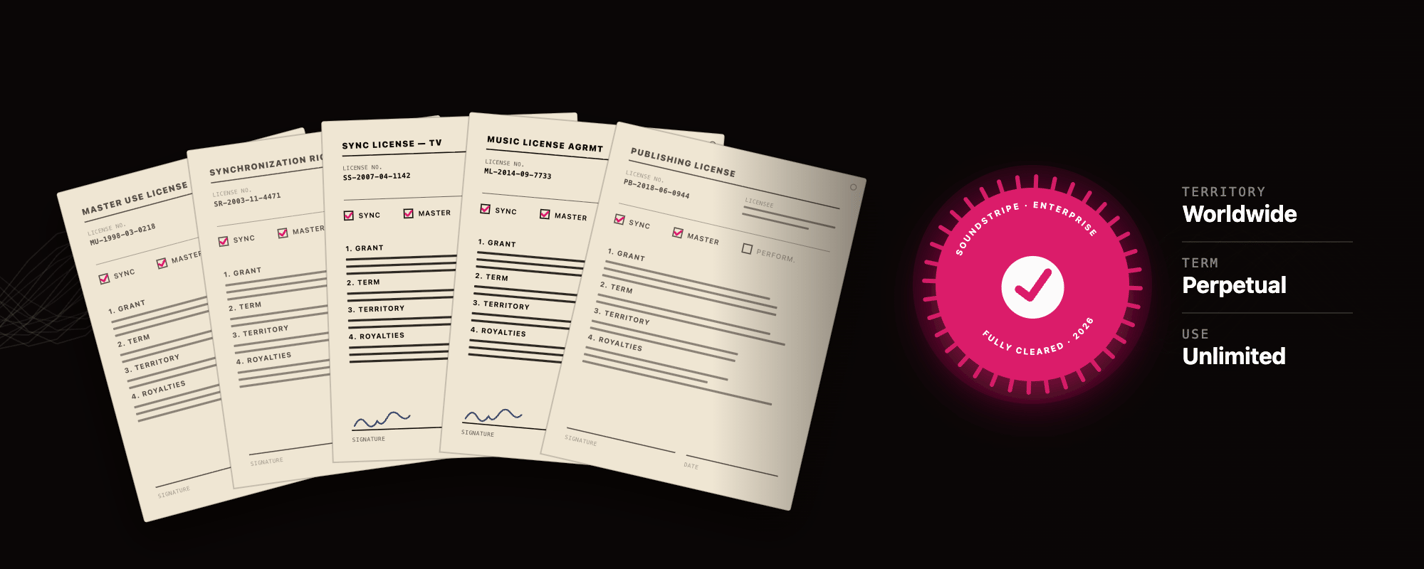
One license that covers all your channels: organic social, paid social, broadcast, OTT, web, internal, paid digital, and the international markets you operate in. Indemnification with a real cap (for enterprise, $1M is the floor, not the ceiling). Perpetual rights on anything you publish during the subscription, so canceling doesn't strand your back catalog. Coverage that extends to the agencies, freelancers, and influencers creating on your behalf. Content ID handling on YouTube, so legitimate uses don't get flagged or demonetized. Cue sheet support for broadcast. And underneath all of that, music actually made by real artists, with the rights wholly owned by the licensor (not licensed to them by a third party who could revoke them).
The next post in this series goes deep on exactly how to evaluate a provider against these dimensions, with a seven-criteria framework. For now, the takeaway is structural: enterprise music licensing is not the same product as a personal subscription. The features, the indemnification, the channel coverage, and the team workflow all have to be different.
The pivot: from per-track to built-for-brands
Soundstripe was built for this version of marketing. 116K tracks by real artists (12 Grammy wins, 30 gold and platinum records, 4 Billboard #1s in the credits, $13M+ paid out in royalties so the artist economy stays healthy). One enterprise license that covers paid, organic, broadcast, OTT, agency partners, and influencer content across every territory. $1M indemnification standard. Perpetual rights on what you publish. Automated YouTube Content ID clearance so your team isn't fielding strikes. Cue sheets when you need them. A dedicated account manager (a real person who knows your brand) instead of a help-center search bar.
If you're putting together a music licensing evaluation for your team or your client's team, that's the bar to set, regardless of which provider you ultimately choose.
Want the full evaluation framework? Download our Buyer’s Guide to Music Licensing
Ready to talk specifics? Book a call with our enterprise team and we'll walk through coverage, indemnification, and team rollout for how your brand actually publishes.
Sound better and create faster with Soundstripe.