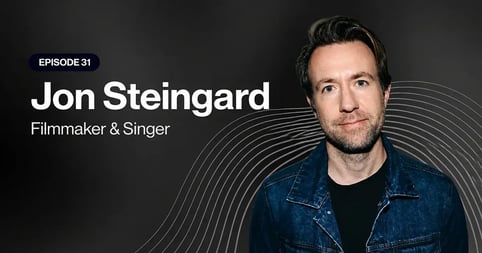
Jon Steingard is a director and cinematographer who runs Steingard Creative and shoots much of his work alongside Jim Cook and the crew at CookHouse Media. Before that he spent about 16 years in the Canadian band Hawk Nelson, joining on guitar in 2004 and taking over as lead singer in 2012. He still makes music, mostly for an audience in China that found him through one of the band's songs.
In this episode of Soundstripe Sessions, Jeff Perkins talks to Jon about the Soundstripe co-founder who used to drive Hawk Nelson's tour bus, what he learned by studying other frontmen, teaching himself to shoot on a phone and a camera that barely shot video, why he hires wedding videographers, how he uses AI to build an edit before anyone rolls a camera, and the song that turned into a headlining tour in China.
The part to read closely is the middle. Jon edits audio first. Before he places a single shot, he wants the cut to work with his eyes closed, and the first creative decision on nearly every project is the music bed. Jim Cook said almost the same thing on his episode, which may explain why the two of them have been working together for more than a decade.
Key takeaways
- Soundstripe co-founder Travis Terrell drove Hawk Nelson's tour bus for a number of years, and the running joke on board was that the driver was the most talented musician there.
- Jon replaced the band's guitar player in 2004. On the road they paid themselves $5 a day, which he stretched across two trips to the dollar menu with $3 left over for deodorant or a prepaid phone card.
- When he became the singer, he studied frontmen like homework. The lesson that stuck came from a great singer having a bad night: being the most enthusiastic person in the room counts for more than being the best singer in it.
- Don't spend money on gear until you are hitting the limits of the gear you have. Start on a phone.
- He will hire a strong wedding videographer without a second thought, because a wedding is a shoot with an opposing team.
- He edits audio first. If the cut doesn't work with his eyes closed, it doesn't work. With the right music bed, he says, 80 percent of the work is done.
- He uses AI to build the whole edit before the shoot, so the client gives notes on pacing before anyone films anything. He doesn't use it to replace the shoot.
- "Sold Out," a Hawk Nelson song he wrote, went viral in China around 2018 and 2019. It led to a video game vocal, Chinese management and his own headlining tours.
Listen to the episode
A pastor and a nurse who said go for it
Jon was born in Vancouver, and his family moved to southern Ontario when he was young. Music was in the house, but nobody was doing it for a living.
Jon: My dad was a pastor and my mom was a nurse. My dad played guitar, my mom played violin. So they were musical, but they weren't career musicians or anything like that. Definitely music was a thing in the house growing up. Sometimes you hear the story of someone who wants to pursue music as a career and their parents are telling them don't do that. That was not my experience. It probably is going to be my kids' experience.
He is joking, mostly. His daughter wants to be a singer, and his advice to her is to go in with both eyes open. His own parents were more relaxed than the era, or their own résumés, would suggest.
Jon: We're talking early 90s. I do think it would have been more common to have parents that were like, go to college. And especially since my dad has a doctorate and my mom has a master's, my parents are pretty educated, so they could have said university is really important. They've told me in retrospect that they were worried, because none of their kids went to college. We're all entrepreneurs. But I don't remember them putting pressure on us. They were only ever encouraging, in our corner, our biggest supporters.
The best musician on the bus
The Soundstripe connection in this episode goes back further than his video work. It starts in the driver's seat.
Jon: Fun fact, one of your founders, Travis Terrell, actually drove our bus for a number of years. And the joke on the bus was always that Travis, while not in the band, driving the bus, was the most talented musician on the bus. Everyone agreed on that. When he got into doing what he does now, it was just fun to see his career grow and know that we had that personal connection. We still talk all the time.
Jeff: Did you ever pull Travis onto stage and say, hey, we need another rhythm guitar tonight?
Jon: He played fiddle a couple times with us. We had this one tour where there was a song we had wanted some strings on, so he would get up in time to be on stage. But then he still was driving the bus, so making sure he was getting enough sleep was always a concern.
Jeff pointed out that Travis and fellow co-founder Micah Sannan tell this part of the story themselves: they were touring musicians who noticed the bus driver was making more money than the band. The founders went through that origin on the first episode of Sessions. Jon remembers noticing it too.
Jon: I remember being like, Travis is smart. You wouldn't think that of all the jobs on this bus, the one that you might choose would be the bus driver, but he was making more than the rest of us. But I think that wears you down, and he and Micah had lots of really creative ideas, both in music and in business, and that's what led to Soundstripe. When I'm engaging with other filmmakers and Soundstripe comes up, I do feel like I get to be like, wow, I know those guys.
Five dollars a day and the dollar menu
Hawk Nelson came out of a local scene in southern Ontario in the early 2000s that was bigger than you would expect, and churches were a large part of why.
Jon: It was very, very common for guys and girls in youth groups at church to start a band. And it was also really common for entire youth groups to just go to a local show every weekend, because it was something to do. So there was this community where it just was not that difficult to sell three or four hundred tickets for a local band. There was a really thriving music scene there, and a number of bands kind of got signed and then got plucked out of that community.
Hawk Nelson signed with Tooth & Nail, the Seattle label. Jon wasn't in the band yet. He was in other bands in the same scene, and the timing worked in his favor.
Jon: Very quickly after they signed, they started going out on the road, and it became apparent that their guitar player, who had just gotten married, was trying to juggle that change with the touring schedule. At the time it was normal to do like 220, 230 shows a year. So it was pretty rigorous, and it very quickly was not going to work, and I ended up replacing him. I didn't participate in making the first album, but I toured the first album, and then I was a part of everything after that. That was 2004.
The early years were what early years usually are.
Jon: Hop in a van, don't shower for a few days. Any money we made, we were putting back into the band, so we paid ourselves like $5 a day. And I remember strategizing, going to McDonald's for lunch and dinner and getting the dollar menu, so you'd have $3 left over if you needed to buy deodorant or a prepaid long-distance phone card to call home, because that was a thing then. It was lean, but it was an adventure. We were in our early 20s. I'm like 43 now, and that sounds awful, but at that time it was an amazing adventure. I wouldn't change it. I don't feel like I need to go back.
Studying frontmen like homework
The band's singer, Jason Dunn, decided to leave in late 2011, and Jon moved from guitar into the lead vocal role and the main songwriting job. He had fronted bands as a teenager. This was a different level of pressure, and he approached it the way he approaches most things, by studying.
Jon: I had to kind of study other frontmen, and I took it as an opportunity to learn and grow. I really studied. Why is this frontman great? Why is he so engaging? Why does he seem to be able to hold an audience so effectively when some other singers or frontmen struggle to do that? I took it as a very analytical exercise, and I feel like over the course of a year or two I got pretty comfortable.
Jeff asked what separated the great ones from the average ones. The first thing Jon noticed was where they were looking.
Jon: They would seem to be able to direct the experience for the entire crowd. And I noticed that they would be speaking to the people in the back. Very often, if they can get the people in the back, they've got everyone in front of them. So just that confidence of being able to project your attention and your command to the people in the back of the room, you'll get everyone by default.
He was in the Christian music world, so the singers he watched most closely came from there, and they did it in completely different ways.
Jon: TobyMac is an excellent frontman, and he's interesting because he doesn't yell. He's kind of soft-spoken when you talk to him, but he has complete command of the room, which is just charisma. Another singer that I studied a lot was Jason Roy from a band called Building 429, who is a dear friend. We actually do some video work together. I was on a call with him this morning about a project. His approach was different. He was an athlete coming up in college, so he's very competitive. Where Toby has this sort of quiet charisma about him, Jason's a bit more of a big personality.
What he took from Jason Roy was less about personality than about the work done before the show.
Jon: One of the things that I learned from Jason is just projecting confidence. You can step on a stage and act like you belong there, even if internally you are feeling uncomfortable. And a lot of that comes back to preparation. He was really meticulous about preparation. So when he stepped on stage, he knows what kind of show they have prepared and he has complete confidence in their ability to execute it. So all he has to do is basically telegraph to the audience, hey, this is going to be awesome. Check this out.
The singer he won't name
The most useful lesson came from watching someone get it wrong, and Jon is careful not to say who.
Jon: There was this one time I was at an awards show, and I was in peak study mode. I watched this singer who was an already well-known singer, but he had joined a different band, so he was fronting this band in front of the industry for the first time. He's an incredible singer, very, very talented, but he looked so uncomfortable. And because he was so visibly uncomfortable, the entire room became uncomfortable. We all felt it. If you close your eyes and listen to his voice, it was amazing. But as soon as you open your eyes, you're just uncomfortable watching him. And he's not always like that. It was just a bad night, I think.
Jon: I came out of that and I remember thinking, if he had sung half as good, but if he had been the most enthusiastic person in the room, it would have been 10 times better. So the lesson I took away was, look, I think there are much better singers than me. But I think I'm capable of being the most joyful, enthusiastic, excited, happy-to-be-there person in the room. And if I can master that, I think that'll be more beneficial than being the best singer, and probably more attainable as well.
He thinks that one travels well beyond a stage.
Jon: That's the lesson I feel like is the most applicable outside music. I try to do this in my work relationships, in my friendships. How can I go into my relationships with people being curious about what's going on in their life, being enthusiastic, being engaged? That stuff was more important than being impressive.
Not everyone needs the homework, he adds. Some people arrive with it.
Jon: I think about Brandon Flowers from the Killers. I can't imagine that guy sitting down and studying other frontmen. He just oozes charisma. I don't think he's ever thought about it. But I'm the other kind, where I really had to study the methods.
Why stadium openers have it hard
Jeff brought up a Coldplay show he saw in Nashville, where the openers looked small in a building that size and Chris Martin did not. Jon has played a few events at that scale and was sympathetic to the openers.
Jon: Stadiums are hard. Very often at stadium shows the openers are playing in daylight, so right there you've lost some vibe. And they're just working with a lot less production than a Coldplay is working with, so it's very difficult for them to feel like their performance fills the space. Opening slots on stadium tours, that is extremely difficult. I've seen a few people do really, really well.
A band too cheap to hire a video guy
His video career started inside the band, in the last few years before it ended. Bands suddenly needed far more visual content than they used to, and Hawk Nelson was paying its own bills.
Jon: Whether it was a music video or lyric videos or video content for live tours with LED walls, we just needed video a lot more often. And we were cheap. We kept on having situations where we had to choose between paying someone whose work I just was not happy with, or we couldn't afford to hire the really expensive, really talented people. At that point we were signed to a new deal, but it was a partnership deal, so we paid for our own albums. We were paying for everything ourselves. Which was fine, I'm not complaining. But it meant we were looking at every nickel and dime.
Jon: So I started encountering situations where we needed video content and I was like, I feel like I can make something, even if I'm not a professional, even if I don't have professional tools. If I'm just creative, maybe I can figure something out.
Other artists saw the work and asked who made it, and he started getting hired. Then he met Jim Cook, who had spent years in the car business before moving into photo and video. The two never formed a company together.
Jon: I'm a freelancer, he's a freelancer. I have my company, he has his company, and we decided instead of getting married, just to move in together for 60 percent of the year or something like that. For both of us, our partnership represents probably 60 or 70 percent of our video work in the year. Theoretically we could start a company together, but we've got a good rhythm running projects through either mine or his and then sorting things out on the back end.
Phone first, gear later
Jeff asked what he was shooting on in the band years. The answer was a phone, and not a good one. Most of what he needed early on didn't have to be shot at all, so he started in post.
Jon: I think I started in iMovie and then moved into Final Cut, and I was just taking stock footage and layering things. I learned very quickly what blending modes were. If I put this clip on top of this clip, what happens? If I put this text on top of this clip, what happens? It was a lot of trial and error. Then eventually I got into After Effects when I needed more abilities, and now probably 80 percent of my work is in After Effects. I'm doing a lot of motion graphics, a lot of semi-VFX, but not explosions. More motion graphics oriented.
Shooting came later, when projects required it, and the first cameras were not ideal.
Jon: I think my first camera was like a Fuji X-E2, which barely shoots video. It was a horrible choice, but it looked cool. Then I think I got the Canon 70D, which is a crop sensor, very consumer-level DSLR. And now I've owned the range. I've owned cinema cameras, mirrorless cameras, the whole gamut.
Having owned all of it, his advice to anyone starting out is to go back to the phone.
Jon: Phones are so powerful now. Whenever someone is starting to get into video, I'm like, shoot some stuff on your phone. Get in the habit of figuring out what needs to be shot. How you can manage lighting, how you can manage audio. How are you managing files? How are you editing them together? How are you color grading? These are all things you can do with iPhone footage, and these are workflows that you need to get comfortable with if you're wanting to get into video.
Jon: I'm always telling people, don't spend money on gear until you're feeling the limitations of the gear that you have. You really need to bump up against those limitations, because otherwise you're just going to be chasing this cycle of the latest thing, the newest thing. It's kind of an illusion that if I get this gear, all of a sudden I'm going to be better at what I do. It might help if it removes the limitation that you're experiencing. But very often the limitation is our own ability, and the more we can work on honing that ability with simpler tools, it just makes you better.
Get on a set and be the most helpful person there
The technical side of cinematography came from two places: YouTube, and standing on other people's sets watching. One of the earliest was a commercial shoot in New York, where a friend at Google brought him in to make a small behind-the-scenes documentary.
Jon: I was pretty green at this point. I got to be on set for three or four days watching this very professional crew shoot a full-on commercial for Google. And just watching them, I was like, okay, they have three people just for that camera. What do each of those three people do? One guy's pulling focus. They're not using autofocus, because it's a whole cinema setup. And when they're swapping lenses, I was paying attention to why they switched to that lens. What is that giving them that the other one didn't? Then whenever there was something I didn't know, I would go watch YouTube videos.
He'd add AI assistants to the list of places to ask questions now. He still thinks the room is where you learn most, and his advice to young people who want into video is specific.
Jon: Just get yourself on sets. Volunteer to be a runner or a PA. Be willing to take simple jobs for not much money, just to get in that environment. And then every time you get the opportunity to be there, be the most helpful person on set, the most reliable, asking the least for yourself. That's what gets you called back. And being in those environments will teach you a ton.
Weddings are a shoot with an opposing team
Jeff noted that a lot of the filmmakers who come on the show started in weddings. Jon doesn't shoot many, though he has filled in for Jim when Jim was in a bind. He does have strong opinions about the reputation wedding shooters get.
Jon: Wedding photographers and wedding videographers have this stigma in the commercial filmmaking space that they're somehow lesser, and I don't share that opinion. A wedding day is very, very difficult, and if you are good at weddings, that says a lot. One of the things Jim and I will do, if we're shooting in a location where we can't get all of our guys there and we have to find someone locally to add coverage, we will look at wedding videographers and wedding photographers pretty readily. Because if you're good at that, you can do almost anything.
The difference shows up in a reel, if you know what to look for.
Jon: Sometimes when you see a reel from a director or a cinematographer, I'll be able to see that every single one of those shots was from a set where everything was set up for you to win. And that's fine. Maybe you're going to be in that environment. But when you see a really great wedding reel, those days are not set up for you to win. Those days are very challenging. It's like the difference between the Harlem Globetrotters playing against no one or playing against someone. There was an opposing team on the wedding shoot. It was weather, it was the mother of the bride, it was the pace.
Eight people who can all do everything
The wedding instinct shapes how Jon and Jim build crews for commercial work too.
Jon: Compared to other production teams, I always feel like we look very punk rock. Not our appearance. I just mean the gear we choose. We're not going to be the guys that show up with a 25-person crew. We're going to show up with an eight-person crew, and every single one of our eight guys is an absolute assassin. On a traditional film set with a large crew, you very often see guys that are assigned to certain roles and they never do anything outside that role. If you can have a whole career working in those environments, good on you. But in our little collection of freelancers, we only hire people that can do kind of everything. Every single one of the guys on our crew can shoot, everyone can edit, everyone can gaff, everyone can do audio. Some people have strengths, so you still play into people's strengths, but having all-rounders is a different way of approaching crewing up a shoot.
Two lines that 10x the budget
Jeff spent the early part of his career at a large New York agency on the Procter & Gamble account, where, as he tells it, shoots ran four spots at a time because the client expected an average cost of about $300,000 a spot. Later, at startups, he saw comparable work made for a small fraction of that. Jon lives at the lean end of that spectrum, and his method for staying there starts with the script.
Jon: With a lot of our corporate clients, we're the scrappy guys. We can turn things around faster than a big agency because we're lean and mean and we're very responsive. But there are some limitations. Like you mentioned, buying out a city block. We can't do that. So a lot of it for us is taking a look at what they're trying to communicate with the video piece and going, what are the really, really expensive pieces that maybe we don't need? Can we communicate this idea without that expensive piece?
Jon: If there's a general script, we'll take a look at it and go, which of the elements are the most expensive, and do they need to be there? Can we bring this from potentially a million-dollar shoot down to a $100,000 shoot by shaving two lines? And very often you can. So we try to communicate that to the client. This idea is not bad, but these little details in the script, they seem like a nice-to-have, and they're 10x-ing the budget right there.
Who is it for, and what should they feel
Jeff asked how he thinks about story, since a beautiful film with nothing to say is still nothing. Jon starts every project with the same questions.
Jon: Whenever I have a client come to me with a project, I'm always asking, who is this for? Who's the audience? And what do you want them to feel? What do you want them to come away with after this 30 seconds or 90 seconds? It's not always what do you want them to feel. Sometimes it's what do you want them to think, what do you want them to be amazed by. But it's always, what is the point? With a layer of, why should they care? Because we're a very busy culture. People have a lot going on. So really nailing who is this for, why should they care, and what do you want to leave them with, that's my big-picture guiding principle.
Audio first, always
This is the center of the episode. Jon does not start an edit with pictures.
Jon: When I get into editing a project, I actually start, and this comes back to Soundstripe, I'm audio first. Always, always audio first. My first version of an edit is always, if I close my eyes, does it sound right? Does it hit the right beats? Am I telling a story that makes sense if my eyes are closed? Do I have enough time to absorb the important moments? If you give people too many points too fast, they just tune out, because they're overwhelmed.
The order is consistent: recorded audio from talent goes on the timeline first, then the music.
Jon: One of the very first things I'll do is choose a music bed, or a selection of music beds if it's a longer piece. And I'm always asking, what do I want to feel? What does this story feel like? This is going to sound like a product pitch at this point, but Soundstripe is the first place I go. Depending on the project, there are some projects where I know for a fact there's a Matt Wigton song that's going to be perfect for this. Or I know there's an Adrian Walther thing that's going to be great. Even if I don't know the exact song, I have his vibe in my head, and I'm like, yeah, that's the vibe.
Both are Soundstripe composers. Matt Wigton works across a wide range of styles, and Adrian Walther's songs have been in the catalog since the early days. Jon's point is less about who than about what the right bed does to the rest of the job.
Jon: It's amazing to me when you get the right music bed. It's like 80 percent of the work is done. I feel like 80 percent of the work is done for me. Then I just drop the necessary audio on top of that, duck the music bed down when necessary, find the visuals that need to go in these places. Once the audio is set, most of the work is done, and it just becomes set dressing after that. And I'm not just saying that because I'm speaking to you at Soundstripe. That really is my philosophy.
Editing to silence
Jeff said that among the post-production people he talks to, most lay out the visuals first and find the song afterward. Jon can't relate.
Jon: I understand that in traditional TV and movies, very often music and scoring comes later. I have a friend that scores indie films, and I was asking him about this. How on earth is this editor, in a moment where you know you're going to have a score, editing it without that? Because that's how I would pace the edits. Not that everything has to be on the beat, but the pacing really is referential to the score or the music bed, at least in my brain. He was saying sometimes they'll pick a piece of music as a placeholder and edit to that, and then maybe when they have someone score it, they might score it to a similar BPM. I've seen people working on edits that are going to have music later, and they're working with no music at all, and I just can't relate. How do you make any choices?
Which makes one kind of client note especially painful.
Jon: I've had clients be like, we love it, everything, can you just swap out the music for this? And they'll send me a completely different song. And I'll be like, you have no idea what you've just done to me. I'll try to be accommodating, but it'll be a reshuffling of the entire edit, because it has to work with that song now.
Thirty seconds, or a whole day
Jeff asked how long it takes him to find the right song.
Jon: Sometimes it's 30 seconds, sometimes it's a whole day. And the ones where it's a whole day, it's really exhausting. There are moments where you're tempted to settle. There'll be something that's so close, and I'll be like, maybe I can make that work. But every time I've tried to convince myself of that, I've always regretted it.
What shortens it is a mental shortlist of composers whose work he already knows.
Jon: Depending on the project, I very quickly know certain artists that have a catalog that I think is going to be great. Like I mentioned Matt Wigton and Adrian Walther. I know what their feel is. Like this morning, I was working on an edit and I was like, I bet you Matt Wigton has something perfect for this. And sure enough, I found one in like two seconds. I have a collection of probably 10 or 12 artists that I'm fairly aware of their vibe, and if I get on a project, I'm like, I think they would have a good thing for this, and I might explore what they've put out most recently. But for the ones where I don't have an idea, it can take a whole day just looking for music.
Jeff called search the number one complaint Soundstripe hears about the creative process, not about the catalog but about the hunt itself, and mentioned two things the company has built around it: Supe, a search tool, and Soundstripe LIVE, a Mac app that watches your timeline and suggests tracks from the catalog that fit the scene.
Jim Cook had told Jeff on his own episode that he was about to spend most of a day listening to music for one project, and, as Jeff remembered it, called that going into the pain cave. Jon leans on Jim for exactly that.
Jon: He's actually remarkably good. Sometimes I lean on him for music selection, because that's one of the things he's quite good at. And he's also good at recognizing when a song that is close is actually close enough. I so dread the moment where you get a half day down the edit path and you're like, this song just isn't working, and you feel like you've just wasted half a day. I'm so always trying to avoid that moment that if a song doesn't feel exactly perfect, I'm always like, got to keep looking. And he's good at being like, stop. Pull stems on this. I think we can make it work. And very often he's right. Plus, if I can get him to go do the hunting for the music, then I don't have to.
Building the edit before the shoot
Jeff asked whether he has used AI tools for video or music. He has, a lot, and he says he is in the minority among the creative people he meets, or at least among the loudest of them. He uses AI tools for code all day, and a Mac Mini on his desk runs half a dozen automated jobs around the clock. For video, image and audio generation, his position is that the tools add to the job rather than replace any part of it.
The clearest example is a fast-turnaround shoot for a tech company he was preparing when the episode was recorded.
Jon: While we're preparing for the shoot, I'm actually building the edit before we shoot. I might sketch what I think this frame will look like, and then throw that sketch into an AI video tool and have it animate the motion. This is just the general motion we plan to film. Then I'll drop that into an edit. I'll also generate a placeholder voiceover of the person speaking. And I'll build our entire edit before we shoot a thing.
Jon: That way we know the pacing is right. We know we're hitting the right points. I can send that to the client, and the client can basically provide edit notes before we've ever shot anything. Then when we get to shoot day, we have our shot list. We know exactly what we need to shoot. We're way more efficient, we're way more confident that we're shooting the right things. We do all of our big shoots this way now. We basically pre-build with AI.
It also settles arguments early.
Jon: The client may have ideas on the front end, like, hey, we think we should do this. And we'll be like, maybe not. This is what it would look like. And they'll be like, oh, right. It just exposes issues that you were always going to encounter, but you encounter them earlier.
The second use is patching. If a B-roll day comes back missing one shot, he will generate a short sequence from reference frames, keeping subjects consistent with the real footage. The tool even adds sound design. But there is a ceiling, and he is clear about where it is.
Jon: It doesn't, for us, replace doing the shoot. I think you can sneak a few shots in like that. But if you build an entire thing in AI, I still think you feel it. So where I'm pro AI is using it as an additional tool in the toolbox, but not having it replace the nuts and bolts of the real work.
Jeff compared it to storyboarding, and to the common criticism that AI takes work away from illustrators. Jon's answer is about who had access to that work in the first place.
Jon: I was never hiring an illustrator before. We're not a big agency. So it just gave me access to a tool I didn't have access to before. I can't speak to larger agencies. Maybe they are replacing illustrators. But I just think as technology progresses, it democratizes tools, and techniques that were once out of reach for people less established just become available.
Sold Out, Wildfire and a tour in China
The last part of the conversation is the side quest. By his account, Jon wrote "Sold Out" for Hawk Nelson around 2015 or 2016. A few years later, just as he was stepping away from the band, it took off somewhere he didn't expect.
Jon: Somewhere around 2018, 2019, ironically right when I started stepping away from band stuff, that song for some reason started to go viral in China. It was used in a lot of social media edits as background music, and it got really, really popular. To the point where I've learned since that I haven't met a person between the ages of 18 and 35 in China that does not know this song. So it's pretty crazy.
Jon: I didn't really believe it at first. But I started getting emails from shady labels trying to buy out the rights, and I'm like, it was with my band. I don't have the rights to sell you.
That attention led to a vocal on "Wildfire," a song in the video game Honkai: Star Rail. It plays during the game's first major boss fight.
Jon: It's not huge here, but it's massive in China. It's the same people that did a game called Genshin Impact, which is more popular and well known here. So I sang this other song on this video game, and that got really popular. So I started going over to China to do these video game events with this video game company. And while I was there, they were like, oh wait, Sold Out is your song? Everybody knows that song.
He got management in China and, by his account, played his first headlining shows there the year before this episode was recorded: three of them, in Shanghai, Beijing and Shenzhen, all sold out. He had an eight-city headlining tour booked for December, and his kids are coming along.
There is a third thread. He wrote a song called "City of Light" for Chongqing, the city in western China known for its neon and for trains that run through buildings.
Jon: The local government, and this is very important in China, the local government is very involved. The local government found it and loved it, and so the tourism board kind of adopted it. It's sort of this fun side quest, because I really thought my time in music was done. I was really content to do video work, and I definitely was content to not be on stage and not be in the spotlight the same way that I had been. And then in the middle of that contentment, all of this random little side quest came to be.
His band over there is a trio, with Jon on guitar and vocals, and he is a fan of the players.
Jon: They're all Chinese, and they're awesome. Chinese culture is very exact, so there are some incredible musicians in China, because culturally they're so obsessed with things being correct and excellent. My drummer, Fu, is a music teacher by day and a session player by night. He lives in Beijing. I have two bass players depending on who's available for a gig. Jinbo, who's an old-school punk rocker, he's also from Beijing. And then Ramona, she's a cool punk rock chick.
He is active on Chinese social platforms, mainly Douyin, Xiaohongshu, Bilibili and WeChat Channels. In the US, he is on Instagram as @jonsteingard, and his video work is at Steingard Creative.
Advice to his younger self
Jeff: What one piece of advice or wisdom would you give to your younger self?
Jon: I would say avoid becoming cynical as much as possible. Sometimes, especially when you're younger, if you encounter successful people that are older than you, sometimes you encounter cynical people. And on the surface, cynicism looks like superiority sometimes, because it looks like they're experienced and they're not impressed by anything because they've seen it all. Maybe. Or cynicism can sometimes be a defense mechanism. And I've learned as time goes on that my favorite people are the people who are endlessly curious, always assume they have something more to learn, and approach new things with curiosity. It's like that Ted Lasso clip. Be curious, not judgmental.
It ties back to the awards show and the singer who couldn't get comfortable.
Jon: The ability to retain a sense of joy and enthusiasm in your work helps your work, and it helps your relationships, and it makes life better for yourself and everyone around you. The more you can work to hold on to that as you grow, the better. So that would be the advice I would give my younger self. Don't get cynical. Continue to be enthusiastic. Don't lose your sense of joy in what you do. Find ways to constantly be learning and improving, because very often that's where you kind of come alive.
Frequently asked questions
Who is Jon Steingard?
Jon Steingard is a Canadian director, cinematographer and musician who runs Steingard Creative and works on a large share of his video projects with Jim Cook of CookHouse Media. He spent about 16 years in the band Hawk Nelson, joining as guitarist in 2004 and becoming lead singer in 2012. Most of his video work now is motion graphics and post-production in After Effects.
What does Jon Steingard do now?
He works mainly in video production, directing, shooting and editing commercial and corporate work, much of it alongside Jim Cook. He also performs in China, where his Hawk Nelson song "Sold Out" became widely known, and by his account he played his first headlining shows there in Shanghai, Beijing and Shenzhen before booking an eight-city tour.
When did Jon Steingard become the lead singer of Hawk Nelson?
In 2012. He joined Hawk Nelson in 2004 to replace the band's original guitar player, toured the band's first album and played on everything after it. When singer Jason Dunn decided to leave in late 2011, Jon moved into the lead vocal role and became the band's main songwriter.
Why is Jon Steingard popular in China?
Because of "Sold Out," a song he wrote for Hawk Nelson that started spreading in China around 2018 and 2019 as background music in social media edits. That led to him singing "Wildfire" for the video game Honkai: Star Rail, then to Chinese management, headlining shows and a song called "City of Light" that he wrote for the city of Chongqing.
What does audio-first editing mean?
Audio-first editing means building the sound of a cut before the picture. Jon lays recorded dialogue on the timeline, chooses a music bed, and checks whether the story works with his eyes closed before he places any visuals. In his experience, once the right music bed is in place, about 80 percent of the edit is done and the visuals follow the pacing the audio sets.
How does Jon Steingard use AI in video production?
He uses it to pre-build edits. Before a shoot, he animates rough sketches of planned shots with an AI video tool and adds a placeholder voiceover, so the client can give notes on pacing before filming. He also uses it to generate the occasional missing B-roll shot. He does not use it to replace a shoot, because he thinks you can feel it when an entire piece is generated.
Is Jon Steingard connected to Soundstripe?
Yes, in a few ways. Soundstripe co-founder Travis Terrell drove Hawk Nelson's tour bus for a number of years, co-founder Micah is a close friend, and Jon uses the Soundstripe catalog as the first place he looks for music on most projects, often starting with composers Matt Wigton and Adrian Walther.