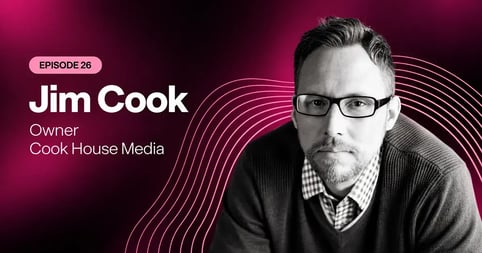
Jim Cook is a producer, director and co-owner of CookHouse Media, a Nashville production company doing commercial, brand and live event work. He grew up in San Diego, played in a hardcore punk band as a teenager, spent 14 years selling and then managing cars at a Mazda dealership, and quit that job at 36 to shoot weddings with his wife. He has been behind a camera ever since.
In this episode of Soundstripe Sessions, Jeff Perkins talks to Jim about the shows he promoted himself at 16, what a car dealership teaches you about negotiating, why almost every filmmaker he respects came up through weddings, the day he went from directing a Miranda Lambert performance to photographing a cake cutting, and the five to seven hours he will spend listening to music before he cuts a single frame.
That last part is the reason to read this one. Most people treat music as the thing you add at the end. Jim treats it as the thing that decides whether the edit works at all, and he is unusually specific about how he searches, when he gives up on a direction, and what he is listening for. If you have ever lost an afternoon to the catalog and come out with nothing, this is the closest thing to a method anyone has given us on the show.
Key takeaways
- At 16, his band could not get on bills with the bigger San Diego bands, so they promoted their own shows, booked a skate demo, and put themselves in the second-to-last slot. People associated them with success before they were any good.
- Why some bands break through: tenacity, not talent. His words: being in a band is mostly a moving company, and the ones who make it are willing to suffer longer.
- 14 years in the car business taught him the muscle he uses on set now, which is figuring it out in real time. His advice to creatives is to make business your art, not just the work.
- Weddings are the best training ground in filmmaking. Six hard shoots in one day, nobody calling action or cut, natural light you have to solve in seconds and no chance at a second take.
- He and his wife built their wedding brand around the process rather than the pictures, because couples cannot reliably judge a photograph and can absolutely judge whether they want to spend a day with you.
- His audio background is what made the visual work click. Color is EQ. If the audio is wrong, nothing else saves it.
- He will spend five to seven hours finding the music for one project, and he builds what amounts to brand guidelines for a project out of the tracks that feel in bounds and out of bounds.
- Some projects need music that stays out of the way. Some need what he calls main character music. Knowing which one you need is most of the job.
- A track he found in the Soundstripe catalog turned into a campaign: they brought the artist in on camera and built the whole demo around the song's separated instruments.
Listen to the episode
San Diego, a punk band, and four accidental promoters
Jim's origin story starts in a youth group and ends in a van.
Jim: Born and raised San Diego. In my mid-teens, pretty church youth group engaged, and then started in a band when I was 16. We had some, I don't know if it was luck or early success or a little bit of both, but we were a hardcore punk rock band out of San Diego. We were playing a lot with Blink-182, more like P.O.D. and Dogwood and all these punk rock bands, a lot of the Tooth and Nail bands. MXPX would come down. So we started having some weird success. We thought it was normal, but it's not normal that four or 500 people show up at a show and you're not that good.
Jeff asked whether there was ever a moment where it felt like they might break through. The honest answer involves a label that never signed them and a room that was probably smaller than he remembers.
Jim: We had a moment where we were really close to signing with Tooth and Nail. I say not signing. We were trying to get Brandon's interest in us, and we were self-producing. We had made our own record, our own CD, and that was kind of a big deal back in 1995 or 1996, to make your own CD without label support. We were just selling them on our own and having some success.
Jim: We had one night at this place called Soma in San Diego that was a known place, and we probably brought in the majority of the crowd. It was like a thousand or 1500 people in there. The number grows as I tell the story. But I remember being like, wow, this is a legit show.
The more interesting thing about that band is not the shows they played. It is what they did when they could not get on the bill.
Jim: What was probably interesting about the four guys in our band is three of us were very entrepreneurial. If we look at our lives now, we're all owners of things. We couldn't get on with some of these big bands, but we were like, wait a minute. We were 16. What if we just put on our own show, and what if we just got a skate demo and got them to set up skate ramps, and then we booked ourselves in the prime second-to-last spot, and then got to play with any band we want, and then we make all the money from the show?
Jim: We were almost like accidental 16-year-old promoters. I remember one time we got MXPX, Stavesacre, us, P.O.D. We built it really nicely, and people associated us with success even though we weren't that good. We got good because we had to play with all these bands all the time, inevitably. But we just made our own way.
Why some bands break through
Jeff has asked versions of this question on most episodes of the show. Jim's answer is the least romantic one we have had.
Jeff: This is one of the things in music that I'm fascinated by. Why do some bands break through and some don't? There's a consistent level of talent, but then some bands just kind of...
Jim: I think it's like in life. I think it's tenacity. They're willing to stick it out. People think being in a band is pretty glorious, and I'm like, no. It's like being in a moving company. You're basically just moving crap until you show up at the place, and then for 30 minutes you get to do something fun, and then you move it all back in a thing again and on to the next moving job. So it's not that glorious. I just think you're willing to suffer.
Jim: I remember when P.O.D. was our biggest breakout of San Diego, before Blink-182 hit. They were men amongst boys, and they were also doing it for 10 years before they became the brand new thing. They were 10 years in, killing it, and then people go, oh, check out this new band. So I think it's suffering.
It is worth sitting with that one, because it comes back later in a different form. The reason he is good at finding music is that he is willing to sit in a chair for five hours doing something most people quit after 20 minutes.
Fourteen years at a Mazda dealership
The band ended when he met his wife in a recording studio. She was a recording engineer, she was moving to Nashville, and she had a family connection to a mix engineer who now works at Soundstripe.
Jim: My wife was a recording engineer. We met in the studio recording something, a college project, some acoustic version of a song of ours. And literally months later, like our first date, she said, I'm moving to Nashville. Her brother-in-law is J.R. McNeely, who works at Soundstripe. She was going to work with J.R. and do audio stuff. And I was like, oh my gosh, well, I'm in love. She was cool as heck and wrecked our band.
That is not his only connection to the company. The label that his band was chasing at 16 is the same label that employed a producer who has since written hundreds of songs for the Soundstripe catalog.
Jeff: You have a lot of connections to Soundstripe, because you have J.R., and then Aaron Sprinkle produced a lot of the MXPX stuff early.
Jim: Aaron, I don't know Aaron but I know of him. I know J.R. and he did tons of projects together. And I was a fan of a ton of the records they always were working on.
So he moved to Nashville, needed income, and walked into a car dealership.
Jim: Worked at Mazda, worked at the lowest level, and then worked all the way up to general manager. Got good at the wrong thing, which was a bummer, because at the end of the day I was just wanting to play guitar and mix records. Every time I had an opportunity at it, I felt like money could never show up. I think I loved it so much that my heart and my brain, in the economy of things, I couldn't figure out how to get paid to do it. But I loved doing it and I was actually pretty proficient at it.
The dealership was Nelson Mazda, in the Nashville area, and he is careful to separate it from the reputation of the industry around it.
Jim: Of the dealership groups, it was the greenest grass on the planet. It was a bunch of really good, kind of Christian-based business that was like, if there was ever a question to do the right thing, just do the right thing. They were just kind.
His kids had a different understanding of the job.
Jim: My kids, when they were growing up, thought dad just made balloons. They would always come to the dealership and I was always handing balloons to them. Dad makes balloons.
Jeff, who worked at Autotrader before Soundstripe, pointed out that 14 years is a real career and asked what transferred. This is the part of the episode that most creative business owners should read twice.
Jim: I always tell people, make business your art. You're going to be arty already. You're going to make cool stuff. Those are the easy things to make art with, making stuff beautiful or making it great. Make business your art. Be creative in your marketing, in how you invoice somebody, in how you do all those things. When you can do that well, it'll start creating some wins in the financial parts of things, and that will create some margin for you to take some swings in other areas of your life.
Jim: If there's one thing I'm built for, it's to go have the hard meetings, have the budget meetings, go negotiate. It's like playing poker. You've got to have a good chip count before you negotiate a deal. If you're low on your chip count, you're not going to negotiate well.
Jim: So many things from the car business, for 14 years, of learning how to overcome objections and basically at the end of the day figure it out. The muscle of figure it out was every day in the car business, because people would come in with whatever the situation was and we were just constantly figuring it out. And then that just transferred to being on set. Now we just figure it out. So it's a muscle you need to learn and develop.
Burning the ship at 36
The camera arrived as a Christmas present for his wife, and then money started arriving for photos she had not planned to sell.
Jim: I bought her a camera like 20 years ago for Christmas, and $50 shows up like a week later, and then $100 shows up, and I'm like, hey, you're kind of taking pictures over there. What's going on? And next thing you know, a couple months in, she's like, I have a wedding booked. And I'm like, I have no idea what I'm doing. And she's like, I need some help.
Jim: I don't know what I'm doing, but I have a gift: if I'm not an artist, if you need me to draw something, I'm horrible. But if it has a power button and some sort of mouse involved, I can usually figure it out. So I'm just figuring it out, and by the end of the night I'm drinking beers and have a camera in one hand and I'm like, oh my gosh, this is the best thing ever. I'm having so much fun.
He is direct about what he was giving up, and he gives the number so the decision is not abstract.
Jim: I'm going to say a number out here just to give context, because I wasn't quitting my Starbucks job. I had worked my way up as a general manager with Mazda and I was making a sizable six-figure-plus income, and they paid for cars. So I had kind of entrapped myself in this 14-year Mazda journey while I was side-questing, trying to make money as a producer, making records and stuff, which wasn't having any financial success.
What moved him was a photography conference, and what he describes is less a business decision than a change in what he thought was allowed.
Jim: We went to this photographers conference. It was called What If. It was like 40 or 50 of some of the top photographers on the planet at the time, talking about things that feel kind of normal now but were really foreign then. Following your bliss, figuring out how to make work play. All these things that were just totally foreign to when I grew up, where you just go make money, go figure out your life, whether you like it or not, and that's what your Gen X pathway should be.
Jim: I felt like I looked into the matrix for the very first time. I was like, wait, I could have fun and do stuff and maybe make a living out of that. So we kind of just decided to burn the ship. We had a mortgage, three kids. I was 36 when I decided, hey, let's go do this. And so we quit everything and started a wedding photography thing.
He also got a tattoo of the conference logo the day he quit, which he describes as joining a crazy cult, and which has aged about as well as a light bulb tattoo from 2012 can be expected to age.
A year after he left, the dealership called him back as a consultant.
Jim: They called me back to figure out, we're short like a million dollars and we need help figuring it out. Can we pay you to consult, to come back and just figure it out? And it was basic stuff. Just being nice and answering the phone properly. They forgot some blocking and tackling things, and I'm like, just do that.
Why so many filmmakers come up through weddings
Jeff put the pattern to him directly: a striking number of working filmmakers and commercial directors started in weddings. Jim's answer is that weddings are a harder shooting environment than most sets.
Jim: I have a dirty little secret. We have a wedding business that we've had for 15 years. We still have it. My wife runs a lot of it, I run the business end of it, and I'll occasionally shoot for it. But it's also how we create a JV scenario where we bring our guys in and we start them in weddings.
Jim: The reason it's a perfect springboard is, let's talk about video, it's six hard shoots in one day. You don't get to say action, you don't get to say cut. You have to figure out natural lighting incredibly quickly. To be able to be that scrappy and to go fast and solve problems in quick time, and just understand where the wind's going to blow and stand there and be ready for the wind to blow and catch it.
Jim: When you transition to an actual set, you're kind of running the podcast at 2x speed, because most people that just came up on set are slow. They're real method. They'll do things I would say generally more correctly, but they're playing for the process, where I think we're playing for the end result. We got good at being scrappy. So all of our guys are kind of baptized through weddings.
He names one of them, now a working cinematographer in Los Angeles.
Jim: One of the guys I'm going to brag on, his name is Dakota Diel. He started with weddings with us, went to USC film school in the process, but he's one of the head cinematographers for NFL films and he's a beast. He's shooting the latest Tesla ad or whatever. He's a major DP, and he would say, oh yeah, if you don't know weddings, you don't know. You need to know how to deal quickly. You don't have time to be all cute and get everything perfect. Just deal with it. Does it look good? All right, cool. Roll.
Sell the process, not the pictures
Jeff raised the part of wedding work everybody complains about, the family pressure, and Jim waved it off. His view is that the pressure is easy and the positioning is the hard problem.
Jim: My wife and I, when we started our wedding company, we thought to ourselves, before we even named it or anything: if we got 10 photographers around town and put a bunch of pictures on a table and asked a bride to come in and pick the photo that you want to pick, which one would you pick? Which one's the best? We're asking people who don't judge visual things for a living to judge a visual thing. It's like a crapshoot at that point.
Jim: But what could we market that would be something they could go, oh my gosh, and connect with? If we could market the fact that my wife and I are two idiots that are nerds, that we don't take ourselves seriously, we're very playful, we could market how the process would be and how the play would be and how the jokes are going to land. People can get behind that and they can get their head around that. And so that led to a lot of success in our wedding business.
He is clear that this is not a substitute for being good. It is a differentiator between people who are already good.
Jim: There's a qualifier. You have to be already at like an A minus. But to differentiate all the A minuses and the A's and A pluses, that's so nuanced.
The car business shows up again in how he handles the couple on the phone.
Jim: I always told brides when we were on the phone, look, we're not trying to have the best wedding shoot ever. We're trying to have the best wedding day ever. Let's just go have fun. Closing a road down in a foreign country on a set, that's stressful. You running around in a field and having dessert is easy. Let's just go do that.
Color is EQ
Jim did not come up as a photographer or a cinematographer. He came up in ProTools, and he thinks that is the reason the visual work landed as fast as it did.
Jim: I had all these years in audio, in ProTools and Nuendo, and then I was taking photos, and then I realized that color is EQ. If you don't have a good song, it doesn't matter how well you mix it or produce it, it's still going to be a crap song. If you don't have a good story or a good underlying thing with good audio, then the thing you're making visually is going to be lame. All those same ingredients still played together. I just jumped over to Final Cut and it was like, oh, this is just a sideways version of ProTools.
Then comes the line that explains the rest of the episode.
Jim: All those years of me doing audio, this goes into Soundstripe: everything in video is good only because of audio. If it's good, it's because the audio is good. It just is. So I care deeply. When I'm editing, whether it be a wedding video back in the day or anything recently, the goal is, when I'm laying it all out, I lay it out where I can close my eyes and I don't even have to watch one visual. And if I'm getting the chill bumps, or I'm holding back tears, or I'm getting that let's-go feeling without even seeing one visual, then we have an edit.
He is also self-taught, and his framing of that is useful for anyone early enough to still hate their own work.
Jim: If you find yourself always frustrated with what you're doing at the early stage, that's great. That means you're on the right track. That means you have taste. If you think what you're doing is good right out of the gate, you don't have taste. Me being self-aware, realizing that what I'm making is terrible, but I do see things out there that are great, and I need to figure out what I've got to do to get there.
Jim: Most of the time I'm mad at everything I do. Every once in a while I hit something and I'm like, look at that, that one's pretty good.
From a drink company to Qualcomm
The commercial work started very small, through a wedding referral, and grew alongside one agency.
Jim: It started super small. When the 5D Mark II started coming out, I was like, whoa, you can do video on these things, this is fun. And then I would just strategically get in over my head about every six months, and through the fear of looking like a fool, I would somehow figure it out.
Jim: One of my wedding connections, the Vanderbilt hotel in Nashville, had a conference and needed somebody to refer out. They probably looked at their wedding vendor list, so they sent me. There was an agency in the middle. It was a drink company, Tampico or something like that. I did a video for them, and that agency and myself kind of just grew together. This agency and myself, making terrible stuff, and then their exposure and my exposure started getting bigger, and next thing you know we're working with large tech companies. Just saying yes to stuff that we had no business saying yes to.
The bigger turn was a person rather than a client. A Christian band's frontman had talked his label into letting him produce his own music video, and neither of them knew what they were doing.
Jim: There's a band called Hawk Nelson, and I was asked to do a music video for them. The lead singer of the band, Jon Steingard, somehow proposed to the label to be able to produce his own music video. He'd never done a music video before, but him and I have the same sort of crazy jump-into-the-deep-end-of-the-pool thing. We didn't know each other yet, but this is a future work wife in the making.
Jim: He had hired this guy, David Molnar, to light it. David called me, and I showed up, and we all met each other. I had the most knowledge of doing video but still didn't know what I was doing. We shot this thing at West Light in Franklin, and then Jon edited it, and it turned out pretty good. It's that song "Diamonds" by Hawk Nelson.
Jim: But that process, Jon and I were like, oh my gosh, we really love how him and I are just brave and doing dumb stuff. So since then forward, we're at like 10-plus years. Jon and I have been connected. He's like my business partner. Right now he's in Mozambique shooting a thing, and then he and I will be in Germany in about two weeks doing a travel show, and then in Hawaii doing a thing for Qualcomm and Snapdragon.
Jim: We've decided to split. If it has AI and After Effects and hard stuff, he's sorting it that way. I'm more on the business end, building long doc stuff. We both have a lot of overlapping things. He and I are kind of mom and dad to our little business here.
Grandpa mode at weddings
He still shoots around a dozen weddings a year, and he is honest about the season where that felt like a demotion.
Jim: Around 2021 I went through a season of shooting weddings where I had a lot of I'm-better-than-this and why-am-I-doing-this. I had a shoot where I was shooting a Miranda Lambert thing for Jimmy Fallon, back in COVID when we were having to do all the performances offsite. So I was directing this thing for Miranda Lambert, and then literally in the next 12 hours I was taking pictures of a bride and groom cutting a cake. It went from this super high high to this kind of perceived low low, and I started feeling really bad. Like, what am I doing? Get your life together.
Jim: And then since then I've kind of moved into grandpa mode with weddings. I go with this sort of grandpa gratitude. I'm like, oh my gosh, I'm getting to take pictures of maybe some of the most important things in somebody's life, versus I put all my eggs in this thing I'm making for this big company, which is disposable. They're going to be gone with that in the next quarter. And I'm taking the photo where maybe this is the last photo of them together with their grandfather.
Jim: I think I've gotten past the yes-I'm-very-capable thing. I can make big ad-looking stuff and I'm not trying to prove myself so much. So I'm letting myself be okay with shooting things that are quote unquote perceived beneath me. I show up to weddings just with a grateful attitude, just being able to bless these people. Yes, I'm more than capable of shooting your day, but that's not the point. I'm here just to serve.
Jim: I don't like how I feel the next morning. I wake up and I feel like I've been hit by a car.
The tradeoff of the wedding calendar is weekends, and he has watched friends optimize their way out of it.
Jeff: I have friends that are wedding photographers in Atlanta, and they started photographing corporate conferences, and they're like, wow, this is way better. It's during the week. We have our weekends back.
Jim: And they're boring, though. There's so much excitement in a wedding.
They had years where they shot 50-plus weddings alongside a full commercial schedule, with his wife, himself and two video guys covering all of it. They cap it at about 12 a year now.
The track that became the campaign
Jeff asked for a favorite project, and the one Jim reached for is a Soundstripe story, so it is worth laying out in order.
Qualcomm was presenting a collaboration at South by Southwest involving a piece of technology that separates a finished song into its individual instruments. Jim and Jon needed a two-minute piece that played like a commercial and held attention like entertainment.
Jim: We had to build a two-minute demo that played like a commercial. So it's not 30 seconds in length and it's not long, but it needed to play like a two-minute ad and be exciting and entertaining. We were looking through tracks, and I was looking on a few of the sites, Soundstripe being one of them, and we ran across a track. This track hit me because it needed to have broad appeal. I usually like using hip-hop or some sort of thing in that space, because it feels like it has a better edge to it. But it had a mass-market country lick at the beginning, and I was like, wow, this is kind of cool. I like this track a lot.
The track also happened to be technically perfect for a stem separation demo, which is the kind of thing you only notice if you think like a mix engineer.
Jim: This track, by the way, was perfect for stems because it had a very noteworthy guitar lick in it, and you could hear all the instruments really distinctly. So if we were making a demo, if you pulled the guitars out, you could obviously hear that they were gone.
Then he made the call that turned a licensed track into the concept.
Jim: I got to thinking, and I was telling Jon, I'm like, does Micah, do any of the guys at Soundstripe know him? What if we brought him in as the artist and built this whole band around him and made him the story? That would feel more authentic than just having somebody else lip-sync this track.
Jim: We did it down in Colombia. We shot it on really nice camera stuff, got a little bit of a budget, and it turned out really great. And then that got us into doing more of these with them. Then we did another video in Joshua Tree with Adobe Premiere and Qualcomm doing a collab, and it turned out where I watch it now and I look back and I'm like, that was really good.
Jeff: That track is one of my favorite tracks in our catalog, I think.
The Micah in that story is Micah Sannan, a Soundstripe co-founder, who Jim knows from somewhere other than work.
Main character music
Jim and Micah go on motorcycle trips together, and the conversations on those trips are mostly about audio.
Jim: Micah and I, I have tons of opinions on audio stuff and he's always picking my brain. Having main character music is key. In the music bed space, sometimes you need a track that's not calling so much attention to itself, like in a podcast or a corporate video. It needs to lay low. It just needs to absorb some gaps. And then sometimes you need the track to be the main character.
Jeff: Yeah. And that was a main character track.
That distinction is the single most useful thing in the episode. Most bad music choices are not bad tracks. They are main character tracks dropped into a project that needed a bed, or a bed dropped into a project that needed a lead.
How he actually picks a track
Jeff pointed out that music search is a pain point for almost every creator we talk to, which is a strange thing for the fun part of the job to become. Jim's answer starts with an uncomfortable premise.
Jim: This sounds elitist, but just because you're a filmmaker doesn't make you good at picking tracks. And you probably need to identify if you're not good, because it's 50 percent of why your thing's going to be good or not. So if you're not good at it, find somebody in your quiver that is.
Jim: My guy Gabe, one of the youngest guys on our group, he's like 23, and myself are probably the two best pickers on our group. Weird that the old guy and the youngest guy are the two best. Because again, it's willing to suffer. I may have to sit in here for eight hours to find one song. That is realistically what I'm signing myself up for that day, potentially.
For a project with multiple videos, what he is building is not a song choice. It is a set of rules.
Jim: We're working on a doc that's a sports drink, and it's kind of an ESPN sort of vibe, like a Hard Knocks thing. So we're trying to create the brand guidelines for that project. We're going to sit down tomorrow and probably listen for seven hours, and we're going to start favoring things that feel like what's in bounds and out of bounds for that project. We kind of create almost like brand guidelines for that project. Some of them are just a one-video thing. This one will have numerous videos.
Jim: It's more important than color, more important than lighting, because your edit will start going downhill in a good way. You'll be making so much momentum. If the track is right, everything's right. And if the track is wrong, you're fighting it the whole time.
When it is a single track rather than a set of guidelines, he describes it as a lottery ticket.
Jim: If I'm having to find a single track, it's a little bit like lottery tickets. I'll hop on and sometimes the second track I checked out is it, and I'm like, oh my gosh, what? And then sometimes I'm five hours in just eating crap, going, it's the next one, next one.
Jeff asked the mechanical question: what does the search actually look like? The answer is a three-stage routine, and it is the most practical thing in the episode.
Jim: A couple things I'll do. I'll start at the top and just literally see what has come out recently. If I don't have a hard idea, I'll just see who's popping, who's got something, or what's the algorithm wanting to show me right away. So I'll let your website do the work at first a little bit. Let me just listen to about 15 of these things until I get frustrated or get a track, or I'll start thinking about my video in a new way.
Jim: I may get a track that inspires me to run a different direction, because I want the track before I go shoot the thing. I want to have most of that put together.
Jim: Then I'll start going, okay, I didn't find anything there. I may go into cinematic and then put another sort of adjective in there that goes with it, and I'll start working there. And if that's not working, I'll start looking at artists that I've used before that somehow the algorithm wasn't serving up just right. I'll go to them and listen to all their latest stuff. Because there's maybe 20 artists that I like, and I just know that they always cook. Their stuff's always good.
He is also working on a documentary about one of the people who has made a career out of exactly this end of the business.
Jim: There's an artist in town. I'm doing a doc for him right now. I don't know if you've heard of Zayde Wølf, Dustin Burnett. He's probably the largest, most successful sync artist in Nashville. Nobody knows his name, and from a Jack Reacher movie to every NFL weekend, they're just playing his stuff non-stop. We did a whole doc on his latest record.
Jeff: It's amazing, the artists that go all in on sync. They have really nice careers.
Jim: I'm not going to out Dustin on his earthly belongings, but he's doing fine.
Little motorcycles, cheap countries
The trips where he and Micah talk about audio have a specific and repeatable formula.
Jim: We're working on our third motorcycle trip. We're doing Mexico in January. We have four of us, and we're extending it to maybe five or six. The recipe is a foreign country that is low cost. We've done Costa Rica, Vietnam. Next one's Mexico. A Honda 125, those little motorcycles that are almost disposable. And it's three hours of riding plus dinner and beers in a nice Airbnb. You rinse and repeat for like six days straight, and it's kind of the best thing ever for your soul.
Jim: You get to talk about the stuff of life, and you suffer a little bit. You're riding in pouring rain. And the suffering is the best part. Not the best part, but a part.
Advice to his younger self
Jeff: If you could give one piece of advice or wisdom to your younger self, what would it be?
Jim: Find the joy, the silliness in the play. The work and the end result that I'm working on is fun, and that has the main character energy of what I'm supposed to be doing. But the joy of what I get to do is traveling with five or six of these guys, and my wife usually is playing band mom with us. Just enjoying the airport and the sky club and dinner, and making sure that I'm fully aware that these are the good old days. I wish I would have got into this earlier, but that is the point. Not the thing we're making. That's the reason why we're getting together.
Jim: Just cultivating relationships with these people that are special, and getting to know them and helping teach them. I have such a heart of teaching now, with my 20-year-olds. I love also getting humbled by seeing new trends come that kind of feel wrong, and going, okay, what is special in that that we should take from? Not being in love with the traditions of things. Be okay with, well, we're going to use AI, or we're going to shoot vertical, or we're going to do this. Who cares? The goal is just to get us guys together and make memories and go do stuff.
Frequently asked questions
Who is Jim Cook?
Jim Cook is a producer, director and co-owner of CookHouse Media, a Nashville production company that does commercial, brand and live event video and photography. He grew up in San Diego, played in a hardcore punk band as a teenager, moved to Nashville in his twenties, and spent 14 years at Nelson Mazda, finishing as a general manager, before leaving at 36 to build a wedding photography and video business with his wife. He now directs commercial and documentary work with longtime collaborator Jon Steingard, formerly the frontman of Hawk Nelson, for clients including Qualcomm.
Why do so many filmmakers start out shooting weddings?
Because a wedding is six hard shoots in one day with no second take. Jim's argument is that you cannot say action or cut, you have to solve natural light in seconds, and you have to cover product details, documentary moments and editorial coverage in the same afternoon. Crews that come up that way learn to move fast and play for the finished piece rather than the process, which is why he starts everyone at his company on weddings before they work on a set.
How long does it take to find the right track for a video?
For Jim, anywhere between two tracks and a full working day. He budgets five to seven hours for a project that needs a music direction rather than a single song, and he says he has spent up to eight hours finding one track. His view is that this is not wasted time, because the music decision affects the edit more than color or lighting does. If the track is right, the edit builds momentum. If it is wrong, you fight it the whole way through.
What is main character music?
Main character music is a track that carries the piece rather than sitting behind it. Jim's distinction is between music that needs to lay low and absorb gaps, which is what a podcast or a corporate video usually wants, and music that is the lead element the visuals are cut around. Picking the wrong one of those two is a more common mistake than picking a bad song.
How should you search a music catalog?
Jim works in three passes. First, newest releases, to see what is fresh and let the site surface things, giving it about 15 tracks before he moves on. Second, a genre plus a mood or adjective, cinematic plus something else, to narrow into a lane. Third, the roughly 20 artists he already trusts, going straight to their latest work, because a search will not always surface them at the right moment. He also tries to find the track before the shoot rather than after, so the music can change the plan.
What is stem separation, and why does it matter for editors?
Stem separation splits a finished mix back into its component parts, so drums, bass, guitars and vocals become separate audio files. For an editor, that means you can mute the vocal under dialogue, ride the drums up in an action section, or strip a track back to one instrument and build it up as the story does. It is also why Jim picked the track he did for the Qualcomm demo: the instruments were distinct enough that pulling one out was audible to anyone watching.
Who is Zayde Wølf?
Zayde Wølf is the project of Nashville writer and producer Dustin Burnett, who has licensed hundreds of songs into film trailers, television, video games and advertising. Jim is making a documentary about Burnett's most recent record, and his framing in the episode is that sync is a career most listeners never see: the name is unfamiliar to the public while the music plays constantly.