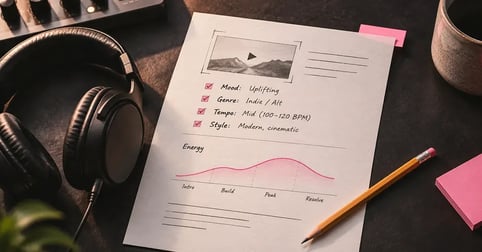
A music brief is a one-page document that tells whoever finds or writes your music what the track has to do, where it will run, and which rights it needs. Write it in this order: the job, the moments, the feel, references, technical specs, usage, then timeline and budget. A copy-ready template sits further down.
Most briefs go wrong in the same two places. They describe a genre instead of the job the music has to do, and they leave usage out, so the shortlist that comes back sounds right and can't be cleared for where the spot is actually running. This guide covers what a music brief is, how it changes depending on who reads it, a seven-step method for writing one, a fill-in template, and how a music brief differs from a sync brief.
Turn your brief into a shortlist
Put your brief to work: search the music library by mood, tempo and length and build a shortlist.
What is a music brief?
A music brief is a short written request that describes the job a piece of music has to do in a specific video, ad or film. It covers the moments the track has to hit, how it should feel, the references to aim at, the technical deliverables, and the usage the track has to clear. It's the shared reference between the buyer and whoever finds, writes or clears the music.
What a music brief is for
A brief does two jobs. It cuts search and revision rounds, because nobody is guessing. And it settles usage before anyone falls for a track. Music isn't a finishing touch, either: the IPA's 2025 Effectiveness Conference gave a session to new evidence on how music choices drive emotional impact, brand recall and effectiveness.
What a music brief looks like
One page of labeled fields, not paragraphs. The template further down shows every field with an example filled in.
Who reads your music brief, and how that changes it
The same music brief gets read three different ways. A library search needs filterable attributes: mood, energy, tempo, vocal or instrumental, length. A composer needs the moments and the emotional arc against picture. A music supervisor or sync team needs usage, territory, term and budget first, because those decide what can be cleared at all.
A self-serve library search
If you're searching a catalog yourself, translate the brief into queries and filters: the feeling line becomes the query, the length a duration filter, "instrumental under voiceover" a vocals filter. Supe, Soundstripe's search tool, takes plain-language descriptions, so a well-written feeling line works as a search on its own. You can also paste a Spotify, YouTube or Apple Music link from your references and pull catalog tracks with a similar tempo, key and mood.
A composer writing custom music
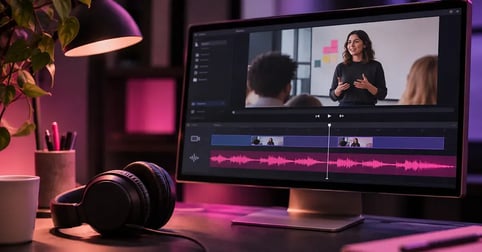
A composer writes to picture, so the brief has to carry it: timecodes, hit points, where voiceover sits, how the energy moves. Send a rough edit if you have one. Soundstripe's custom music team works from your brief: you send it, they match a composer, and the track gets built to it.
A music supervisor or sync team
Supervisors handle music across film, TV, games, advertising and trailers (that's the scope the Guild of Music Supervisors describes), and the first thing they need is usage. Media, territory, term and budget decide which tracks are even worth pitching. Soundstripe's sync team asks for the same thing up front: "the track or the brief, the media type, and where it will run."
How to write a music brief in 7 steps
Writing a music brief is a sequence, not a checklist. The job defines the moments, the moments define the specs, and the specs and usage decide what a search can return. Work the seven steps in order and anyone can act on the brief without a follow-up call.
How to Write a Music Brief
- State the job the music has to do
Write one sentence on what the music has to achieve in this edit: carry a product reveal, sit under an interview without competing, drive a 6-second cutdown. Leave genre out of this line.
- Map the moments the music has to hit
List the timecodes that matter, like the reveal and the logo. Note where voiceover needs room and any sound that has to stay audible. These are the points nobody else can guess.
- Describe the feeling before the genre
Say how the viewer should feel at the start and at the end, then add mood, energy curve and a tempo range. Genre labels mean different things to different people; a described feeling is harder to misread.
- Choose references and anti-references
Pick two or three references and say what's right about each one, such as the tempo or the way it builds. Add what to avoid. Treat references as direction, not the target.
- Set the technical specs and deliverables
List every length you'll cut, down to the shortest version. Say vocal or instrumental, note any hard tempo or key needs, and ask for stems or alternate mixes if the edit needs them.
- Spell out usage and licensing
Write down the media (online, paid social, TV, cinema), paid or organic, territory, term, and whether it's client work. Usage turns a track you like into a track you can run.
- Add timeline, budget and who signs off
Give the date options are due, the edit lock and the air date. Add a budget range and name the one person who approves the track.
On references, a 2026 brand guide to music licensing recommends 2 to 3 reference tracks, with what you like about each, rather than leaning on one. Reference track search turns a streaming link into a catalog shortlist. Watch for temp love, when a reference sits in the edit so long it becomes the only acceptable answer.
For the feeling step, see emotionally driven ads with music. For specs, formats set hard limits: YouTube bumper ads run between 5 and 6 seconds, so say whether the track has to resolve inside that window. For deliverables, see music stems.
On usage, a recorded song can carry two separate works, the musical work and the sound recording, and they're commonly owned and licensed separately. That's why master use and sync rights both show up when a track gets cleared. If an organic post might become an ad, say so and read music licensing for social media and ads before you pick. For client work, settle who pays first; see music licensing costs with clients.
Music brief template
This music brief template follows the seven steps in order, so you can fill it in top to bottom. Copy it into a doc, replace the example column with your project, and send it as one page. The example is a 30-second running shoe launch spot with social cutdowns.
For social cuts, lead with the shortest length and note where captions sit. For paid ads and TV, the media, territory and term rows are mandatory. For long-form or streaming work, add a cue sheet to deliverables and name the platform, because platforms set their own rules: Prime Video's music rights requirements make cue sheets mandatory for licensed titles where it holds a first-run or exclusive license, and state it has no blanket agreement covering sync of commercial or production library music in that content. For the creative side, see choosing music for film.
Music brief vs sync brief
A music brief is what the buyer writes to get the right track. A sync brief is the term supervisors, libraries and artists use for a request sent to rights holders and writers to pitch against. The core fields are the same. The difference is the reader: a sync brief is written to be answered with submissions, and the deal that follows is a sync licensing agreement.
Test your brief on real tracks
Brief done? Test it against the catalog and find the track that hits your reveal on the first pass.
Music brief FAQ
A music brief is usually one page of labeled fields: project and format, the job the music has to do, key moments with timecodes, feeling and tempo, references and anti-references, technical specs, usage and licensing, deadlines, budget and approver. Anyone reading it should be able to start without a follow-up call.
A music brief exists to get the right track back on the first or second try. It turns a creative instinct into fields a library search, a composer or a sync team can act on, and it settles usage, territory and term before anyone falls for a track that can't be cleared for where the work will run.
Work in order. State the job the music has to do, map the moments it has to hit, describe the feeling before the genre, choose two or three references with notes, set the technical specs, spell out usage and licensing, then add deadlines, budget and an approver. The template above lays out every field with an example.
A music brief is written by the person buying music to describe what a project needs. A sync brief is the industry term for a request that supervisors, libraries and artists circulate so writers and rights holders can pitch tracks against it. The fields overlap almost entirely; the sync brief is written to collect submissions.
Yes. Include two or three reference tracks and say what's right about each one, such as the tempo, the instrumentation or how it builds, plus anti-references for what to avoid. Treat them as direction rather than the target, so the search finds music with the same effect instead of a soundalike.