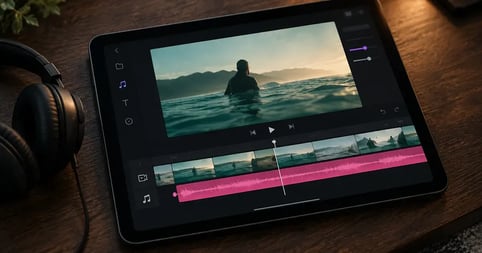
To add music to Alight Motion, open your project, tap the plus button, choose Audio, then tap View All and pick your file. On iPhone and iPad there is a step before that one which most tutorials skip: the audio file has to already be sitting in the Alight Motion folder in Files, or the app will not show it to you at all.
That detail causes most of the confusion around audio here. Alight Motion is a motion design tool first, so its audio browser behaves less like a music picker and more like a file browser pointed at one location. Once you know where it looks, importing takes fifteen seconds.
Below: the steps per device, why an imported file sometimes refuses to appear, what extracting audio does to a track's ownership, and how to tell whether your song is one you can post.
Skip the workaround.
Every track in the Soundstripe library is cleared before you download it. Start listening.

How to add music to Alight Motion
Alight Motion imports audio through the plus button on the project editing screen, under the Audio menu. The app reads one set location rather than scanning your device, so getting the file into the right place is part of the process. The tap path is the same on every device. Where the file has to live is not. The flow resembles how to add music to CapCut, minus the built-in catalogue.
How to add music to Alight Motion on iPhone or iPad
- Move the file into the Alight Motion folder
Open Files, tap Browse, then On My iPhone or On My iPad, and find the Alight Motion folder. If the track is downloading for the first time, save it straight there. If it is already elsewhere in Files, long press it, tap Move, and send it to that folder.
- Open your project
Launch Alight Motion and open the project you want the music in. A brand new project and one you have worked on for weeks behave identically here.
- Open the audio browser
Tap the plus button, choose Audio, then tap View All and select Files. This is the browser that reads the folder you just moved your track into.
- Add the track to your timeline
Tap the audio file you want. It lands on your timeline as its own layer, which you can trim, move, and split like any other layer.
That sequence comes from Alight Motion's own instructions, updated June 2025. The folder sits in the local storage area Apple describes under Browse, then On My iPhone.
On Android
The plus button and the Audio menu work the same way. The file step is where it differs, and it is worth being straight with you: Alight Motion documents iOS only. There is no Android walkthrough in its help center. Android file managers vary by manufacturer, so rather than guess at a path, check where your download landed before hunting for it in the app.
Why your audio file does not show up in Alight Motion
If you imported a track and the audio list is empty, the file is almost certainly fine and in the wrong place. Alight Motion's browser reads one specific folder, not your whole device, so a song in Downloads, in an unsynced cloud folder, or inside another app's storage is invisible to it. Move the file, then reopen the browser.
Two more things to rule out. A cloud file that appears in Files but has not downloaded locally will not import, so tap it once to pull it down. And save anything that arrived through a messaging app into Files first, because chat attachments often sit somewhere the app cannot reach. Location matters more than format, though the best audio format for video editing is worth a read.
Extracting audio from a video is not the shortcut it looks like
Alight Motion can pull the audio off a video layer already in your project. Per the app's documentation, tap the layer, tap the three dots, choose Extract Audio. Useful for sound you shot yourself, or for splitting a voiceover from footage.
It is also the standard workaround for getting a chart song into an edit, and it does not work the way people hope. Extracting audio changes the file. It does not change who owns the recording. A song lifted out of someone else's video is the same copyrighted recording it was before, and the platform you upload to recognises it just as easily. How YouTube's Content ID system works covers the matching side.
Where to find music you can publish
Music you can post is music you hold a licence for, and that comes from a library rather than another video. What royalty free music means is worth reading first, because the phrase gets used loosely and it does not mean free.
Check two things before a track goes in your timeline. Whether the licence covers every place you plan to post, not just today's: a platform's built-in library is usually cleared for that platform alone, the trap the TikTok music library sets when a video gets repurposed. And whether it covers your account type, since TikTok's own guidance (updated July 2025) tells businesses not to use its general library commercially.
Soundstripe's library runs to 116,000 tracks, cleared before download, in WAV or MP3 so the file drops into a mobile timeline as easily as a desktop one. Since Alight Motion is built for motion work, royalty free music for animation is a sensible starting point, and music for videos covers the rest.
What a copyright claim does to your video
A copyright claim and a copyright strike are different things, and mixing them up is why this topic feels scarier than it is. A claim is automated: the platform matches your audio against a database and flags it. A strike is a legal removal request from a rights holder. A claim does not put a strike on your channel.
What a claim does depends on what the rights holder asked for. YouTube explains that a claim can block the video, run ads on it and send the revenue elsewhere, or simply track its views, and any of those can apply in some countries and not others. One case matters if you post short form: a Short longer than one minute with an active claim gets blocked regardless of which option the rights holder picked.
All of it traces back to one fact: a recording carries two separate copyrights, one in the song and one in the recording of it. The U.S. Copyright Office puts it plainly, that using someone's recording requires a licence, a statutory licence, or an exemption. Nothing done inside an editing app substitutes for one. How to license music for video covers the rest.
Start with a cleared track.
Create a free account and search 116,000 tracks that are cleared before you download them.
Frequently asked questions
Open your project, tap the plus button, choose Audio, tap View All, then select your file. On iPhone and iPad the file must already sit in the Alight Motion folder in Files before the app will list it. Move it there via Files, then Browse, then On My iPhone.
On iOS, save the file into the Alight Motion folder inside Files, or long press an existing file and move it there. The app's browser reads that folder rather than your whole device, which is why a track in Downloads or an unsynced cloud folder never appears.
From a music library that licenses tracks for the places you publish. Alight Motion has no built-in catalogue, so every track comes from your own device and the licence is your responsibility. Soundstripe offers 116,000 cleared tracks as WAV or MP3, both of which import fine.
The file format has nothing to do with it. MP3 is a container, not a permission, so an MP3 of a chart song is as copyrighted as the original recording. What makes a track legal to publish is the licence attached to it, whether the file is an MP3, a WAV, or anything else.
Check the licence terms at the source, not the label on the download button. Royalty free describes how payment works after licensing, not whether music is free or uncopyrighted. If a source cannot tell you which platforms its licence covers, treat that as your answer.