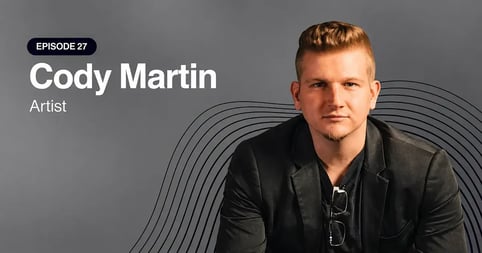
Cody Martin is a composer for film, television and video games who has been writing for the Soundstripe catalog since the end of 2016, not long after the company started. Jeff Perkins puts his numbers on the platform at more than 16 million plays and a million downloads, and his music has turned up in campaigns for Domino's, Crayola and National Geographic. He works out of a studio about three hours south of Nashville, and he taught himself everything in it.
Aaron Sprinkle came on an earlier episode to talk about writing songs for the catalog from the rock side. Cody comes at the same job from the orchestral side, and the two conversations answer different halves of the same question: what do you actually build when the person using your music has not made the video yet?
In this episode of Soundstripe Sessions, Jeff talks to Cody about the two years of mold remediation work that paid for his first studio, the music theory he never learned and does not entirely regret, why a cue written for an editor has to be built differently than a cue written for a scene, and the song he wrote for his wife that became his most downloaded piece of music on the platform.
Key takeaways
- He picked up a guitar at 13, played in a Christian rock band called Oathkeeper in Wisconsin, and got hooked on writing the intros the band walked out to.
- He is entirely self-taught. He calls the rules of theory his biggest crutch, and film scoring the place where breaking them was allowed.
- He spent two years doing water restoration and mold remediation, living at his parents' place rent free, to pay for the gear he needed.
- He applied to Soundstripe once and got in. Every other company he approached took three or four attempts.
- It took three or four years of writing four to six tracks a month before the royalties compounded enough to leave the day job.
- Library music and film music are different builds. A film cue turns on a dime; a catalog track has to sit underneath an edit someone else is still cutting.
- His most downloaded track on the platform is the song he wrote for his wife to walk down the aisle to.
Listen to the episode
Bourbon, a sword on the wall, and a studio he does not leave
The episode starts with Jeff describing what the audio cannot show. Cody is in a treated room with a mixer behind him, soundproofing on the walls, a sword mounted up high, and a glass of something on the desk that keeps jingling.
Jeff: Important first question. What kind of bourbon is that?
Cody: I started off this morning with a casual glass of Blanton's. That's definitely one of my favorites, but I transitioned to a Basil Hayden Dark Rye, which is probably my more average go-to.
It was two in the afternoon. Cody's defense is that the studio is where he lives.
Cody: I rarely leave my house. Half the time I lock myself in here, so most of the time if I am leaving my house, it's either grabbing groceries for my wife and kids or running to grab some Chipotle for lunch. But I make sure that I'm not intoxicated at that point.
Jeff's read on this was that the arrangement sounded less like a job and more like the plot of Breaking Bad, with music instead of chemistry.
Cody: Yeah, but I don't try to escape. I actually enjoy being here. This is my favorite part of my day, just to be able to sit in and drop into a mix or a composition and knock everything out and keep on moving forward.
The sword, for the record, is a Lord of the Rings thing. It comes back later.
Pennsylvania, Wisconsin, and a band called Oathkeeper
Jeff: Let's talk a little bit about your background and your origin story. Where did you grow up?
Cody: I originally was born in Pennsylvania and I lived there till I was roughly 12 years old, and then we moved to Wisconsin. I spent the majority of my teenage years doing rock band and going to concerts and trying to figure out where in the world my role in the music industry laid itself out.
The instrument came at about 13, and it came from watching his dad mess around with one.
Cody: My father had tinkered around with bass guitar and acoustic guitar, and I was fascinated with the idea of just playing to some of my favorite bands growing up, throwing the CD into a CD player and jamming out to what I enjoyed listening to. So I just kind of tinkered around a lot. I would pick it up whenever I had the chance, and eventually I just got hooked and I was playing all the time.
Within a couple of years the interest had moved from playing to capturing. He and his brother started a band with their friends, and then found a studio willing to record them for nothing.
Cody: We found a studio that was willing to essentially record everything for free for us, and we took advantage. So we probably spent 24 to 30 hours of non-stop production. We just didn't sleep. We just kept on recording and testing stuff out. We had access to the studio for an entire weekend without anybody having to interrupt us, so we just took advantage of it and had a blast.
The band had a name and a genre and, now, no recorded evidence.
Cody: The name of the band was Oathkeeper, and we were like a Christian contemporary rock band. We loved playing gigs. We have nothing on iTunes or Apple Music or Spotify. All of that has been wiped from the record. So if you guys do look it up, I'm sorry, you're not going to find nothing.
Oathkeeper is also where he first met a Soundstripe co-founder, years before either of them knew it mattered. Micah Sannan, now co-CEO of Soundstripe, spent four years in the band Disciple, and Oathkeeper opened one of those shows.
Cody: That's kind of how we originally connected, and then we reconnected in 2015, 2016 roughly around that time frame, and got set up with Soundstripe. It was kind of funny. We didn't really realize who each other was until after I was brought on board, which was more ironic than anything else. And then we realized, oh my goodness, we've known each other for a long time.
The rock years did not get left behind either. Acoustic and rock playing still shows up in what he turns in.
Cody: A lot of the elements of rock music or acoustic sort of stuff I've actually implemented into some of the stuff that I've written for Soundstripe. Even the old stuff kind of trickles itself back in every now and then, and that's been a lot of fun.
Self-taught, and the rules he decided to break
Jeff: Did you take lessons growing up, or are you self-taught?
Cody: I am very self-taught. If there was one thing that I could have told myself when I was younger, it was to probably dive into that side of things, especially learning more classically, honing in on music theory and learning that at an earlier stage. It probably would have been a bigger advantage. But my biggest crutch was the rules.
The rules, in his telling, arrived as other people's corrections. You are not doing this the right way. That does not go with that.
Cody: The way that my mindset was when writing music was creating an emotion or evoking an emotion regardless of what the rules of theory really tell you to do. That's when I started realizing that film score and writing to picture was probably more my avenue, because I was okay with breaking rules when they were necessary.
He does not pretend the tradeoff was free. He can name what the missing theory costs him and still land on the same side of it.
Cody: Today I can look back and say, well, this definitely would have been useful if I would have known theory and I would have put a little bit more time into researching it. But I don't know if it would have helped my creativity, because a lot of times music theory can limit what your creative ideas are trying to communicate, especially when you're scoring a picture. So in a way it was a blessing and a curse at the same time.
The permission to work that way came from listening to someone doing it at the highest level. Hans Zimmer is the name he keeps returning to, and the specific thing he took from him is not a sound but a hierarchy: feeling first, correctness second.
Cody: Hans Zimmer obviously knows enough about music from a music theory standpoint to where he knows exactly what he's doing and how he wants to change certain things. But starting off he didn't really follow that path. He wrote more just what he was hearing in his head, and he really improvised and found ways to break the rules when they made sense. It's not about creating this vast, theoretically complicated composition. It's about finding a way to make everything cohesively exist that evokes a certain emotion or feeling within a certain parameter.
Two years of mold remediation to pay for a studio
College lasted about eighteen months across a couple of community colleges, and ended without a degree, because the math stopped working.
Cody: I realized at that point, what I'm learning here is great, but it's not going to really give me an advantage when it comes to how I want to build a business. So I ended up leaving college. I applied for a nine-to-five general labor sort of job.
Jeff: Was it home renovation you were doing?
Cody: The company that I worked for specialized in water restoration and mold remediation. So if a house flooded, or if someone's house was left unattended for six months while it was a vacation home and there was mold everywhere because a pipe burst, we'd go in and clean that up and get the house back to snuff.
Two years of that, for one purpose. The gear he wanted was not cheap, and the reason he wanted it was that sample libraries and virtual instruments had just crossed a line.
Cody: At the time, from a technology standpoint, it wasn't very popular. It wasn't something that a lot of people really thought about in terms of, oh, let's take a bunch of virtual instruments, lump them all together and create something that sounds similar to an orchestral ensemble. Virtual instruments were just starting to get to the point where they were sounding incredibly realistic, and if you used those tools appropriately you could create something that a lot of people would have a difficult time distinguishing between a real live orchestra and something that was virtually recorded.
Cody: So my whole goal at that point was, all right, I'm going to work my tail off for a two-year stretch and invest into the gear that I need to build this, and start honing in my craft, figuring out what type of music I can really create with this.
To compress the timeline he had to ask his parents for something he had never asked for.
Cody: My parents really wanted me to find a way to be successful in what I was passionate about doing. But I had to take the steps in order to actually show them, hey, what I want to do is very unique and kind of unorthodox here, but I really think I could make this work. So I told my dad, I've never asked you for money, I've never asked to live here rent free, but I'm asking now. Can I just live rent free for a year and save up this money so that I can buy the computer that I need, the gear that I need? They took a leap of faith and let me crash for a while.
He is direct about why the shortcut mattered. He could have done it slower.
Cody: I could have done it without doing all that. It just would have taken a lot more time, and for me time was a lot more valuable. I wanted to get into that industry as soon as I possibly could, to really get my foot in the door, because I knew eventually a lot of that stuff was subject to change. Even from a licensing standpoint, things are so much different now compared to what they were ten years ago.
Still clocking in, writing music every night
Buying the gear did not end the day job. It ran alongside it for another year and a half.
Cody: I was still working full-time. I wasn't just going to quit my job now that I had all the money that I needed to buy the gear that I needed. It was kind of a, I'm going to work a nine to five, I'll clock out, I'll come home, I'll eat dinner, and then I'll spend the rest of my night writing music. And that's what I did for about a year and a half.
He is not sentimental about what came out of that stretch.
Cody: I look back now ten years ago and I'm thinking, wow, what was I thinking? Why was I doing this? From a mixing standpoint I look back at my mixes then and things have really evolved since then. But at the time I was thinking to myself, yeah, I'm ready for this. It's been a year, I've written a fairly large catalog of music, I'm going to start applying different places.
Two of those applications turned into work. One of them stuck.
Cody: The two places that I found the most success were with you guys and then one other licensing company, which unfortunately I don't really do any work for anymore. I'm almost exclusively Soundstripe related, just based off of how successful everything has been and how amazing the team over here has been. It's almost been exclusively Soundstripe material for the last three years or so.
The Soundstripe application is the part he still finds odd.
Cody: I think I only applied once, which is surprising. Every other place that I ever applied for, I had to probably apply three or four times, like you do for most companies. But again, at the time it was a very different sort of atmosphere, because licensing was just kind of starting to become a little bit more of a popular thing for musicians to be able to approach.
That timing point is the one worth stealing if you are a writer sitting on unreleased material. His argument for production music is that it is a destination for finished work that otherwise has nowhere to go.
Cody: There are a lot of musicians and composers and songwriters that have so much that's just sitting there that they don't know what to do with. That's the beauty of the licensing industry. You've got so many different avenues that you can be pouring and funneling this music into.
Why it took three or four years to quit
Jeff: At what point did you feel like, okay, I could quit my day job and just do this full-time?
Cody: It probably took about three years, three or four years. At the time it was more of like, this is great, I have a monthly income that I can rely on if I'm writing a specific amount of tracks every month, my bills are getting paid. For the first year and a half, two years, almost three years really, I was able to at least pay a large portion of my bills with the stuff that I was earning from Soundstripe. But I still wasn't earning enough to where I was able to go full-time.
Then the second income stream caught up with the first. This is the part he wants aspiring composers to understand, because it is the part that looks like nothing is happening.
Cody: Something clicked, I think by the third or fourth year, where the royalties were starting to really build. And it takes about that amount of time, no matter who you're signed with or what sort of contract you have. If you're writing four to six tracks a month for anybody and they're all getting registered and they're all getting distributed, eventually the catalog continues to build, and so do the royalties. They just continue to snowball.
What tipped the decision was not a number. It was arithmetic on hours.
Cody: It was about the third or fourth year where I realized, wow, it's more secure for me to be able to be confident enough to leave my nine to five and just do this full-time, and find ways to utilize the time that I actually have. It makes more sense to have 12 hours of time available to me as opposed to only six hours a day. Finding ways to utilize that time, whether it was searching for clients, going to conferences and connecting with people, networking with people. It just opened up a much bigger door.
Jeff's summary of the royalty model is the cleanest version of it in the episode: you keep working, but a growing share of what you are paid is for work you finished years ago. Cody's own framing of it is a warning as much as an invitation.
Cody: It's definitely not impossible to achieve, but you have to be able to invest a lot of your time, effort and energy into building something like this, because it's not something that just happens overnight. You have to put a lot of time into it in order for you to see the results that you want.
Zimmer, Newman, Williams, and the difference between them
Jeff: I want to talk about your influences. Who else were your influences musically?
Four names, and a clear reason for each. He starts with the one he does not fully connect with, which is the interesting answer.
Cody: So many composer buddies of mine love John Williams. I love John Williams. His stuff is so insanely great. But I never really connected with John Williams' work unless it was a blockbuster, a century shattering film that defines pop culture in a new form. He was so good at building these worlds from a musical perspective, but they were always strictly classically interpreted. He didn't break the rules like Hans Zimmer would in most cases. He stuck strictly with a symphony orchestra and for the most part utilized every element of the orchestra to conduct what he wanted to portray on screen.
If you want the counterargument, our piece on what John Williams' most famous scores can teach you makes the case for the orchestral discipline Cody is describing here as a limit.
Zimmer is the opposite pole, and the example Cody reaches for is Sherlock Holmes, where the instrument list was assembled rather than inherited. Zimmer built that 2009 score around banjo, cimbalom, squealing violins and a deliberately broken pub piano, and for the 2011 sequel he traveled to Slovakia to find Roma musicians and brought them to Vienna to record.
Cody: He would use a lot more non-traditional instruments, synthesizers and modular synths, and he'd travel across the world just to capture really unique indigenous instruments, so many different elements of different cultures and styles, and he would blend these things together to create something so insanely unique. For him, the soundtrack for every film should have its own unique orchestra. Finding a way to shape the feeling of that was always the most inspiring for me.
Thomas Newman gets described as the midpoint, which is a useful way to hear him.
Cody: Thomas Newman kind of did a combination of both. He was the in between between John Williams and Hans Zimmer. He definitely stuck himself more in the orchestral symphonic element, but he loved finding ways to warp and manipulate the instruments that he had to evoke those feelings.
The fourth name is Harry Gregson-Williams, who was mentored by Zimmer at the studio then known as Media Ventures and went on to score The Chronicles of Narnia: The Lion, the Witch and the Wardrobe in 2005. Cody's attachment to that score is specific.
Cody: One of my favorite soundtracks of all time is The Chronicles of Narnia, The Lion, the Witch and the Wardrobe. That soundtrack was for me one of the best adaptations of C.S. Lewis's work. He also did a really great job of combining different elements together, not sticking strictly with the orchestra, but finding ways to create the atmosphere that was needed to lift this film into something even more notable.
And then the Lord of the Rings sword on the wall gets its explanation.
Cody: Obviously I'm a very big Lord of the Rings fan, so Howard Shore's music for those films is absolutely spectacular. And he's obviously worked on a slew of amazing films as well, so I don't get tired of listening to his stuff either.
What he listens to when he is not working
Jeff had asked J.R. McNeely a version of this question on an earlier episode and gotten a slightly bleak answer: the job takes some of the pleasure out of just listening, and concerts are ruined by the mix. Cody heard that episode and wanted to file a partial dissent.
Cody: I can't go that far. For me, when it comes to listening to music on my off time, I love it. I love listening to other artists and other composers. My kids love listening to my work. They'll just hop on Spotify or Apple Music and throw my music up, and most of it's the Soundstripe stuff, and they'll have it playing up in the living room while they're playing.
There is exactly one thing that wears him out.
Cody: Every now and then they'll just randomly switch to a random Christmas album in the middle of July. The only time where I ever get tired of listening to music is if it's Christmas music in the middle of July. Apart from that, even if I'm out on vacation and I'm just chilling, most of the time I still have music stuck in my head.
He does grant J.R. the underlying point, which is about silence rather than about music.
Cody: I understand what he means when he says that. There are times where you'd like things to just be quiet for a second, so that you can take a breather and then keep on pressing into what you're really passionate about.
Then the actual answer, which is not orchestral at all.
Cody: I'm more geared toward listening to the stuff that I listened to in high school. I like the nostalgic stuff. I listened to the 2000s punk rock era. I listened to a lot of Relient K, which ironically was J.R.'s wheelhouse. He did a lot of things with Relient K. When we connected on Soundstripe and I found out that he was going to be mixing a lot of my stuff, I think I was probably three years into Soundstripe at this point, and I had a fan geekout moment. I was like, oh my goodness, this is the best day of my life.
Alongside that: Skillet, Avenged Sevenfold, Papa Roach, and punk rock generally, which he admits is a strange listening diet for someone who writes orchestral music all day. Jeff guessed folk, something closer to a bridge back to classical. Cody went the other way on purpose, and one album explains the whole apparent contradiction.
Cody: Skillet released an album called Comatose, and that was one of my favorite rock albums of all time, because they were the first rock band that I saw that started implementing orchestral elements, whether it was cellos or violins or whatever. They found a way to bring a cinematic element into their creative style and their writing style. I remember going to their concerts and they would have the most epic introductions for a rock band coming onto stage.
That is the connective tissue between the punk records and the day job. The thing he was chasing in a live room in the mid 2000s is the same thing he now builds on purpose.
Cody: That was probably the precursor into how I got really motivated into orchestral stuff, because I realized, huh, whenever I'm watching a movie, if I'm visualizing something that has an orchestral element to it, it has a much higher probability of bringing in that euphoric goosebump sort of moment.
Asked why that works, he does not claim to know, and the not knowing is most of why he stays interested. If you want the research side of the same question, we have a longer piece on the psychology of music and how it moves an audience.
Cody: There's something about the arrangement of these instruments, the way that everything is structured, and the way that people creatively use their own inspiration to create something so insanely unique that sounds completely different from everything else. This element of music is just never going to go away. It's almost like it's its own language. You're breaking the barriers of language when it comes to using orchestral music, because it's something that creators and composers can use to really support or enhance whatever story you're trying to tell.
Writing for an editor is not the same as writing for a scene
This is the practical center of the episode. Cody does both jobs. He scores films, and he writes tracks that go into the catalog for someone he will never meet to cut into a project he will never see. Jeff asked whether the process is the same.
Cody: No, in most cases it's actually quite different. And I say that just based off of what the end goal is.
The first difference is who he is imagining on the other end.
Cody: For Soundstripe I have to visualize that most of the creators on the platform are going to be aiming for YouTube channels, or these could be wedding videographers, or these are going to be producers or editors that are looking for something to cue in on a show. So I've got to find a way to structure the music in a way that's going to be beneficial for them to use in the editorial phase, versus me scoring to something so narrow and specific to an actual film.
The second difference is structural, and it is the sentence worth writing down if you score picture for a living.
Cody: On the orchestral side of things you have to write in a way that helps carry the story forward. So if there's an explosion, or if a shot transitions from one moment to another or from one person to another, the whole tone of the music might have to change within a five-second stretch. With licensing and with platforms, you have in a lot of ways to simplify what is needed to create an emotion.
His own formulation of the library brief is the best definition of underscore anyone has given on this podcast: music that creates the room without asking to be looked at.
Cody: If I'm doing licensing work, I have to create an environment and an atmosphere that can essentially tuck itself in the back and not necessarily take priority, but still create the environment that the editor or the producer needs in order to get the job done.
Which means his templates for the catalog are built differently from his templates for film. Fewer turns, more room.
Cody: With Soundstripe you get more success in creating things more simply and really establishing the quality and the environment, versus keeping things really complex and having certain things come in and out and transition back and forth from happy to sad, from sad to suspenseful. You're doing less transitions and you're just creating an environment that actually works better for the editor or the producer, whoever it is that's really trying to align the vision with the project that they're working on.
That is a design decision, not a compromise, and it is the reason a good royalty free cinematic track can sit under a two-minute brand film and a fifteen-minute documentary cut without fighting either one.
Three tracks from the catalog
Jeff played three of Cody's tracks in the episode and asked him what was behind each. All three are in his catalog page, and like everything in the library they go through the Soundstripe mixing and quality control process before release. Cody has rotated through a few of the staff engineers over the years, J.R. McNeely among them, and currently works with Eric.
Underdark
Jeff heard something close to the Dark Knight in it: haunting, heavy, superhero adjacent. That was three films away from right, and Cody named all three.
Cody: When I was sitting in and putting that particular track together, I was kind of trying to find a way to blend Dune, Mad Max and Dark Knight all into one big, massive, crushing track. And that was kind of the end result. There were a lot of elements out of those three films that I really liked listening to, and I kind of used as a reference when I was building the template and the instrument arrangement.
Cody: It's got some string elements in it, but it's very hybrid orchestral, and it's got its own characteristic that kind of defines that moment in cinema where Mad Max and Dark Knight and Dune were really taking the reins in terms of the sort of music that a lot of people were listening to.
Revelry
The second one goes the other direction entirely. Jeff described a hero's journey, someone finishing something and running to hand it in. Cody's own label for it is less romantic and more honest about the brief.
Cody: That one was very corporately approached. It has more of a corporate sort of vibe to it, and those were always tracks I have a lot of fun creating, because it has a very innovative and kind of uppity approach, and it's very versatile when it comes to what you can use it for.
Cody: I remember it being quite popular the last few months, just because of the sheer versatility of what people were able to use it for. The original inspiration was, yeah, very corporate, maybe a little bit romantic, and finding ways to just keep things playful and entertaining in that regard.
You can hear Revelry in the library.
Moving Mountains
The third one is his most downloaded track on the platform. Jeff told him that on air, and it was news to him.
Cody: That actually is news to me, but that's very ironic, because that was actually the song that I wrote for my wife right before we got married. That was our wedding song essentially. We played a portion of it during the time that my wife was actually walking down the aisle.
Asked what he was trying to say with it, he went further back than the wedding.
Cody: When I was in my early 20s, this is before my wife and I had met, the first few years of my 20s were a pretty dark area of my life. And when my wife and I met, a lot of that dynamic had shifted. That was the first time in a long time where I was just in this blissful state of acknowledging an unconditional love sort of scenario.
Cody: I wanted my best to really evoke that emotion of what it feels like when you have no barriers, no challenges, no difficulties in front of you. And even if they are there, you're not bothered by them. They feel like nothing compared to what you already have in front of you. I wanted it to be this very uplifting, romantic, blissful track that was encouraging and inspiring, something that people would be able to listen to and use in the same fashion that I originally intended it to be used for.
That last clause is the whole logic of the catalog in one line. He wrote it for one specific person on one specific day, built it so someone else could use it, and it turned into the most downloaded thing he has. Moving Mountains is in the library, and there are five more of his tracks in our roundup of royalty free orchestral music.
Advice for teenage Cody Martin
Jeff: If you could go back and give teenage Cody Martin one piece of advice or wisdom, what would it be?
Cody: Do not let anybody tell you how to pursue your passion. If they're telling you that you don't have the ability to achieve what you're passionate about, that's the last piece of advice that you should be listening to. If someone's telling you that you're not good enough, you keep on pressing forward and keep on doing it.
He is not speaking hypothetically. People told him this directly, and he does not think they were being cruel.
Cody: I've had a lot of people in my life that have told me that I would not find success in this industry, and I wouldn't find a way to make things work, and I should cut my losses and just move on with life. The condition of their heart from that was great. But when you're passionate about something and you know that you have a calling in this, especially if you're in the early stages of figuring out what it is that you're wanting to do with it, the worst thing that you can do is just drop it and move on to something else.
The second half of the answer is about who you stand next to while you do it.
Cody: The more people that you spend your time with that excel in that same thing, the more people you surround yourself with that can encourage you and move you forward and propel you into an area of success, the happier you're going to be and the more content with life you're going to be as well.
Frequently asked questions
Who is Cody Martin?
Cody Martin is a composer for film, television and video games who has been writing for the Soundstripe catalog since the end of 2016. He is entirely self-taught, works primarily in orchestral and hybrid cinematic music, and writes from a studio about three hours south of Nashville. In this episode Jeff Perkins puts his numbers on the platform at more than 16 million plays and a million downloads, and his music has appeared in campaigns for Domino's, Crayola and National Geographic.
Is Cody Martin classically trained?
No. He is self-taught, and he says learning theory earlier would have been an advantage he does not entirely wish he had taken. His view is that the rules of theory were his biggest crutch as a young writer, and that film scoring appealed to him because breaking those rules was allowed when the emotion called for it. He picked up his first instrument at around 13 and learned recording and mixing alongside playing.
How did Cody Martin pay for his first studio?
He left community college after about eighteen months, took a nine-to-five job doing water restoration and mold remediation, and worked it for two years while living at his parents' place rent free with their agreement. He then kept the job for another year and a half after buying the gear, writing music every night after dinner, before he had enough of a catalog to start applying to licensing companies.
What is the difference between writing library music and scoring a film?
A film cue has to carry the story, so the tone may need to change inside a five-second stretch when the shot or the scene turns. A library track has to work for an editor who is still cutting, so it is built simpler and with fewer transitions: an environment that sits behind the picture and creates the feeling without taking priority. Cody keeps separate templates for the two jobs for exactly that reason.
How long does it take to earn a living writing music for a licensing platform?
In Cody's experience it took three or four years. For the first two to three years the income covered a large portion of his bills but not all of them. The shift came when royalties from a catalog he was adding four to six tracks a month to began compounding, since registered and distributed tracks keep earning after they are written. His warning is that the pattern is consistent and slow no matter which company a writer signs with.
What is Cody Martin's most downloaded Soundstripe track?
Moving Mountains, which he wrote for his wife before they were married and played while she walked down the aisle. He did not know it was his most downloaded track until Jeff told him during the episode. The other two tracks played in the episode are Underdark, a hybrid orchestral piece he built by blending references from Dune, Mad Max and The Dark Knight, and Revelry, a versatile corporate-leaning cue.
Who are Cody Martin's biggest influences?
Hans Zimmer, Thomas Newman, John Williams, Harry Gregson-Williams and Howard Shore. He draws a distinction between them that shapes his own writing: Williams worked strictly within the symphony orchestra, Zimmer assembled a new orchestra for every film out of non-traditional instruments, and Newman sits between the two. Away from orchestral music he listens mostly to 2000s punk and rock, including Relient K, Skillet, Avenged Sevenfold and Papa Roach.