Delay is an audio effect that records a sound and plays it back a moment later, so you hear the original followed by one or more repeats. Those repeats can land once as a tight slap, or stack into a fading trail of echoes. Producers reach for delay to add space, width, and rhythm to a track without blurring it the way reverb can.
You have been hearing delay your whole life without naming it. The doubled vocal on a fifties rockabilly record. The guitar figure bouncing between your ears. The last word of a line repeating twice and gone.
This guide covers the three controls behind every delay, the main types and what each sounds like, the millisecond ranges that turn thickening into echo, how delay differs from reverb and latency, and how to recognise it on a record somebody else mixed.
You can hear it. Now go find it.
You can hear the delay you want. Skip the plugin chain and start from a track that has it.
What is delay in music?
Delay is a time-based audio effect. It captures an incoming signal, holds it for a set interval, then plays it back so the repeat arrives as a separate audible event. Three controls do most of the work: how long the effect waits, how many times the sound repeats, and how loud those repeats sit against the original. The repeat is normally quieter and duller than the source.
A real echo loses energy on the way back to your ears and the highs go first, which is why a delayed repeat reads as further away. Delay sits in a different family from compression in music: compression changes how loud things are, delay changes when they happen.
Delay time
Delay time is the gap between the original sound and its first repeat, set either in milliseconds or in note values locked to the project tempo. Pin it to an eighth note and it stays in time as the tempo moves. This control decides whether you hear thickening, a slap, or rhythm.
Feedback
Feedback routes the delayed signal back into the effect, so each repeat generates another. Low feedback gives a repeat or two, high feedback a long fading tail. Push it far enough and the repeats stop fading, start building, and run away into overload.
Mix (wet and dry)
Mix balances dry (untreated) against wet (delayed). The delay usually wants to sit under the source, not beside it: audible when you listen for it, unnoticed when you are not. Getting that wrong turns a clear mix vague, the same discipline as setting audio levels anywhere else.
Delay vs reverb vs echo
Delay gives you repeats you can count. Reverb gives you so many overlapping reflections that they blur into one continuous wash, and no single reflection can be picked out. Echo is not a third effect: it is delay at a long enough setting that every repeat reads as its own event. Clap in a stairwell and you get reverb. Clap across a canyon and you get echo.
The practical difference is clarity. Reverb surrounds a sound; delay repeats it and leaves the original untouched in the middle. That is why a heavily delayed vocal still sounds close and direct while a heavily reverbed one drifts back and goes vague, and why a short delay often fixes a muddy mix that more reverb would worsen. Manufacturers describe delay time and number of repeats as the two parameters that define it. Where each belongs in a session is a sound editing vs sound mixing question.
Is delay the same as audio latency?
No. Delay is an effect you add on purpose, to a source you choose. Latency is lag you never asked for: audio drifting behind picture, a monitored take arriving late in your headphones, a wireless speaker running behind the room. The two share a word and very little else.
The one place they meet runs the other way. Engineers sometimes delay a whole audio mix on purpose, by the right amount, to line it back up with a video that is lagging behind it. That is delay as a repair: everything at once, no repeats, no audible effect.
The main types of delay
The types of delay differ in the character of the repeats, not the underlying principle. Digital repeats are clean copies. Tape and analog repeats degrade a little further every time they recirculate. Slapback, ping-pong, multi-tap, and reverse describe where the repeats land or how they play back, not how they are generated. Producers work with six or so common types.
Digital delay
Digital delay stores the signal and plays it back with no loss, so every repeat is accurate. It has less character than the types emulating old hardware, which is why it is useful: space without colour.
Tape delay
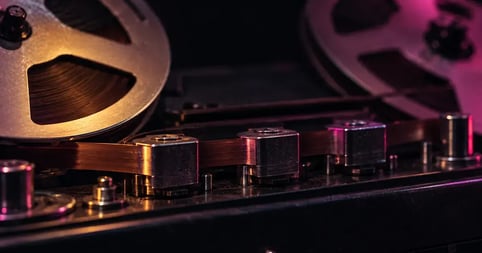
A tape machine has separate record and playback heads, and tape takes time to travel between them, so feeding playback back to the record head produces a repeat. Head spacing and tape speed set the gap. Because every repeat re-records the last, the echoes pick up saturation and wobble and darken until they fade. That degradation is the sound people want.
Analog bucket brigade delay
Analog delay arrived as a smaller, sturdier alternative to a tape machine. The signal passes along a chain of switched capacitors, one step at a time, the way a line of people passes buckets. It loses definition at every handover, giving a gritty, lo-fi repeat and not much delay time.
Slapback delay
Slapback is a single fast repeat, close enough behind the original to read as one thickened event rather than an echo. It is the sound on early rock and rockabilly vocals. If a vocal sounds doubled but you hear no second voice, this is usually why.
Ping-pong and stereo delay
Stereo delay runs independent times on the left and right channels. Ping-pong goes further, with two delay lines each feeding the other so the repeats bounce side to side. Set the left line to 150 milliseconds and the right to 200, and the first repeat lands at 150 milliseconds and the second at 350. Very short offsets between channels widen a mono source instead, a trick called the Haas effect, the mechanism behind much of what gets called 8D audio.
Multi-tap delay
A multi-tap delay offers more than two delay lines, each with its own time, level, and pan position. The name comes from tape machines with several playback heads reading the loop at different points. Instead of an even train of repeats you get a designed rhythm, which turns a single hit into a rhythmic figure.
Reverse delay
Reverse delay plays the captured audio backwards, so each repeat swells in rather than hitting and decaying. Psychedelic, and practical: the repeat opens with the fading tail and puts the transient at the end, which keeps it out of the way of percussion.
How delay time changes what you hear
Delay time changes the result more than any other control. Very short offsets do not register as repeats at all; they thicken the sound. Mid-length offsets separate into a distinct slap. Long offsets read as rhythm or atmosphere. The ranges below are working conventions, not hard thresholds.
Roughly 20 to 50 milliseconds: thickening and doubling
Set a delay this short and your ear stops hearing two events. Below roughly 30 milliseconds the repeat stops registering as a repeat and changes the timbre instead, through comb filtering between original and copy. Engineers work here to fatten a guitar or a stack of backing vocals with nobody noticing an effect is on. One recommendation puts the window around 20 to 40 milliseconds.
Roughly 50 to 125 milliseconds: slapback
Here the repeat separates into its own audible hit. Classic tape slapback landed here because head spacing and tape speed set the gap, which came out at just under a tenth of a second. The fifties sound is less a style choice than a consequence of the machines.
300 milliseconds and up: rhythmic and ambient
Long delays stop being texture and become a part. Lock them to the tempo and the repeats become rhythm. Add feedback and they become atmosphere. It is where sound design in film borrows delay to place a voice or a footstep in a space.
How to hear delay on a record you did not make
Almost every guide to delay teaches you to dial it in. Very few teach you to hear it, which is the skill you need when choosing a finished track rather than mixing one. Listen at the ends of phrases, where the repeats sit exposed rather than buried under the next line.
- A repeat that follows the phrase rather than surrounding it. If it surrounds it, that is reverb.
- Repeats you can count. Two, three, four, then gone.
- A trail that gets darker as it fades. Tape or analog character.
- Repeats alternating between your ears. Ping-pong, easiest on headphones.
- A vocal that sounds doubled with no second voice. Slapback.
- Repeats landing on the beat or offbeat. The delay is synced to the tempo.
One caution. On a finished stereo mix the delay is printed into the record and there is no turning it down. Music stems get you closer to the individual parts, but even a stem usually arrives with its effects committed.
Delay in royalty free music
Licensed music arrives mixed. The delay on the vocal, the width on the guitars, the tail on the last chord: it was all decided by whoever made the record and baked into the file you download. You are not choosing a delay setting. You are choosing a track that already has the treatment you want.
Which makes listening the real skill. For a vocal that feels close and immediate, look for tight repeats and short tails. For distance and atmosphere, look for long synced delays with feedback. If you are still working out what royalty free music covers, start there first.
The track choice is the effect choice.
The effect is already in the record, so the real decision is which record you start from.
Delay produces repeats you can count, arriving one after another behind the original sound. Reverb produces so many overlapping reflections that they blur into one continuous wash with no individual repeat audible. Echo is not a separate effect but delay set long enough that each repeat reads as its own event.
It depends on the vocal, and no single preset works everywhere. Roughly 20 to 50 milliseconds thickens the voice without sounding like an effect. Around 50 to 125 milliseconds gives the retro doubled slap. Longer settings locked to the tempo add rhythm. The constant is keeping the repeats quieter than the dry vocal.
Both orders are used and neither is wrong. Delay into reverb smears the repeats into the space, blending and softening them. Reverb into delay repeats the already reverberant sound, so each repeat carries the room. Pick based on whether you want the repeats blended or distinct.
Digital delay gives clean, accurate repeats. Tape delay adds saturation and wobble that build with each repeat. Analog bucket brigade delay is grittier and shorter. Slapback is one fast repeat. Ping-pong and stereo delay spread repeats across the stereo field. Multi-tap runs several independent lines. Reverse delay plays repeats backwards.
No. Delay is an effect added deliberately to a chosen source to create audible repeats. Latency is unwanted lag, such as audio drifting behind video or a monitored take arriving late in headphones. The only overlap is corrective: an engineer may delay a whole mix to bring it back into sync with picture.