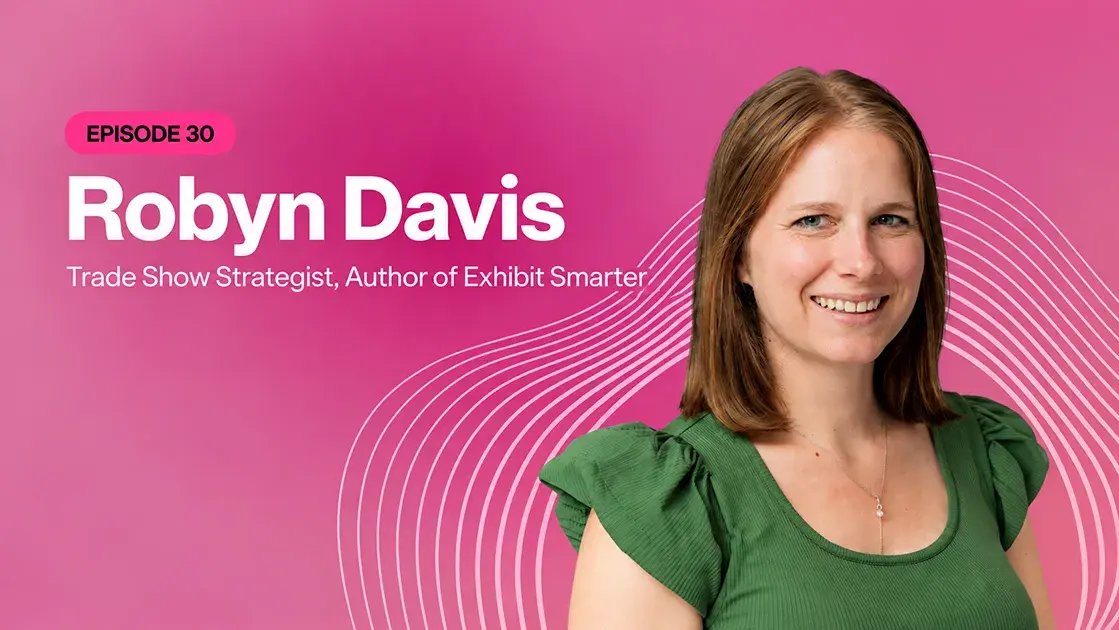
Robyn Davis builds exhibitor training programs for trade show organizers, including the SHOT Show, IMTS and CONEXPO-CON/AGG. Through her company, Exhibitors WINH, she teaches the companies paying for booth space how to get something back for it. She has an aerospace engineering degree, certifications in talent development and exhibition management, and a new book, Exhibit Smarter: A Step-by-Step Guide to Trade Show Success.
In this episode of Soundstripe Sessions, Jeff Perkins talks to Robyn about the salary number that sent her from aerospace into promotional modeling, the eight-week pre-show plan she recommends, why you should never buy an attendee list, what a booth is actually for, the test she runs on every giveaway, what exhibiting really costs, and the two weeks after the show that decide whether any of it worked.
This one is a practical episode. Jeff has worked trade shows for Autotrader, ParkMobile and a software testing company, so half the conversation is him describing things he has tried and Robyn telling him, kindly, which ones worked and why. If your team has a booth on the calendar this year, it is worth the hour.
Key takeaways
- She turned down a government aerospace job on her first day because of the salary on the paperwork, then worked NASCAR races and state fairs to pay the bills until the next hiring cycle.
- The biggest exhibitor mistake is treating the show as three days. The work that pays off happens in the eight weeks before and the two weeks after.
- Don't buy attendee lists from third parties. One large show she works with bought a list to test it and found fewer than 10% of the names were actually attending.
- A booth serves two audiences: the attendee walking by, who needs to know in a glance whether you are for them, and your own staff, who need the backdrop as a reminder of what to say.
- The Robyn Davis test: if Robyn wants your giveaway, it is probably the wrong giveaway, because she can't buy anything from you.
- Booth space used to be about a third of an exhibitor's total cost. She says it is now closer to a fifth.
- Follow up within 24 to 48 hours, then make three to seven touches over two weeks depending on how qualified the lead is.
Listen to the episode
What she's working on right now
Robyn described herself as being in book mode. The release falls in the middle of her busiest stretch of the year.
Robyn: I do have some of my other trade show organizer events coming up. When this airs, it'll be the beginning of October and I'll be on my way to IMEX America, which is one of the largest trade shows for trade show people, and all different types of tourism and things like that. I'm speaking to their Future Leaders Forum, which is a passion of mine, to support young professionals early in their career. And then a little later that month I get to go to NBAA-BACE, which is a trade show for professionals in the private aviation industry. There's a trade show for everything.
Jeff agreed, and listed the ones he has worked: software testing, medical devices, parking, and now music. That observation, that most people never notice trade shows are an industry of their own, is a big part of why she wrote the book.
Robyn: I think there's a lot of professionals out there, startups, small businesses, corporate marketers, who go to trade shows and they spend a quarter, a third of their budget for the whole year on just their trade shows, but they don't have any strategy behind it. They don't know how they're supposed to do it properly. They get so bogged down by the logistics that they aren't actually achieving their goals. Organizers can offer support to their exhibitors, but only about 30% of organizers do. A lot of exhibitors don't take that on for themselves either. But anyone can afford a $30 book. So I hope this fills that gap for those professionals.
From aerospace engineering to the show floor
Jeff asked the obvious question: how does an aerospace engineering graduate become the trade show expert? Robyn calls it a wild story, and it starts with a number on a form.
Robyn: I graduated and I had a few really great job offers right out of college, and I was pretty proud of that. I picked one that was this top secret middle management thing for the government. But on my first day I'm signing the paperwork and there was a number on the page and I was like, "What is this number?" And they're like, "That's your salary." And I'm like, "No, it's not." It was a lot lower than I expected. Being fresh out of college, I didn't know I could argue with that. It was just a big misunderstanding, and I walked away.
Robyn: Aerospace engineering hires about twice a year. That's their typical hiring cycle. So I needed to find another way to pay my bills until the next season, and I fell into promotions. NASCAR races, state fairs, things like that. I ended up being really good at it, managed a mobile marketing tour, and met the stand-and-smile booth bunny girls. I like to clarify it was always the business suit kind, not the bathing suit kind.
The work paid better than the promotions circuit. It also left her feeling useless.
Robyn: They give you too much hair and makeup, a stack full of flyers to pass out, and that's kind of it. With my engineering degree, I really just wanted to do more. I didn't like feeling helpless. So I went home from one of those trade shows and I started cold emailing exhibitors, before it was spam. I'd send out hundreds of messages a day with my headshot and resume to exhibitors all over the country and say, "I'll still come stand and smile. You won't have to pay me any more, but I want to learn about your company so I can be helpful."
Out of that came the frameworks, then training and consulting, and then a second scaling problem.
Robyn: If I can help one exhibitor and I want to do this for the rest of my career, why couldn't I help all the exhibitors and make the business really scale? That's when I started working with trade show organizers to help all of their exhibitors. And now that I work with some of the largest trade shows in the country, I was looking for a way to scale again. That's where Exhibit Smarter comes in, so that professionals who don't have such generous organizers can take advantage of it too.
The biggest mistake: thinking it's three days
Asked for the single most common mistake she sees, Robyn did not hesitate.
Robyn: One of the biggest things I see exhibitors do is come to a trade show and think it's just those three days that matter. They don't worry about before or after. They kind of check the boxes and show up, and then they hope that some magical money truck is going to back up into their booth and make everything work for them. When you only focus on those three days, you miss out on your pre-show marketing, you miss out on the strategic partnering opportunities and everything else you could be doing before, and then the follow-up and evaluation, all the things you could be doing after.
Jeff's experience matched. Every time he has joined a new company and looked at its trade show program, the before and the after are where the balls get dropped.
Robyn: If they're doing any pre-show marketing, it's a single email or a single phone call, or it's a bunch of posts on social media that are the same image over and over. Come to my booth, come buy my stuff. And follow-up, if they're lucky, will be a month later, and they'll say, "Oh, I didn't want to bother anyone sooner." I think a lot of exhibitors misunderstand that attendees really do want to find the right solutions. They're paying to travel, if not for their registration as well. They're taking time out of their office and away from their family, and they're looking forward to connecting. For exhibitors to hold back because they don't want to bother anyone, I think it's a real disservice to the attendees.
Eight weeks of pre-show marketing
Robyn's pre-show plan runs eight weeks. It uses several channels so you are not repeating yourself, and it moves through topics in a sequence so the outreach builds instead of nagging.
Robyn: I like to pick two or three communication methods. It could be email, social media, phone calls or text messages. There's a whole bunch of options, but pick at least two or three so you're not doing the same thing back to back. Then move through different topics over that time. I split the eight weeks into four segments. I like to start with awareness building, where you make sure everyone knows about the trade show, knows about your affiliation with it, and knows why they should be registering already. So it's not just about you. It's about serving your audience and what they need to know to get engaged sooner.
There is a timing reason that matters more every year. Attendees are committing later.
Robyn: I was just at an event for the top 100 trade shows in the country, and they were showing statistics on the screen that registration times are getting shorter. People are registering closer and closer to the event, and they're missing out on a lot of the helpful information that show management is sending out in advance, and that the exhibitors who are doing this the right way are sending out in advance. Having that prerequisite content to help attendees have a better experience is a gap exhibitors could fill.
Narrow is better than wide
Jeff asked how wide to cast the net: all 3,000 attendees, or the 300 you actually want? Robyn's answer came with a country music analogy.
Robyn: Focus as narrowly as you possibly can, because then you can be more specific in your communications and it will resonate more. Think about a country music song. They are singing directly to one person who made an impact on their life, some girl they're in love with or some man who broke their heart. The blue eyes and the white dress, those really descriptive features, they're not just for music. They're for trade shows too. The more specific you can be about your audience, the more your message will resonate.
She also recommends running parallel campaigns: one to your audience segment and one to members of the media covering the show.
Never buy the attendee list
Jeff mentioned, in passing, that he has bought attendee lists from data providers before. Robyn wanted to come back to that, and Jeff saw it coming.
Jeff: I think you're going to chastise me, aren't you?
Robyn: No, I hate to do it, but I don't want anyone to waste their money. It's a really common scam across all different trade shows. You'll get a bunch of emails and phone calls about buying attendee lists, about hotel reservations and show daily advertising. These are things outside providers say they offer. One of the large trade shows I work with had a meeting for their exhibitors earlier this summer, and they said they actually bought one of those lists from the emails. They compared it to their own list and found that less than 10% of the people on the list they bought were actually attendees at their show.
Robyn: A lot of times you'll start getting those emails really early in the cycle, even before registration has opened. So technically there are no attendees yet, and they're already saying, "We have 50,000 names for you." Very strongly, do not buy those lists. Report them to the FTC when they try to solicit you.
The legitimate route, she says, usually runs through the organizer.
Robyn: Most trade shows have a way for you to communicate with attendees, even though they can't give you the contact information. A lot of times they can use their registration provider to send an email on your behalf. That's usually called an eblast service, if you want something to ask for. And they can segment it. Of the people who registered and opted in to receive communications from exhibitors, they can mail to that specific segment, so you can send a really tailored email. Some smaller shows share attendee companies and titles, and with your own powers of research you can often find those professionals.
When hustle starts to look like spam
Jeff then told a story against himself. At a show of about 500 people, his team took the list of names and companies, enriched it with emails, and sent everyone a pre-show and a post-show message. The organizer called them out for it, because it made attendees think the show was handing out their details.
Robyn's fix is not to stop. It is to change what you send and how you say where you got it.
Robyn: Attendees get really annoyed with exhibitors who are just promoting themselves. Generally speaking, if you are sending something that's more helpful, and if you are transparent about how you got their information, it lands differently. Hey, you're in our industry, we understand you might be attending this trade show, we wanted to offer you an opt-in to receive seven tips for your specific segment over the next seven days. Give them something of value. They want to feel like they have an option rather than being forced into communications they weren't expecting.
Robyn: And even just changing your language around. Don't say "I" and "we" even half as much as you say "you." You have this situation. You're invited. You may be looking for. Not only will it help you say more helpful things, it will also be received better, because they'll know it's for them rather than for you.
A booth has two audiences
On to the show itself. Jeff asked what separates a winning booth from one that is just fine. Robyn's answer starts with who the booth is for, and there are two answers.
Robyn: Your booth design should serve two audiences. One is the attendee walking by. You want the right people to know you are here, just like those signs at the airport. You are here, you should stop, or you should keep going, this is not for you, and that's fine. So normally I recommend putting your audience segment somewhere at the top of your booth, in really clear language. Retailers need this, or whoever your audience is.
Robyn: The second audience is your team. Your team knows your company well, but they don't necessarily know how to communicate about it at trade shows. So they need specific trade show training, but they also need that backdrop of reminders, where they know how to move in your booth and how people flow through, even in a small 10x10. And they remember the talking points they're supposed to ask about. It's not bullet points they read like a presentation. It's the picture or the logo or the phrase. Keep it as streamlined as you can. There are already so many distractions at trade shows.
Make it something they can touch
Jeff's instinct has always been demos, the higher impact the better. Robyn agreed and pushed it further.
Robyn: If your company has a way to make your product or service interactive, that's the best thing you can do in your booth. A demonstration is an easy, obvious way to get started, but even if it's not a product that can be demonstrated, there are other ways to create that interaction. Let them hold the item, let them push the button, let them choose their own adventure as to what they want to see next. If it's not a demonstration, maybe it's an assessment, where experts on your team give a three-part takeaway of what's next. A speed test where people compare your product against another. A drop test, where you can see how cushiony the shoes are because an egg won't break on them. Whatever you can do to immerse your audience in your world.
The Robyn Davis test for giveaways
Then Jeff brought up the most popular activation he has ever run. At a parking conference, back when he ran ParkMobile, they put a screen printer in the booth with three shirt designs. The line went around the expo hall. They ran out of most sizes, and large men walked away happy with smalls. Was it worth it?
Robyn: The right attendees will be on a mission to help their company. They don't generally notice that you're the right person to help them if they see your t-shirts first. They might walk past and not come back, because they think this is just a t-shirt booth. Another thing, I call it the Robyn Davis test. I can't tell you how many booths I've stood in line at to get toy trucks for my nephews. I have a big screen TV at home that I won at a trade show booth. But if I, Robyn Davis, want whatever you're giving away, it's probably not the right fit for your booth, because I can't buy anything from you.
The alternative is a giveaway only your audience would want. Her favorite example is cheap.
Robyn: In the healthcare space, a company had lollipops with the diseases they were helping to eradicate on them. People like lollipops, but if you're walking by and they say, "Would you like a disease lollipop?" a regular person would be like, "No, gross." A doctor who cares about solving that problem is going to say, "This is amazing, I want six to give to my office." It's memorable, it's something they'll post on social media and tell their friends about, and it's specific to that segment.
Jeff had a version of this from the software testing world: a ten-question quiz that told testers what kind of tester they were, from rock star to grumpy, with a matching sticker to take home. Robyn liked it, and pointed out how far it could scale, from a quiz and a sticker up to a back wall where people line up by type, record short videos, and meet up by category later.
Robyn: Some exhibitors exhibit just to exhibit, and they don't know whether or not it's working. They just know they're supposed to do things at a trade show, so they do what they see everyone else doing. That's one of the most important things I hope exhibitors take away from this: they have an opportunity to be more successful by doing the right things.
Bring data, not swag
Jeff's best activation had no giveaway at all. At the national automotive dealers show, Autotrader built scorecards showing each dealer how their performance ranked against other dealers in their market and nationally. The booth had desks, screens and a receptionist, and dealers booked appointments. Some sat for an hour or two going through data they had never seen.
Robyn liked the idea, with one caveat about time per visitor, and then added the part most exhibitors miss.
Robyn: I don't typically encourage so much time with one person in your booth. A meeting space might be a more appropriate place for that much interaction, so that you can get more people through. But I love that you brought up data, and that you're reflecting it back to them in a really serious value-add way. It benefits their business whether or not they choose to work with you, and they'll remember you and recommend it to their friends.
Robyn: Take that data a step further and look at all the people you talked to. What did you learn about them? What are the top three things they were missing? Turn that into content, a webinar series or social media posts, or even phone calls. "Hey, I was just at this trade show, this is what I learned from the people I was talking to. Are you experiencing something different?" That helps you in the rest of your work as well.
That last point is where a lot of post-show content gets made, and it is the same discipline as filming an event video people will actually watch: plan what you want to come home with before you get there.
Who should staff the booth
Jeff circled back to the phrase Robyn used for her own early job. She explained it.
Robyn: I thought booth bunny was a little more flattering than booth babe. What they're really called is event hostesses, or temporary staff. At the time it was more of an eye candy thing: somebody relatively attractive who people would notice, so they'd come take a flyer and your team could swoop in. I personally don't think that's an effective use of temporary staff. I think it's more offensive to people than it is beneficial to your booth. Exhibitors are misguided that their product or their service or their value isn't enough to make the right people want to visit. They think they need gimmicks, and it actually hurts them more than it helps.
Temporary staff still have a role, she says, as long as they are trained.
Robyn: When I was working for myself, I was filling the gaps: qualifying people as they came in and routing them to the right person in the booth, grabbing the right materials to insert into the conversation, taking notes. Nobody noticed I was there except to support the other people. Translators can be really helpful too. But it has to be someone who's trained. Otherwise you get people who come up and quiz the booth staffer to see if they can explain what the company does, and that's embarrassing.
Robyn: I'd suggest pulling from different departments within your own company before you look for outside staff, because attendees want to meet them. I'm looking for a job, so I want to meet someone from HR. I'm a current customer, so I want someone from customer service or product. I want to meet the executives to make sure my large enterprise account is taken care of. All of those people could be better matched from your own team, assuming they're well trained as well.
Get out of the booth
A lot of the action at a show is nowhere near the booth. Jeff asked how to split the team between covering the space and working the rest of the event.
Robyn: The recommendation is to have two or three staffers per 10x10 space always in the booth. Start with that minimum. Then look at the agenda and see where your audience is going to spend their time. Which sessions are most relevant to your audience segment? Send representatives there. I think that's one of the biggest missed opportunities for exhibitors on site.
She gave the reason with a habit of her own.
Robyn: I often sit in on sessions, the 101s, the what's trending, anything about regulations where I think exhibitors could get mentioned. I'll sit in the back of the room and list the exhibitors who were mentioned. If they don't have a representative there, either someone says something really nice and other people in the audience want an introduction, and that conversation gets lost. Or it turns into a gripe session about a bad experience with your company, other people pile on, and everyone in the room knows not to work with you. If you were there, you could have helped clarify it, or gone up to that person afterward and said, "What's going on? Let's fix this."
She also takes notes on the questions people ask in relevant sessions, because each one is a piece of content, a booth talking point, or a follow-up email topic.
Parties, dinners and the bring-a-buddy meal
Jeff has hosted plenty of off-site events, some useful and some that amounted to buying the whole show free drinks. Robyn's answer to the cost problem is to share it.
Robyn: One way to save money on that kind of activation is to do it in partnership with another organization that serves the same audience you do but doesn't compete with you. My favorite low-cost option is a bring-a-buddy meal. If you're on the West Coast, a bring-a-buddy breakfast is really easy. You and two or three partners from other exhibitors each bring one of your best customers, someone everyone else will want to meet. You're paying for yourself and your guest, everyone else pays for theirs, and you get to meet all these new people who are already well vetted, because they're working with your partners.
The same logic scales up to a reception, a restaurant buyout or a ballroom. Swap guest lists in advance, she says (not contact details, just who is invited), so your team can prepare. Then avoid the two classic mistakes.
Robyn: Either they focus too much on their company and on sales, and it's really awkward for the attendees to spend an entire dinner or an entire baseball game hearing about your product. Or they don't have a next step. That's where it's appropriate to bring it back to the booth. "Have you experienced the thing we're doing in our booth yet? Have you gotten your assessment? I've got a few priority time slots blocked out tomorrow." A lot of exhibitors either think it's all business, but attendees don't, or they think it's a party and forget about the business part.
Jeff: Yeah, they usually think it's a party.
What exhibiting actually costs
Jeff called this the dirty underbelly of the industry: the electrical, the carpet, the $2,000 rented TV. At smaller companies, he started buying a TV at a local store for a fraction of that, then donating it after the show. Robyn liked the donation idea and reframed the rest.
Robyn: I don't think it should be a negative thing. The problem is there's not enough transparency when you sign up that your booth cost is not everything you're going to pay for. It used to be about a third of an exhibitor's overall cost was the booth versus everything else. Now it's trending closer to a fifth. So have that budget in mind, and be prepared that your booth is not the bulk of your cost anymore. It's not even close. When you know that, you can plan for it, and it's not frustrating when all those other costs come up.
For smaller companies that think they can't afford to be there at all, she had two suggestions.
Robyn: Talk to your organizer. A lot of organizers do first-timer deals and specials. They'll have a special part of the show floor where you don't get a whole 10x10, more of a podium-style space, but it's way less money and most things are bundled in. And be mindful of what you don't need. You probably don't need a $50 small trash can in your booth, because there's a big trash can in the aisle right next to you. A lot of organizers also give away things for free, ways to amplify your presence, that exhibitors don't know about and so they don't use. You should be able to break even on a trade show. It should be achievable.
Two weeks of follow-up
The last stage is the one Jeff says he has watched companies drop the most: great conversations at the booth, then nothing in the pipeline.
Robyn: I recommend a two-week follow-up plan, with your first touch within 24 to 48 hours after the show, and then three to seven total touches over two weeks. A touch is any time you interact with someone you met. You need their contact information and all your notes, so you can connect with them based on how they were qualified. Hot leads get more like seven touch points. People who aren't leads at all but are still relevant might get three. But everyone you meet should get that first 24 to 48 hour touch.
Robyn: Keep the same mindset from pre-show marketing: the same language, the same focus on value. It should feel like a natural progression from the trade show itself into your long-term follow-up and keeping-in-touch efforts. Build on that momentum and end up further along, ready for whatever the next step is for that attendee.
Give it more than one year
Jeff added a lesson of his own. In his experience, year one at a new show often produces conversations but no deals. Year two, things start to move. By year three, you are part of the community. The mistake is pulling out after the first year.
Robyn: I like to say exhibiting is an iterative process. Every time you participate, you should be able to improve. That means doing a really good job with your evaluation. Document everything, so you know where you're starting from next year. People think they're going to remember, and you're not. You pour your blood, sweat and tears into this, and by the time you get to evaluation you feel like what you did must have been as good as it could be. So either the show didn't work or you don't have a good product.
Robyn: That's one of the things that hurts me the most as a small business owner myself: seeing companies go, find out it didn't work because they did the wrong things, decide their product was bad, shut down their business and get a real job. You won't be able to do everything your first year. That's normal. Do your best, and next year do better. And budget for it on that couple-year cycle. Shows with a first-year program often have a step-up program for the second year, too.
Advice to her younger self
Jeff: What's one piece of advice or wisdom you would give your younger self?
Robyn: I've been thinking about this a lot, because I've listened to some of your other episodes and I'm always fascinated by what people say. For me, it's hearing that I don't have to do everything myself. It's something I still struggle with. I still feel a lot of times that I need to be the one to take care of things and do them properly. But asking for help is a skill. I think we all have to practice to get good at it. If I had started practicing when I was younger, that would have been good for me and good for my career.
Jeff called it one of his favorite answers to that question. To find Robyn, go to ExhibitSmarter.com, where the book is available, or connect with her on LinkedIn. If this episode is your kind of conversation, the Brooke MacLean episode on building an agency covers the same ground from the agency side: telling a better story is what gets the results.
Frequently asked questions
Who is Robyn Davis?
Robyn Davis, CPTD, CEM, is a trade show trainer, consultant and speaker, and the founder of Exhibitors WINH. She builds exhibitor training programs for trade show organizers, including the SHOT Show, IMTS and CONEXPO-CON/AGG, and has worked with exhibitors since 2009. She holds a degree in aerospace engineering, received the IAEE Distinguished Service Award in 2025, and is the author of Exhibit Smarter: A Step-by-Step Guide to Trade Show Success.
What is Exhibit Smarter about?
Exhibit Smarter: A Step-by-Step Guide to Trade Show Success is a practical guide for startups, small businesses and corporate marketers preparing to exhibit at a trade show. It covers event selection, planning, booth design, pre-show marketing, staff selection and training, post-show follow-up and evaluation. Robyn wrote it because, in her words, only about 30% of organizers offer support to their exhibitors.
How far ahead should you start marketing before a trade show?
Robyn recommends an eight-week pre-show marketing plan. Pick two or three channels, such as email, social media and phone or text, and split the eight weeks into four segments that move through different topics, starting with awareness building. The emphasis is on adding value for the attendee rather than promoting yourself, and on targeting the narrowest audience segment you can.
Should you buy a trade show attendee list?
No. Robyn calls third-party attendee lists a common scam. One large show she works with bought a list to test it and found that fewer than 10% of the names were actually attendees. Instead, ask the organizer whether they offer an eblast service, where their registration provider emails attendees who opted in to exhibitor communications on your behalf.
How many people should staff a trade show booth?
Robyn's recommendation is two or three staffers per 10x10 booth space in the booth at all times. Beyond that minimum, send representatives to the sessions most relevant to your audience, because exhibitors often get mentioned in them. She suggests drawing staff from different departments of your own company before hiring temporary staff, and training everyone who works the booth.
How much of a trade show budget goes to booth space?
Robyn says booth space used to be about a third of an exhibitor's overall cost and is now trending closer to a fifth. Everything else, including travel, training, services, shipping and activations, makes up the rest. For new or smaller exhibitors, she suggests asking the organizer about first-timer deals, which often bundle most costs into a smaller, cheaper space.
How soon should you follow up after a trade show?
Within 24 to 48 hours. Robyn recommends a two-week follow-up plan with three to seven total touches, depending on how each contact was qualified: hot leads get closer to seven, relevant contacts who aren't leads get closer to three. Everyone you met should get the first touch inside that 48-hour window, using the same value-first language as your pre-show outreach.