A tracking shot is a filmmaking technique where the camera physically moves through space alongside, behind, or in front of a moving subject. Unlike a pan or tilt, which rotate the camera on a fixed axis from a stationary position, a tracking shot displaces the entire camera body through the scene. That physical displacement is what creates immersion, placing the audience inside the action rather than watching it from a distance.
Tracking shots can run as short as a few seconds or stretch into a 6-minute continuous take with no cuts. The four main types of tracking shots are the dolly shot, trucking shot, follow shot, and oner. They can be executed with equipment ranging from a classic camera dolly on rails to a motorized gimbal to a drone. Some of the most analyzed sequences in cinema history are tracking shots.
This guide covers what a tracking shot is and how it differs from a pan, the types of tracking shots and when to use each, how the dolly shot relates to (and differs from) the tracking shot, the names filmmakers use for this technique, equipment options for every budget, iconic tracking shot examples from film history, and a step-by-step breakdown of how to execute the shot on location.
Make your tracking shot feel impossible to cut.
Find music that carries motion through the cut.
What Is a Tracking Shot?
A tracking shot is, at its core, a camera movement technique built around physical displacement. The camera body moves through space, not just rotates in place. That distinction separates tracking shots from every other basic camera move.
The Core Definition
According to the cinematography definition, a tracking shot is "any shot where the camera follows backward, forward, or moves alongside the subject being recorded." StudioBinder defines it as "any shot that includes a moving camera that follows or tracks one or more moving characters or subjects." The name comes from the original practice of laying physical tracks on a set and mounting the camera on a wheeled dolly that rolled along them.
Tracking shots are a foundational tool in cinematography. They can follow a single character, sweep through an environment, or hold a subject in frame while the background continuously changes. The common thread is that the camera occupies a new position in space at the end of the shot compared to the beginning.
How a Tracking Shot Differs from a Pan or Tilt
A pan sweeps the camera left or right from a fixed mounting point. A tilt moves the camera up or down from that same fixed point. Neither changes where the camera is in the room. A tracking shot changes where the camera is in the room. That physical displacement creates a fundamentally different experience for the viewer. When you watch a pan, you sense a camera revealing a scene. When you watch a tracking shot, you sense a presence moving through it.
What Does a Tracking Shot Do?
A tracking shot does three things that static shots and quick cuts cannot: it sustains a continuous shot flow through a scene, places the viewer inside the environment, and adapts to a wide range of emotional registers.
Think about how establishing shots orient a viewer to a location from a fixed distance. A tracking shot can do the same work while also moving the audience through that location. For more on how fixed-position shots build spatial context, see establishing shots in narrative.
Immersion: Making the Viewer a Participant
According to tracking shots and viewer engagement at Boords, a tracking shot "pulls the viewer into the environment, allowing them to experience the setting and the character's journey in real-time." The camera's physical movement triggers spatial perception in the audience in a way a static camera cannot. You feel the distance of a corridor, the width of a room, the speed of a chase.
Continuity: Sustaining Unbroken Action
A tracking shot relies on a mobile camera to capture a continuous flow of action without cuts. Editors and directors use this quality deliberately. Removing the edit removes the audience's psychological reset point, which builds tension, momentum, or unease depending on the scene.
Versatility: Suspense, Chaos, Walk-and-Talk
The same technique covers radically different emotional terrain. A slow follow shot down a dark hallway builds dread. A rapid lateral track through a crowded battlefield creates disorientation. A smooth side-by-side travel alongside two characters in conversation creates intimacy. The direction, speed, and framing all determine what the shot communicates.
Types of Tracking Shots
The four main types of tracking shots each define a specific direction of camera movement and a specific relationship to the subject. According to the tracking shot type taxonomy at StudioBinder, these categories are used consistently across professional production contexts.
Wide framing frequently appears in tracking shots that pull back from subjects to reveal the environment around them. See mastering the wide shot for how wide framing choices interact with camera movement.
Dolly Shot
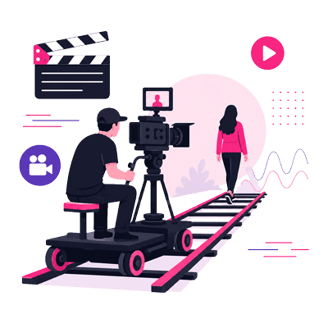
A dolly shot is a tracking shot where the camera moves physically forward or backward relative to the subject. The camera is mounted on a wheeled platform (a camera dolly), often on rails, and pushed smoothly toward or away from the subject. This creates the classic push-in or pull-out movement familiar from dramatic close-ups and reveal sequences.
Trucking Shot (Crab Shot)
A trucking shot, also called a crab shot, is a tracking shot where the camera moves laterally (directly left or right) alongside the subject. If a character is walking down a street and the camera travels beside them at the same pace while staying perpendicular to their direction of travel, that is a trucking shot. It keeps the subject in consistent profile framing throughout the move.
Follow Shot
A follow shot is a tracking shot where the camera trails directly behind the subject, maintaining a consistent distance as the subject moves forward. It places the audience behind the character rather than alongside or in front of them. This perspective creates urgency in chase sequences and intimacy in scenes where a character is navigating an unfamiliar environment.
Oner
An oner is a tracking shot that captures an entire scene or sequence in a single, uninterrupted take with no edits. The defining characteristic is the editorial choice (no cuts), not the direction of movement. A oner can incorporate multiple movement types within a single continuous take, switching from a follow shot to a lateral trucking shot within the same unbroken sequence. Alfonso Cuarón's approximately 6-minute battle sequence in Children of Men (2006) is the most technically complex mainstream oner in recent film history, a single long take that required multiple pre-planned crew positions and several days of rehearsal.
Dolly Shot vs. Tracking Shot: What's the Difference?
A dolly shot is a specific type of tracking shot. All dolly shots are tracking shots, but not all tracking shots use a dolly. Tracking shot is the umbrella term. Dolly shot is one method within that umbrella, defined by the equipment used (a wheeled platform on rails) rather than the relationship to the subject.
This is the most commonly confused distinction in production terminology. The table below clarifies the key differences.
| Aspect | Dolly Shot | Tracking Shot |
|---|---|---|
| Equipment | Camera mounted on a wheeled dolly, typically on rails | Any equipment: dolly, Steadicam, gimbal, drone, or vehicle mount |
| Direction of movement | Typically forward or backward (push-in or pull-out) | Any direction: forward, backward, lateral, diagonal, or aerial |
| Scope | Specific technique (a subset) | Umbrella term covering all moving-camera shots that follow or reveal a subject |
| Common examples | Dramatic close-up push-ins, reveal pull-outs | GoodFellas Copacabana entrance, Children of Men battle oner, The Shining tricycle corridor |
Based on Adobe, StudioBinder, and Wikipedia source descriptions. Verify terminology against your production's style guide.
For a deeper look at how the dolly functions as a standalone tool, see dolly shot mechanics, which covers the equipment, technique, and creative applications in full detail.
What Is a Dolly Shot, Specifically?
A dolly shot places the camera on a wheeled platform (the dolly), which typically rolls along metal or PVC rails. The smooth, linear movement this produces is difficult to replicate with handheld equipment. The dolly shot excels at controlled push-ins toward a stationary subject, pull-outs that reveal a wider environment, and precise, repeatable moves that require exact framing on every take.
Are All Dolly Shots Tracking Shots?
Yes. As how dolly shots and tracking shots overlap at Adobe explains, "a tracking shot refers to any shot where the camera follows a subject; a dolly shot involves the camera being mounted on a wheeled platform (a dolly)." Every dolly shot moves the camera through space in relation to a subject, which makes it a tracking shot by definition. But a Steadicam shot, a drone shot, and a gimbal shot are also tracking shots, none of which require a dolly.
What Is Another Name for a Tracking Shot?
A tracking shot goes by several names depending on direction, equipment, and filmmaking tradition. The three most common alternate terms are trucking shot, travel shot, and dolly shot, though each carries a slightly different meaning.
Trucking Shot
"Trucking shot" is the most precise alternate term for a lateral tracking shot. According to the dictionary entry for trucking shot at Merriam-Webster, it is a standard film industry term for lateral camera movement alongside a moving subject. The name likely comes from the camera moving parallel to the subject in the way a truck might travel alongside a train. When the alternate-names question comes up in production, trucking shot is the most accurate synonym for lateral movement specifically.
Travel Shot
"Travel shot" is more common in European filmmaking tradition and functions as a broad interchangeable term for any tracking shot. It's used interchangeably with tracking shot across several European production contexts. It is less common in American production terminology but appears frequently in French film theory (the original French term is "travelling").
Why "Dolly Shot" Is Only Sometimes a Synonym
"Dolly shot" is technically a subset of tracking shots, not a full synonym. In casual production conversation, directors and operators sometimes use "dolly shot" to mean any smooth tracking move, regardless of equipment. In precise usage, a dolly shot requires the camera to be on a wheeled platform. A gimbal follow shot is not a dolly shot, even if it moves on the same axis.
Equipment for Tracking Shots
The equipment you choose for a tracking shot shapes both the visual quality of the movement and, in some cases, the name of the shot itself. Equipment choice also directly affects your shot angle options, which is worth planning in advance. For a full breakdown of how gear choices interact with camera height and angle, see shot angles and levels.
Camera Dolly and Tracks (Classic Setup)
A camera dolly is a wheeled platform designed to carry a camera smoothly across a surface, typically along metal or PVC rails. This setup gives the most controlled, repeatable movement available on a prepared surface. It is the standard tool for studio push-ins, pull-outs, and any move requiring precise framing at a specific focal length on every take. The trade-off is setup time: laying tracks, leveling them, and testing the move adds 20 to 40 minutes to a shot setup.
Steadicam and Motorized Gimbals
The Steadicam (introduced by Garrett Brown in 1975) was the technology that first freed tracking shots from literal tracks. A Steadicam is a body-mounted stabilization harness that allows an operator to walk or run while the camera remains virtually smooth. The iconic tracking shots in The Shining (1980) and GoodFellas (1990) both relied on Steadicam operators.
In 2026, the motorized gimbal is the most accessible entry point for independent filmmakers. According to choosing a camera rig for smooth movement at No Film School, gimbals have become standard on productions where a Steadicam operator or dolly track setup would be impractical. Three-axis motorized gimbals electronically counteract operator movement and produce results that approximate a Steadicam at a fraction of the cost.
Drones for Aerial Tracking
Drones have replaced cable cams for most high-angle tracking shots over large distances. A drone following a moving vehicle through a landscape, tracking a character across a rooftop, or sweeping alongside a boat produces aerial tracking shots that previously required helicopter rigs. The trade-off is wind sensitivity at low altitudes and the requirement for a separate drone pilot and camera operator on professional shoots.
Vehicle Mounts and Cable Cams
Vehicle mounts attach cameras to cars, motorcycles, or trucks for high-speed action tracking. Cable cams run on suspended wire systems that allow precise, programmable camera moves over distances no operator-carried rig could cover. Both appear regularly in commercial film production and broadcast sports coverage.
The equipment you choose shapes not only the smoothness of the shot but also its name. And the choices filmmakers have made with these tools produced some of the most celebrated tracking shot examples in cinema history.
Famous Tracking Shot Examples in Film
These tracking shot examples span seven decades and four distinct approaches to the technique. Each entry includes the specific shot mechanics, the approximate running time, and what the movement achieves emotionally.
GoodFellas (1990): The Copacabana Entrance
The Copacabana entrance in GoodFellas is a Steadicam tracking shot directed by Martin Scorsese and shot by cinematographer Michael Ballhaus. The shot follows Henry Hill and Karen Friedman through the service entrance and kitchen corridors of the Copacabana nightclub before emerging into the main showroom, running approximately 3 minutes without a cut. According to the GoodFellas Copacabana shot breakdown at NoFilmSchool, the unbroken movement is a deliberate storytelling choice: it mirrors Karen's experience of being swept into Henry's world with no pause to question what she's seeing. It remains one of the most analyzed tracking shots in cinema for its fusion of character psychology and camera technique.
The Shining (1980): Danny's Tricycle Corridors
Stanley Kubrick's The Shining uses low-angle Steadicam tracking shots following young Danny as he rides his tricycle through the hallways of the Overlook Hotel. The sequence runs approximately 2 minutes and 40 seconds and establishes the hotel's labyrinthine menace through sustained continuous shot movement at the child's eye level. The low angle and persistent follow position amplify dread without showing a direct threat.
Children of Men (2006): The Battle Oner
Alfonso Cuarón's Children of Men contains what many cinematographers consider the most technically demanding oner in mainstream cinema. The battle sequence follows protagonist Theo through a collapsing urban combat zone for approximately 6 minutes without a single cut. The sequence required multiple pre-planned camera handoffs, with the full crew choreographed around the camera operator's path and debris effects integrated as real production elements. This is the canonical reference for how a long take can generate sustained, escalating dread through the refusal to cut away.
Touch of Evil (1958): The Opening Crane Shot
Orson Welles' Touch of Evil opens with a crane-tracking hybrid that follows a time-bomb-rigged car through the streets of a border town for approximately 3 minutes without dialogue. The shot begins with the bomb being placed, follows the car at street level and crane height as it moves through pedestrian traffic, and ends with the explosion. The combination of crane movement and lateral tracking across multiple city blocks made it one of the most technically ambitious tracking shot examples of its era.
How to Shoot a Tracking Shot
Most guides stop at definitions and examples. What follows is a practical 7-step process covering equipment setup through final review.
How to Shoot a Tracking Shot
- Plan the shot with a storyboard and location scout.
Decide the direction of movement (push-in dolly, lateral trucking, follow, or aerial drone), the start and end frame, and whether the shot follows a subject or reveals an environment. Map all obstacles on the camera path before the shoot day. Identify where crew members need to be positioned along the move and whether any set elements need to be cleared from the path.
- Choose your equipment based on location and movement type.
Use a dolly on tracks for studio precision and push-in or pull-out moves. Use a motorized gimbal for location walk-and-talks and run-and-gun follows. Use a drone for aerial follow shots. Use a vehicle mount for high-speed action sequences. Confirm all gear is secured and tested before talent call time.
- Set up the movement path and run a bump test.
If using a dolly, lay tracks and confirm level across the full run. If using a gimbal, walk the path at shooting speed to identify floor irregularities. Roll the rig empty before talent arrives to surface any vibration sources. This bump test catches problems invisible to the naked eye that translate as visible shudder on a stabilized camera at telephoto lengths, as smooth camera movement on location at Videomaker describes.
- Block the shot and rehearse with the subject at least three times.
Walk the camera operator and the subject through the move together at full speed before rolling. Mark the floor for consistent subject positioning at key frames. Agree on speed cues, the operator matches the subject's pace, not the other way around. Three full rehearsals at shooting speed establish muscle memory for both parties and surface any remaining path conflicts.
- Set focus and confirm framing before rolling.
If the subject moves relative to the camera during the shot, assign a dedicated focus puller or verify autofocus tracking reliability under the specific lighting conditions. For focus pulling on moving subjects, see rack focus technique, which covers the approach directly. Lock focal length and exposure before the first take.
- Execute the shot and maintain consistent speed through the cut point.
The operator matches the subject's pace without leading or lagging. Most operators instinctively decelerate before the director calls cut, keep the move smooth through the last frame. An inconsistent speed at the end of the take makes the shot unusable for anything but the opening.
- Review playback at full speed and adjust before the next take.
Watch the complete take before giving notes. Common adjustments: increase overall speed (most first takes run too slow), tighten or loosen the follow distance, and recheck the end frame for a clean cut point. Never evaluate a tracking shot from the monitor during the take, only from playback at full speed.
Find the Right Music for Your Tracking Shot
The right music turns a technically clean tracking shot into a scene people remember. Soundstripe gives you 116K+ tracks from real artists, all cleared for film, commercial, and online use under a single license. No per-project fees, no rights negotiations, no guessing whether a track will clear in distribution. Whether you are scoring the quiet dread of a corridor follow shot or the kinetic energy of a six-minute battle oner, the soundtrack is already waiting.
Turn smooth camera moves into scenes that land.
Find cleared tracks that keep the motion alive.
Frequently Asked Questions
A tracking shot is a filmmaking technique where the camera physically moves through space alongside, behind, or in front of a moving subject. Unlike a pan or tilt, which rotate the camera on a fixed axis from a stationary position, a tracking shot physically displaces the camera body through space. The technique gets its name from the original practice of mounting cameras on wheeled platforms that rolled along laid tracks. Today it covers any sustained camera movement, regardless of the equipment used.
A dolly shot is a specific type of tracking shot. All dolly shots are tracking shots, but not all tracking shots require a dolly. Tracking shot is the umbrella term covering any shot where the camera physically moves to follow a subject, regardless of equipment (dolly, Steadicam, gimbal, or drone). A dolly shot specifically means the camera is mounted on a wheeled platform, typically moving along rails. A Steadicam shot, for example, is a tracking shot but not a dolly shot.
A tracking shot is also called a trucking shot or travel shot, depending on the direction of movement and the filmmaking tradition. "Trucking shot" is the most precise alternate term, listed by Merriam-Webster and typically used when the camera moves laterally alongside the subject. "Travel shot" is more common in European filmmaking. "Dolly shot" is technically a subset of tracking shots but is used loosely as a synonym in many production contexts.
The GoodFellas Copacabana entrance (1990) is a celebrated tracking shot following Henry Hill and Karen Friedman through service corridors into the main showroom. Other canonical examples include Stanley Kubrick's Steadicam follow of Danny's tricycle through the Overlook Hotel hallways in The Shining (1980), Alfonso Cuarón's approximately 6-minute single-take battle sequence in Children of Men (2006), and Orson Welles' opening crane-tracking hybrid in Touch of Evil (1958). Each uses the technique differently to achieve immersion, menace, or scale.
Yes. A tracking shot describes any sustained camera movement through space, and gimbals, Steadicams, drones, and vehicle mounts all qualify without a dolly. The most accessible entry point for independent filmmakers in 2026 is a motorized gimbal, which stabilizes handheld movement well enough to simulate a dolly glide. Drones have replaced cable cams for high-angle tracking over large distances. The Steadicam was the technology that first freed tracking shots from literal tracks, as seen in The Shining (1980).
A trucking shot is a tracking shot where the camera moves laterally alongside the subject, parallel to their path of movement. It is listed by Merriam-Webster as a standard film term and is considered the most precise synonym for the lateral variant of a tracking shot. When a character walks down a hallway and the camera travels beside them at the same pace, that is a trucking shot. It differs from a pan, where the camera rotates rather than physically moving.
A follow shot is a tracking shot where the camera trails directly behind the subject, maintaining a consistent distance as the subject moves. It places the audience behind the character rather than alongside or in front of them, and is often used in action sequences or pursuit scenes to create urgency. The follow shot differs from the trucking shot (lateral movement) and the push-in dolly shot (forward movement toward a stationary subject). Many chase sequences rely on the follow shot to maintain momentum without breaking viewer orientation.
A "oner" is any single uninterrupted camera take that captures an entire scene or sequence with no cuts, often achieved using a tracking shot. The term emphasizes the editorial choice (no editing) rather than the direction of camera movement. A oner can incorporate multiple movement types within a single take. Alfonso Cuarón's approximately 6-minute battle sequence in Children of Men (2006) is one of the most technically complex oners in mainstream film history, requiring multiple pre-planned crew positions and several days of rehearsal.
For a tracking shot, you need a stabilized camera support: a dolly on tracks for studio work, or a motorized gimbal for location shooting. The right tool depends on movement type and location. A dolly gives the smoothest, most controllable movement on a prepared surface. A motorized gimbal is lighter and more adaptable for run-and-gun locations. Drones cover aerial tracking over large areas. For most independent filmmakers in 2026, a gimbal is the practical entry point.
A tracking shot physically moves the camera body through space; a pan rotates the camera on a fixed axis without changing its position. A pan sweeps across a scene from a stationary point, useful for revealing a wide environment or following slow action at a distance. A tracking shot places the audience inside the movement because the camera's position changes, not just its angle. The immersive quality of a tracking shot comes precisely from this physical displacement through space.
A tracking shot creates immersion by physically displacing the camera through the scene, making the audience feel like a participant rather than a distant observer. The specific emotional effect depends on direction and speed. A slow follow shot behind a character in an unfamiliar environment builds dread. A rapid lateral track through a chaotic scene creates disorientation. A smooth wide dolly pull-back from a conversation creates emotional distance or revelation. Directors choose the shot type and speed to match the psychological effect they need.
Tracking shots have no technical length limit; some last under 10 seconds while others, called oners, run 6 minutes or more without a cut. In practice, length is constrained by choreography complexity, operator stamina, and the distance the subject travels. Conventional tracking shots in mainstream films last 15 to 60 seconds. Extended oners like Children of Men (approximately 6 minutes) require multiple pre-planned camera handoffs and extensive multi-day rehearsal.
Yes. A drone shot that follows a moving subject through space qualifies as a tracking shot, used for high-angle or aerial perspectives. Drones fall into the same equipment category as dollies and gimbals when the camera is actively following a subject through space. They excel at high-speed aerial follow shots and sweeping lateral tracks over landscapes, terrain, or vehicles that no ground-based rig could match. They are now standard in commercial, documentary, and feature film production.
The GoodFellas Copacabana scene (1990) is a Steadicam tracking shot following Henry Hill and Karen Friedman through service corridors into the main showroom. Directed by Martin Scorsese and shot by cinematographer Michael Ballhaus, the sequence moves through the kitchen and service corridors before emerging into the main room in a single take lasting approximately 3 minutes. The unbroken movement mirrors Karen's experience of being swept into Henry's world with no pause to question what she's seeing. It is one of the most frequently analyzed tracking shots in cinema for its fusion of character psychology and camera technique.